Transcription of Material Safety Data Sheet - Diamond B Constructors
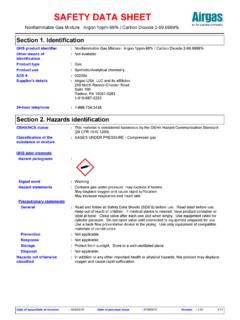
1 Material Safety data SheetARCAL 25 - 75% argon , 25% Carbon and company identificationProduct name:ARCAL 25 - 75% argon , 25% Carbon DioxideMaterial uses:Not :10094 Supplier/Manufacturer:Air Liquide America Specialty Gases LLC2700 Post Oak DriveHouston, TX 77056-8229 USAGENERAL MSDS INFORMATION: 1-713-896-2896 Validation date:11/02 by:Atrion Regulatory Services, case of emergency:CHEMTREC: 1(800) 424 identificationPhysical overviewSignal word:CAUTION!Hazard statements:HIGH PRESSURE GAS. GAS REDUCES OXYGEN AVAILABLE FOR Material THAT MAY CAUSE TARGET ORGAN DAMAGE, BASED ONANIMAL :Contains gas under pressure. In a fire or if heated, a pressure increase will occur andthe container may burst or explode. At very high concentrations, can displace thenormal air and cause suffocation from lack of oxygen. Do not puncture or incineratecontainer. Do not enter storage areas and confined spaces unless adequatelyventilated. Avoid breathing gas. Use only with adequate ventilation.
2 Keep containertightly closed and sealed until ready for status:This Material is considered hazardous by the OSHA Hazard Communication Standard(29 CFR ).Routes of acute health effectsInhalation:At very high concentrations, can displace the normal air and cause suffocation from lackof :As this product is a gas, refer to the inhalation :Contact with rapidly expanding gas may cause burns or :Contact with rapidly expanding gas may cause burns or chronic health effectsChronic effects:Contains Material that may cause target organ damage, based on animal :No known significant effects or critical :No known significant effects or critical :No known significant effects or critical effects:No known significant effects or critical States1/8 ARCAL 25 - 75% argon , 25% Carbon identificationFertility effects:No known significant effects or critical organs:Contains Material which may cause damage to the following organs: lungs,cardiovascular system, skin, eyes, central nervous system (CNS).
3 Over-exposure signs/symptomsInhalation:No specific :No specific :No specific :No specific conditionsaggravated by over-exposure:Pre-existing disorders involving any target organs mentioned in this MSDS as being atrisk may be aggravated by over-exposure to this on ingredientsNameCAS number%argon7440-37-175carbon dioxide124-38-925 There are no additional ingredients present which, within the current knowledge of the supplier and in theconcentrations applicable, are classified as hazardous to health or the environment and hence require reporting inthis aid measuresEye contact:Check for and remove any contact lenses. Immediately flush eyes with plenty of waterfor at least 15 minutes, occasionally lifting the upper and lower eyelids. Get medicalattention contact:In case of contact, immediately flush skin with plenty of water for at least 15 minuteswhile removing contaminated clothing and shoes. Wash clothing before reuse. Cleanshoes thoroughly before reuse. Get medical attention :Move exposed person to fresh air.
4 If not breathing, if breathing is irregular or ifrespiratory arrest occurs, provide artificial respiration or oxygen by trained tight clothing such as a collar, tie, belt or waistband. Get medical :As this product is a gas, refer to the inhalation of first-aiders:No action shall be taken involving any personal risk or without suitable training. If it issuspected that fumes are still present, the rescuer should wear an appropriate mask orself-contained breathing apparatus. It may be dangerous to the person providing aid togive mouth-to-mouth to physician:No specific treatment. Treat symptomatically. Contact poison treatment specialistimmediately if large quantities have been ingested or measuresFlammability of the product:Non-flammable gas. Contains gas under pressure. In a fire or if heated, a pressureincrease will occur and the container may burst or mediaSuitable:Use an extinguishing agent suitable for the surrounding suitable:None States2/8 ARCAL 25 - 75% argon , 25% Carbon measuresSpecial exposure hazards:Promptly isolate the scene by removing all persons from the vicinity of the incident ifthere is a fire.
5 No action shall be taken involving any personal risk or without suitabletraining. Contact supplier immediately for specialist advice. Move containers from firearea if this can be done without risk. Use water spray to keep fire-exposed thermaldecomposition products:Decomposition products may include the following materials:carbon dioxidecarbon monoxideSpecial protectiveequipment for fire-fighters:Fire-fighters should wear appropriate protective equipment and self-contained breathingapparatus (SCBA) with a full face-piece operated in positive pressure release measuresPersonal precautions:No action shall be taken involving any personal risk or without suitable surrounding areas. Keep unnecessary and unprotected personnel fromentering. Avoid breathing gas. Provide adequate ventilation. Wear appropriaterespirator when ventilation is inadequate. Put on appropriate personal protectiveequipment (see Section 8).Environmental precautions:Ensure emergency procedures to deal with accidental gas releases are in place to avoidcontamination of the for cleaning upSmall spill:Immediately contact emergency personnel.
6 Stop leak if without spill:Immediately contact emergency personnel. Stop leak if without risk. Note: see section 1for emergency contact information and section 13 for waste and storageHandling:Put on appropriate personal protective equipment (see Section 8). Eating, drinking andsmoking should be prohibited in areas where this Material is handled, stored andprocessed. Workers should wash hands and face before eating, drinking and contaminated clothing and protective equipment before entering eating gas under pressure. Avoid contact with eyes, skin and clothing. Avoidbreathing gas. Use only with adequate ventilation. Wear appropriate respirator whenventilation is inadequate. Empty containers retain product residue and can behazardous. Do not puncture or incinerate :Store in accordance with local regulations. Store in a segregated and approved in a dry, cool and well-ventilated area, away from incompatible materials (seeSection 10). Keep container tightly closed and sealed until ready for controls/personal protectionUnited StatesIngredientExposure limitsargonOxygen Depletion [Asphyxiant]carbon dioxideACGIH TLV (United States, 1/2009).
7 TWA: 5000 ppm 8 hour(s). TWA: 9000 mg/m 8 hour(s). STEL: 30000 ppm 15 minute(s). STEL: 54000 mg/m 15 minute(s).OSHA PEL 1989 (United States, 3/1989).TWA: 10000 ppm 8 hour(s). TWA: 18000 mg/m 8 hour(s). STEL: 30000 ppm 15 minute(s).11/02 States3/8 ARCAL 25 - 75% argon , 25% Carbon controls/personal protection STEL: 54000 mg/m 15 minute(s).NIOSH REL (United States, 6/2008).TWA: 5000 ppm 10 hour(s). TWA: 9000 mg/m 10 hour(s). STEL: 30000 ppm 15 minute(s). STEL: 54000 mg/m 15 minute(s).OSHA PEL (United States, 11/2006).TWA: 5000 ppm 8 hour(s). TWA: 9000 mg/m 8 hour(s).Recommended monitoringprocedures:If this product contains ingredients with exposure limits, personal, workplace atmosphereor biological monitoring may be required to determine the effectiveness of the ventilationor other control measures and/or the necessity to use respiratory protective measures:Use only with adequate ventilation. Use process enclosures, local exhaust ventilation orother engineering controls to keep worker exposure to airborne contaminants below anyrecommended or statutory measures:Wash hands, forearms and face thoroughly after handling chemical products, beforeeating, smoking and using the lavatory and at the end of the working period.
8 Appropriatetechniques should be used to remove potentially contaminated clothing. Washcontaminated clothing before reusing. Ensure that eyewash stations and Safety showersare close to the workstation protectionRespiratory:Use a properly fitted, air-purifying or air-fed respirator complying with an approvedstandard if a risk assessment indicates this is necessary. If operating conditions causehigh gas concentrations to be produced or any recommended or statutory exposure limitis exceeded, use an air-fed respirator or self-contained breathing apparatus. The gascan cause asphyxiation without warning by replacing the oxygen in the air. Respiratorselection must be based on known or anticipated exposure levels, the hazards of theproduct and the safe working limits of the selected :Chemical-resistant, impervious gloves complying with an approved standard should beworn at all times when handling chemical products if a risk assessment indicates this : Safety eyewear complying with an approved standard should be used when a riskassessment indicates this is necessary to avoid exposure to liquid splashes, mists :Personal protective equipment for the body should be selected based on the task beingperformed and the risks involved and should be approved by a specialist before handlingthis exposurecontrols:Emissions from ventilation or work process equipment should be checked to ensure theycomply with the requirements of environmental protection legislation.
9 In some cases,fume scrubbers, filters or engineering modifications to the process equipment will benecessary to reduce emissions to acceptable and chemical propertiesPhysical C ( F)Melting/freezing C ( F)Critical C ( F)11/02 States4/8 ARCAL 25 - 75% argon , 25% Carbon and chemical g/cm3 Vapor [Air = 1]Viscosity:Not and reactivityChemical stability:The product is to avoid:Avoid excessive materials:Not decompositionproducts:Under normal conditions of storage and use, hazardous decomposition products shouldnot be of hazardousreactions:Under normal conditions of storage and use, hazardous reactions will not normal conditions of storage and use, hazardous polymerization will not informationAcute toxicityNot toxicityNot toxicityNot informationEcotoxicity:No known significant effects or critical ecotoxicityNot States5/8 ARCAL 25 - 75% argon , 25% Carbon considerationsWaste disposal:The generation of waste should be avoided or minimized wherever possible.
10 Emptycontainers or liners may retain some product residues. This Material and its containermust be disposed of in a safe way. Dispose of surplus and non-recyclable products viaa licensed waste disposal contractor. Disposal of this product, solutions and any by-products should at all times comply with the requirements of environmental protectionand waste disposal legislation and any regional local authority requirements. Do notpuncture or incinerate container. Empty pressure vessels should be returned to should be in accordance with applicable regional, national and local laws and to Section 7: HANDLING AND STORAGE and Section 8: EXPOSURE CONTROLS/PERSONAL PROTECTIONfor additional handling information and protection of informationRegulatoryinformationUN numberProper shippingnameClassesPG*LabelAdditionalinf ormationDOT ClassificationUN1956 Compressed gas, ( argon ) instructionPassenger aircraftQuantity limitation: 75 kgCargo aircraftQuantity limitation: 150 kgSpecial provisions77 IMDG ClassUN1956 COMPRESSED GAS, ( argon ) schedules(EmS)F-C, S-VIATA-DGR ClassUN1956 Compressed gas, ( argon ) and CargoAircraftQuantity limitation:75 kgPackaging instructions: 200 Cargo Aircraft OnlyQuantitylimitation: 150 kgPackaging instructions: 200 Limited Quantities -Passenger AircraftQuantitylimitation: ForbiddenPackaging instructions:ForbiddenPG* : Packing informationHCS Classification:Compressed gasTarget organ Federal regulations.