Transcription of MATERIAL SAFETY DATA SHEET Diesel Fuel
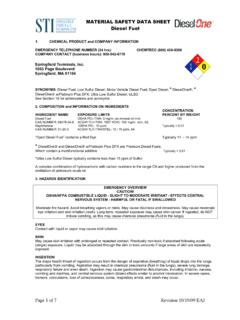
1 MATERIAL SAFETY DATA SHEETD iesel Fuel JAE 90/91/01 noisiveR 7 fo 1 egaP1. CHEMICAL PRODUCT and COMPANY INFORMATION EMERGENCY TELEPHONE NUMBER (24 hrs): CHEMTREC (800) 424-9300 COMPANY CONTACT (business hours): 800-542-0778 SYNONYMS: Diesel Fuel; Low Sulfur Diese l; Motor Vehicle Diesel Fuel; Dyed Diesel ; * DieselOne ;*DieselOne w/Platinum Plus DFX; Ultra Low Sulfur Diesel ; ULSD See Section 16 for abbreviati ons and acronyms. 2. COMPOSITION and INFORMATION ON INGREDIENTS CONCENTRATION INGREDIENT NAME EXPOSURE LIMITS PERCENT BY WEIGHT Diesel Fuel OSHA PEL-TWA: 5 mg/m, as mineral oil mist 100 CAS NUMBER: 68476-34-6 ACGIH TLV-TWA: 1997 NOIC- 100 mg/m skin, A3 Naphthalene OSHA PEL: 10 ppm Typically < CAS NUMBER: 91-20-3 ACGIH TLV-TWA/STEL: 10 / 15 ppm, A4 Dyed Diesel Fuel contains a Red Dye Typically 11 - 14 ppm * DieselOne and DieselOne w/Platinum Plus DFX are Premium Diesel Fuels, Which contain a multifunctional additive Typically < 0.
2 01 *Ultra Low Sulf ur Diesel typically co ntains less than 15 ppm of Sulfur A complex combination of hydrocarbons with carbon numbers in the range C9 and higher produced from the distillati on of petroleum crude oil. 3. HAZARDS IDENTIFICATION EMERGENCY OVERVIEW CAUTION! OSHA/NFPA COMBUSTIBLE LIQUID - SLIGHT TO MODERATE IRRITANT - EFFECTS CENTRAL NERVOUS SYSTEM - HARMFUL OR FATAL IF SWALLOWED Moderate fire hazard. Avoid breathing vapors or mists. May cause dizziness and drowsiness. May cause moderate eye irri ta ti on and skin irri tati on (rash ). Long-te rm, repeated exposure may cause skin cancer If ingested, do NOT induce vomiting, as this may cause ch emical pneumonia (fl uid in the lu ngs). EYESC ontact with liquid or va por may cause mi ld irritation.
3 SKINMay cause skin irritation with prolonged or repeated contact. Practically non-toxic if absorbed fol lowing acute (single) exposure. Liquid may be absorbed through the skin in toxic amounts if large areas of skin are repeatedly exposed. INGESTIONThe major health threat of ingestion occurs from the danger of aspiration (breathing) of liq uid drops int o the lungs, particularly fr om vomiting. Aspiration may result in chemical pneumonia (fl uid in the lungs), severe lung damage, respiratory fa ilure and even death. Ingestion may cause gastrointestinal disturbances, including irr itation, nausea, vomiting and di arrhea, and ce ntral nervous system (brain) effects similar to alcohol int oxication. In severe cases, tremors, convulsions, loss of consciousness, coma, respiratory arrest, and death may occur.
4 Springfield Terminals, Page Boulevard Springfield, MA 01104 MATERIAL SAFETY DATA SHEETD iesel Fuel JAE 90/91/01 noisiveR 7 fo 2 egaPINHALATION Excessive exp osure may cause irritati ons to the nose, throat, lungs and re spirato ry tract. Central nervous system (b rain) effe cts may incl ude headache, dizziness, loss of balance and coordination, unconsciousness, coma, respiratory failure, and death. WARNING: the burning of any hydrocarbon as a fuel in an area without adequate ventilation may result in hazardous levels of combustion products, including carbon monoxide, and inadequate oxy gen levels, which may cause unco nsciousness, suffocation, and death . CHRONIC EFFECTS and CARCINOGENICITY Similar products produced skin cancer and systemic toxicity in labora to ry animals fo llo wing repeated applicati ons.
5 The significance of these results to human exposures has not been determined see Section 11 Toxicological In fo rmation. IARC classifi es whole Diesel fu el exhaust particulates as probably carcinogenic to humans (Group 2A). NIOSH regards whole Diesel fuel exhaust particulates as a potential cause of occupational lung cancer based on animal studies and limited evidence in humans. MEDICAL CONDITIONS AGGRAVATED BY EXPOSURE Irritation from skin exposure may aggrava te existing open wounds, skin disorders, and dermatitis (rash). 4. FIRST AID MEASURES EYESIn case of contact with eyes, immediately fl ush with cl ean, low-pressure water for at least 15 min. Hold eyelids open to ensure adequate flushing. Seek medical attention. SKINR emove contaminated clothing.
6 Wash contaminated areas thoroughly with soap and water or waterless hand cleanser. Obtain medical attention if irritation or redness develops. INGESTIONDO NOT INDUCE VOMITING. Do not give liquids. Obtain immediate medical attention. If spontaneous vomiting occurs, lean vi ctim forwar d to reduce the ris k of aspiration. Monitor for breathing difficulties. Small amounts of MATERIAL , which enter the mouth, should be rinsed out until the taste is dissipated. INHALATION Remove person to fresh air. If person is not breathing provide artificial respiration. If necessary, provide additional oxygen once breathing is restored if trained to do so. Seek medical attention immediately. 5. FIRE FIGHTING MEASURES FLAMMABLE PROPERTIES: FLASH POINT: > 125 F (> 52 C) minimum PMCC AUTOIGNIT ION POINT: 494 F (257 C) OSHA/NFPA FLAMMABILITY CLASS: 2 (COMBUSTIBLE) LOWER EXPLOSIVE LIMIT (%): UPPER EXPLOSIVE LIMIT (%): FIRE AND EXPLOSION HAZARDS Vapors may be ignited rapidly when exposed to heat, spark , open flame or other source of ignition.
7 When mixed with air and exposed to an ignition source, flammable vapors can burn in the open or exp lode in confined spaces. Being heavier than air, vapors may travel long distances to an ignition source and flashback. Runoff to sewer may cause fi re or explosi on haza rd. EXTINGUISHING MEDIA SMALL FIRES: Any exti nguisher suitable for Class B fires, dry chemical, CO2, water spray, fire fighting foam, or Halon. LARGE FIRES: Water spray, fog or fire fighting foam. Water may be ineffective for fighting the fire, but may be used to cool fire-exposed containers. MATERIAL SAFETY DATA SHEETD iesel Fuel JAE 90/91/01 noisiveR 7 fo 3 egaPFIRE FIGHTING INSTRUCTIONS Small fires in the incipient (beginning) stage may typically be extinguished using handheld portable fire exti nguishers and other fire fighting equipment.
8 Firefighting activities that may result in potential exposu re to high heat, smoke or to xi c by-pro ducts of co mbustion sh ould require NIOSH/MSHA- approved pressure-demand self-contained breathing apparatus with ful l facepiece and full protective clothing. Isolate area around container involved in fire. Cool tanks, shells, and containers exposed to fi re and excessive heat with water. For massive fires the use of unmanned hose holders or monitor nozzles may be advantageous to further minimize personnel exposure. Major fires may require withdrawal, all owing th e tank to burn. Large storage ta nk fires typically requir e specially trained personnel and equipment to extinguish the fire, often including the need for properly applied fir e fighting ACCIDENTAL RELEASE MEASURES ACTIVATE FACILITY S SPCC, SPILL CONTINGENCY OR EMERGENCY RESPONSE PLAN.
9 Evacuate nonessential personnel and remove or secure all ignition sources. Consider wind direction; stay upwind and uphill, if possible. Evaluate the di rection of product travel, diking, sewers, etc. to confirm spill areas. Do not touch or walk-through spilled MATERIAL . Spills may infiltrate subsurface soil and groundwater; professional assistance may be necessary to determine the extent of su bsurface im pact. Carefully contain and stop the source of the spill, if safe to do so. Protect bodies of water by diking, absorbents, or absorbent boom, if possible. Do not flush down sewer or drainage syste ms, unless system is designed and permitted to handle such MATERIAL . The use of fire fighting fo am may be us eful in certain situations to reduce vapors. The proper use of water spray may effectively disp erse pro duct vapors or the liq uid its elf, preventing contact with ignition sources or areas/equipment that require protection.
10 Take up with dry earth, sand or other non-combustible, inert oil absorbing materials. Carefully shovel, scoop or sweep up into a waste container with clean, non-sparking tools for reclamation or disposal. Response and clean-up crews must be properly trained and must utilize proper pro te cti ve equipment (see Section 8). Local and / or Federal notification may be required if this MATERIAL is released to the environment (see Section 15 for additional information).7. HANDLING and STORAGE HANDLING PRECAUTIONS Handle as a combustible liquid. Keep away from heat, sparks, and open fl ame! Electrical equipment should be approved for classified area. Bond and ground co ntainers during product transfer to reduce th e possibil ity of static-initiated fir e or expl osion.