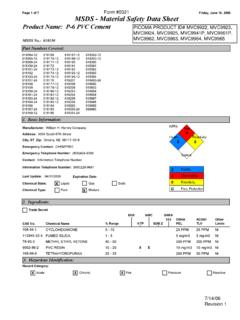
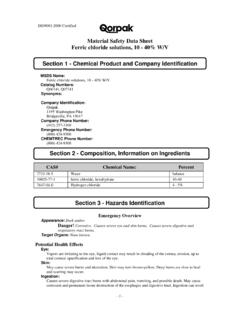
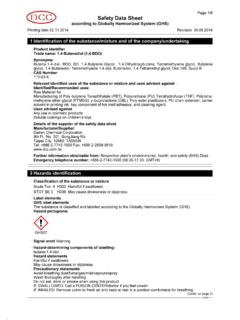
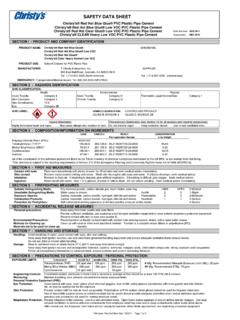
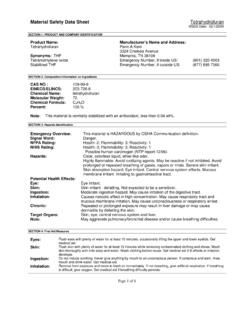
Transcription of Material Safety Data Sheet - Finar Chemicals Ltd.
1 Material Safety data Sheet Tetrabutylammonium fluoride MSDS Section 1: Chemical Product and Company Identification Product Name: Tetrabutylammonium fluoride Catalog Codes: 11785,11786 CAS#: RTECS: . TSCA: CI#: . Synonym: TBAF. Chemical Formula: C16H42 FNO3 Contact Information: Finar Limited 184-186/P, Chacharwadi Vasna, Sarkhej-Bavla Highway, Ta.: Sanand, Dist.: Ahmedabad, Email: Web: Section 2: Composition and Information on Ingredients Composition: Name CAS # % by Weight Tetrabutylammonium fluoride 429-41-4 Section 3: Hazards Identification Emergency Overview Warning! Hygroscopic (absorbs moisture from the air).
2 Contact with acids liberates toxic gas. Causes eye, skin, and respiratory tract irritation. Target Organs: Respiratory system, eyes, skin. Potential Health Effects Eye: Causes eye irritation. May cause blindness. May cause permanent corneal opacification. May cause chemical conjunctivitis and corneal damage. Skin: Causes skin irritation. May cause cyanosis of the extremities. Ingestion: May cause gastrointestinal irritation with nausea, vomiting and diarrhea. May cause cardiac disturbances. Ingestion of large amounts may cause CNS depression. Inhalation: Causes respiratory tract irritation.
3 Vapors may cause dizziness or suffocation. May cause cardiac abnormalities. Inhalation at high concentrations may cause CNS depression and asphixiation. May cause burning sensation in the chest. May cause acute pulmonary edema, asphyxia, chemical pneumonitis, and upper airway obstruction caused by edema. Chronic: Effects may be delayed. Section 4: First Aid Measures Eyes: Immediately flush eyes with plenty of water for at least 15 minutes, occasionally lifting the upper and lower eyelids. Get medical aid. Skin: Get medical aid. Immediately flush skin with plenty of water for at least 15 minutes while removing contaminated clothing and shoes.
4 Ingestion: Do not induce vomiting. Get medical aid. Health 2 Fire 1 Reactivity 1 Personal Protection E 1 2 1 Inhalation: Remove from exposure and move to fresh air immediately. If not breathing, give artificial respiration. If breathing is difficult, give oxygen. Get medical aid. Notes to Physician: Section 5: Fire and Explosion data General Information: As in any fire, wear a self-contained breathing apparatus in pressure-demand, MSHA/NIOSH (approved or equivalent), and full protective gear. Vapors may form an explosive mixture with air. Vapors can travel to a source of ignition and flash back.
5 During a fire, irritating and highly toxic gases may be generated by thermal decomposition or combustion. Will burn if involved in a fire. Use water spray to keep fire-exposed containers cool. Containers may explode in the heat of a fire. Flammable liquid and vapor. May form explosive peroxides. Vapors may be heavier than air. They can spread along the ground and collect in low or confined areas. Will be easily ignited by heat, sparks or flame. May accelerate burning if involved in a fire. Containers may explode when heated. Runoff from fire control or dilution water may cause pollution. Extinguishing Media: Water may be ineffective.
6 Do NOT use straight streams of water. For large fires, use water spray, fog or regular foam. For small fires, use dry chemical, carbon dioxide, water spray or regular foam. Cool containers with flooding quantities of water until well after fire is out. Flash Point: -17 deg C ( deg F) Autoignition Temperature: Not applicable. Explosion Limits, Lower:Not available. Upper: Not available. NFPA Rating: (estimated) Health: 2; Flammability: 4; Instability: 1 Section 6: Accidental Release Measures General Information: Use proper personal protective equipment as indicated in Section 8. Spills/Leaks: Absorb spill with inert Material ( vermiculite, sand or earth), then place in suitable container.
7 Avoid runoff into storm sewers and ditches which lead to waterways. Clean up spills immediately, observing precautions in the Protective Equipment section. Remove all sources of ignition. Use a spark-proof tool. Isolate area and deny entry. Provide ventilation. Place under an inert atmosphere. Do not use combustible materials such as paper towels to clean up spill. A vapor suppressing foam may be used to reduce vapors. Section 7: Handling and Storage Handling: Wash thoroughly after handling. Remove contaminated clothing and wash before reuse. Use only in a well-ventilated area. Ground and bond containers when transferring Material .
8 Use spark-proof tools and explosion proof equipment. Avoid contact with eyes, skin, and clothing. Empty containers retain product residue, (liquid and/or vapor), and can be dangerous. Keep container tightly closed. Keep away from heat, sparks and flame. Avoid ingestion and inhalation. Use with adequate ventilation. If peroxide formation is suspected, do not open or move container. Avoid contact with air and sunlight. Do not pressurize, cut, weld, braze, solder, drill, grind, or expose empty containers to heat, sparks or open flames. Unused Chemicals should not be returned to the container. Do not distill since this removes peroxide-inhibitors.
9 Storage: Keep away from sources of ignition. Do not store in direct sunlight. Store in a tightly closed container. Flammables-area. Regularly check inhibitor levels to maintain peroxide levels below 1%. Do not break the seal on the container until it is needed. Label the container with the date it was first opened. Long-term storage is not recommended. Section 8: Exposure Controls/Personal Protection Engineering Controls: Facilities storing or utilizing this Material should be equipped with an eyewash facility and a Safety shower. Use adequate ventilation to keep airborne concentrations low.
10 Exposure Limits Chemical Name ACGIH NIOSH OSHA - Final PELs Tetrabutylammonium fluoride none listed none listed mg/m3 TWA (as F) (listed under Fluorides). OSHA Vacated PELs: Tetrahydrofuran: 200 ppm TWA; 590 mg/m3 TWA Tetrabutylammonium fluoride: No OSHA Vacated PELs are listed for this chemical. Water: No OSHA Vacated PELs are listed for this chemical. Personal Protective Equipment Eyes: Wear appropriate protective eyeglasses or chemical Safety goggles as described by OSHA's eye and face protection regulations in 29 CFR or European Standard EN166. Skin: Wear appropriate protective gloves and clothing to prevent skin exposure.