Transcription of MATERIAL SAFETY DATA SHEET - Glassven
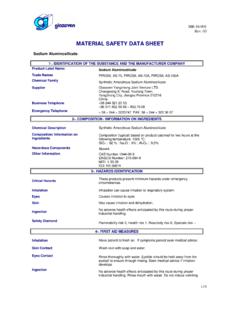
1 MR-16-001 Rev. 03 1/5 MATERIAL SAFETY data SHEET Synthetic Amorphous Silica. 1-. IDENTIFICATION OF THE SUBSTANCE AND THE MANUFACTURER COMPANY product Label Name: Precipitated Silica Trade Names PIROSIL PS-120, PIROSIL PS-200, PIROSIL PS-250, PIROSIL PS-300, PIROSIL PS-2000 Chemical Family Precipitated Amorphous Silica. Silicon Dioxide. Precipitated Hydrated Amorphous Silica. Supplier Glassven Yangzhong Joint Venture LTD. Changwang Xi Road, Youfang Town, Yangzhong City, Jiangsu Province 212216 China. Business Telephone +58 244 321 23 53. +86 511 852 59 68 Emergency Telephone + 58 244 322 37 47 Fax 58 244 322 36 07 2-. COMPOSITION/ INFORMATION ON INGREDIENTS Chemical Description Precipitated Synthetic Amorphous Silica Composition/ Information On Ingredients SiO2 anhydrous: 98 % Contains no detectable crystalline silica Detection limit < % by weight Composition typical based on product calcinated for two hours at the following temperature 1050 C.
2 Hazardous Components Absent. Other Information CAS Number 112926-00-8 (7631-86-9) EINECS Number: 231-545-4 Harmonized System: 3-. HAZARDS IDENTIFICATION EC Classification This product is not classified as dangerous according to Directive 1999/45/ EC . Critical Hazards This product present minimum hazards under emergency circumstances. Inhalation Inhalation can cause irritation to respiratory system. Eyes Causes irritation to eyes. Skin Avoid prolonged, repeated or excessive contact with the skin. May cause irritation and discomfort. Ingestion No adverse health effects anticipated by this route during proper industrial handling. MR-16-001 Rev. 03 2/5 SAFETY Diamond Flammability risk 0, Health risk 1, Reactivity risk 0, Specials risk -- 4-. FIRST AID MEASURES Inhalation Move patient to fresh air.
3 If symptoms persist seek medical advice. Skin Contact Wash skin with soap and water. Eye Contact Rinse thoroughly with plenty of water. Eyelids should be held away from the eyeball to ensure through rinsing. Seek medical advice if irritation develops. Ingestion No adverse health effects anticipated by this route during proper industrial handling. Rinse mouth with water. Do not induce vomiting 5-. FIRE FIGHTING MEASURES Flash Point None Flammable Limits In Air-Lower (%) Not applicable Flammable Limits In Air-Upper (%) Not applicable Extinguishing Media Not applicable Special Firefighting Procedures Not applicable Discharge Take suitable precautions against the discharge of static electricity during handling operations. 6-. ACCIDENTAL RELEASE MEASURES Personal Precautions In case of dust formation use dust mask Environmental Precautions This product does not present any particular risk to the environment.
4 Refer to applicable national, state and local regulations prior to washing in drain. Methods for Cleaning Up Collect as much as possible in a clean container for preferable reuse or disposal. Avoid dust generation. Do not allow MATERIAL to escape into drains or waterways. 7-. HANDLING AND STORAGE Handling Wash thoroughly after using this product . Do not eat, drink, smoke or apply cosmetics while handling this product . Avoid breathing dust or particles generated by this product . Use in a well-ventilated location. Remove contaminated clothing after being in contact with the product . Employees who handle this MATERIAL should be trained to handle it safely. Open containers slowly on a stable surface. Containers of this product must be properly labeled. Empty containers may contain residual amounts of this product , therefore, empty containers should be handled with care.
5 Storage Requirements Store containers in a dry location. Store away from incompatible materials. Keep container tightly closed when not in use. Inspect all incoming containers before storage to ensure containers are properly labeled and not damaged. EXPOSURE CONTROLS/PERSONAL PROTECTION Exposures Limits: TLVs ACGI 10 mg/m3 UK EH 40/95 3 mg/m3 respirable dust, 8 hours oes 6 mg/m3 total dust, 8 hours oes MR-16-001 Rev. 03 3/5 PELs OSHA 80 mg/m3 (total dust) %SiO2 or 20 mppcf NIOSH REL : TWA 6 mg/m3 DFG MAK 4 mg/m3 QES:TWA 5 - 10 mg/m3 USA OSHA CFR 29 PART 6 mg/m Ventilation and Engineering Controls Use with adequate ventilation to exposure levels are maintained below the limits provided in this section. Prudent practice is to ensure eye wash station/ SAFETY showers are near locations where this product is used or stored.
6 Personal Protection In case of dust formation use dust mask. Respiratory Protection If respiratory protection is needed, such as during emergency response to uncontrolled releases, use only protection authorized in 29 CFR , applicable State regulations or the appropriate standard of Canada and its provinces. Advice on respiratory protective equipment is given in British standards BS 2091 and BS 4275 and the HSE publication HS(g) 53. in the USA, ASTM E1156-88 (re-approved 1993) specifies standards practice for handling amorphous silica. Hand Protection Wear rubber gloves for routine industrial use. Eye Protection Splash goggles or SAFETY glasses with side shields. Skin and Body Protection Use body protection appropriate for task. Hygiene measures: Handle in accordance with good industrial hygiene and SAFETY practice.
7 9-. PHYSICAL AND CHEMICALS PROPERTIES Appearance Powder Color White Odor Odourless Boiling Point/ Range Not applicable Melting Point/ Range Not determined Flash Point Not applicable Flammability Not applicable Explosive Properties Not applicable Explosion Limits Not applicable Oxidizing Properties Not applicable Vapor Pressure Not applicable Density Variable Bulk Density Variable Solubility in Water Insoluble Solubility in Other Solvents Insoluble in most organic solvents pH VALUE Partition Coefficient N - Octanol/Water Not determined Relative Vapor Density (Air=1) Not applicable Viscosity Not applicable Other Information Volatile matter: 5 % moisture (2 hours @ 105 c) Impurities: contains less than 3,5 % Na2SO4 10-. STABILITY AND REACTIVITY Stability The product is stable Condition to Avoid None known Materials to Avoid Hydrofluoric acid MR-16-001 Rev.
8 03 4/5 Hazardous decomposition products: None 11-. TOXICOLOGICAL INFORMATION These product components are not found on the following lists: FEDERAL OSHA Z LIST NTP IARC CAL/OSHA And therefore are neither considered to be nor suspected to be cancer-causing agents by these agencies. Synthetic amorphous silica is a permitted food additive in the UK, USA and many other countries. It has been fully evaluated by the codex alimentarius commission and given clearance for use as a food additive. Mutagenecity, Embryotoxicity and Teratogenicity This product is not reported to produce mutagenic, embryotoxic, and teratogenic effects in humans. Reproductive Toxicity This product is not reported to cause reproductive effects in humans. Sensitization Information The components of this product are not known to be sensitizes with repeated or prolonged use.
9 Animal Toxicity LD 50 (ORAL, RAT)= >10000 mg/kg 12-. ECOLOGICAL INFORMATION Synthetic amorphous silica is virtually inert and has no known adverse effect on the environment. Ecotoxicological Information EC0 : >1000 PPM (daphnia magna) (24-hours acute immobilization test) EC0: >10000 PPM (rainbow trout) (4-days static study). EC0: >10000 PPM (freshwater fish) (96-hours static acute toxicity study) Ectotoxicity data LD 50 (CARP)= 10000 mg/ lt /72 hrs DISPOSAL CONSIDERATIONS product Waste disposal in accordance with regulations (most probably controlled landfill). Contaminated Packaging According to local regulations. Classification under Rcra This classification is not applicable for this product . 14-. TRANSPORT INFORMATION LAND ADR Class: Not restricted ADR Item Number: Not relevant RID Class: Not restricted RID Item Number: Not relevant Hazard Identification N : Not relevant Substance Identification N : Not relevant Trem-Card: Not relevant UN Number: None Proper Shipping Name: Not relevant SEA IMO/IMDG CODE Class Not restricted Packing Group: Not relevant UN Number: None EMS: Not relevant MFAG: Not relevant Marine Pollutant: No Proper Shipping Name: Not relevant Packing Group: Not relevant AIR ICAO-TI/ IATA-DGR UN Number: None Class: Not restricted Packing Group: Not relevant MR-16-001 Rev.
10 03 5/5 Proper Shipping Name: Not relevant Other Information Basic Shipping Classification Not relevant 15-. REGULATORY INFORMATION SARA 313 Synthetic amorphous silica is not listed on the SARA 313. TSCA (USA), AICS (Australia), DSL (Canad ) Synthetic amorphous silica is listed in TSCA, AICS, DSL under CAS N 7631-86-9 silicon dioxide Identification According To EEC Directives Synthetic amorphous silica is not classified as dangerous according to the rules of 67/548/EEC as amended by 92/32/EEC. EC LABELLING: This product is not classified as dangerous according to Directive 1999/45/EC and no warning label is required. E number 551 FAO/WHO (JECFA) Silicone Dioxide FOOD CHEMICAL CODEX Silicone Dioxide HARMONIZED TARIFF CODE INCI (CTFA) Hydrated Silica FDA This product may be used in accordance with the 21 CFR Parts 160, 172,173,175,176,177,182,573,584; in Sections referred to Silicon Dioxide NATIONAL CHEMICAL INVENTORY LISTING: AUSTRALIA AICS: Synthetic amorphous Silica 112926 00-8 CANADA DSL / NDSL: Synthetic amorphous Silica 112926 00-8 CHINA IECSC: Synthetic amorphous Silica 112926 00-8 EUROPA EINECS: Synthetic amorphous Silica 231-545-4 JAPAN ENCS: Silicone Dioxide 1 548 KOREA KECI: Synthetic amorphous Silica KE 31032 PHILLIPINES PICCS Synthetic amorphous Silica 112926 00-8 UNITED STATES TSCA: Silicone dioxide 7631 86 9 16.