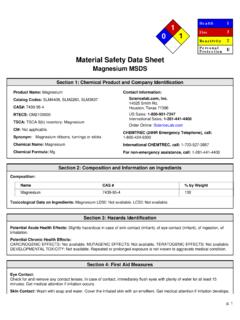
Transcription of MATERIAL SAFETY DATA SHEET GLYCERIN MSDS
1 MATERIAL SAFETY data SHEET GLYCERIN MSDS Section 1 : Chemical Product and Company Identification Product name : GLYCERIN Contact Information : Catalog codes : SLG 1171, SLG1894, SLG1111, SLG1615 KUDA INDONESIA CAS#: 56-81-5 JL. MADIUN BLOK RTECS: MA8050000 UNIT USAHA KAWASAN MARUNDA TSCA 8 (b) inventory: GLYCERIN JAKARTA-UTARA 14120 CI#: Not Available PHONE : +62-21-44852388 Synonim: 1,2,3 Propanetriol; Glycerol Chemical Name : GLYCERIN Chemical Formula: C3H5 (OH)3 Section 2: Composition and Information on Ingredients Composition : Name CAS # %by Weight GLYCERIN 56-81-5 100 Toxocological data on Ingredients : GLYCERIN : ORAL (LD50): Acute: 12600mg/kg (Rat).
2 4090 mg/kg (Mouse). DERMAL (LD50): Acute: 10000 mg/kg (Rabbit). MIST (LC50): Acute: > 570 mg/m a hours (Rat) Section 3 : Hazards Identification Potential Acute Health Effects: Slightly hazardous in case of skin contact (irritant,permeator), of eye contact (irritant), of ingestion, of inhalation. Potential Chronic Health Effects: CARCINOGENIC EFFECTS: Not available. MUTAGENIC EFFECTS:Not available. TERATOGENIC EFFECTS: Not available. DEVELOPMENTAL TOXICITY: Not available. The substance may be toxic to kidneys. Repeated or prolonged exposure to the substance can produce target organs damage. Section 4 : First Aid Measures Eye Contact : Check for and remove any contact lenses.
3 In case of contact, immediately flush eyes with plenty of water for at least 15 minutes. Cold water may be used. Get medical attention if irritation occurs. Skin Contact : Wash with soap and water. Cover the irritated skin with an emollient. Get medical attention if irritation develops. Cold water may be used. Serious Skin Contact : Not available Inhalation : If inhaled, remove to fresh air. If not breathing, give artificial respiration. If breathing is difficult, give oxygen. Get medical attention immediately. Serious Inhalation: Not available. Ingestion: Do not induce vomiting unlessdirected to do so by medical personnel. Never give anything by mouth to an unconscious person. Loosen tight clothing such as a collar, tie, belt or waistband.
4 Get medical attention immediately . Serious inhalation: Not available Ingestion : Do not induce vomiting unless directed to do so by medical personnel. Never give anything bu mouth to an unconscious person. Loosen tight clothing such as a collar, tie, belt or waistband. Get medical attention if symptoms appear. Serious Ingestion : Not available. Section 5 : Fire and Explosion data Flammability of the Product : May be combustible at high temperature Auto-Ignition Temperature : 370:C (698:F)(NFPA Fire Protection Guide to Hazardous Materials, 13th ed., 2002; NIOSH ICSC, 2001; CHRIS,2001)392 C (739 F) (Lewis, 1997) Flash Points: CLOSED CUP: 160:C (320:F).(Chemical Hazard Response Information System,2001;Lewis,1997).
5 OPEN CU: 177:C ( :F)(Budavari,2000; Chemical Response Information System,2001; niosh icsc,2001) OPEN CUP: 199:C (390F) (National Fire Protection Association,Fire Protection Association,Fire Protection Guide to HazardousMaterials,13 ed., 2002) Flammable Limits : LOWER: Products of Combustion: These products are products are carbon oxides (CO,CO2), irritating and toxic fumes. Fire Hazards in Presence of Various Substances: Slightly flammable to flammable in presence of open flames and sparks, of heat, of oxidizing materials. Non-flammable in presence of shocks. Explosion Hazards in presence of various substances: Risk of explosion of the product in presence of mechanical impact: Not available.
6 Risk of explosion of the product in presence of static discharge: Not available. Explosive in precense of oxidizing materials. Fire Fighting Media and Instructions : SMALL FIRE: Use Dry chemical powder. LARGE FIRE: use water spray, fog or foam. Do not use water jet. Special Remarks on fire Hazards: Not available. Special Remarks on Explosion Hazards: GLYCERIN is incompatible with strong oxidizers such as chromium trioxide, potassium chlorate , or potassium permanganate and may explode on contact with these compounds. Explosive glyceryl nitrate is formed from a mixture of GLYCERIN and nitric and sulfuric acids. Perchloric acid, lead oxide + GLYCERIN form perchloric esters which may be explosive.
7 GLYCERIN and chlorine may explode if heated and confined. Section 6 : Accidential Release Measures Small Spill: Dilute with water and mop up, or absorb with an inert dry MATERIAL and place in an appropriate waste disposal container. Finish cleaning by spreading water on the contaminated surface and dispose of according to local and regional authority requirements. Large Spill: Stop leak if without risk. If the product is in its solid form: use a hovel to put the MATERIAL into a convenient waste disposal container. If the product is in its liquid form: do not get water inside with an inert MATERIAL and put the spilled MATERIAL in an appropriate waste disposal.
8 Do not touch spilled MATERIAL . Use water spray to reduce vapors. Prevent entry into sewers, basement or confined areas;dike if needed. Elimination all ignition sources. Call for assistance on disposal. Finish cleaning by spreading water on the contaminated surface and allow to evacuate through the sanitary system. Be careful that the product is not present at a concertration level above TLV on the MSDS and with local authorities. Section 7: Handling and storage Precautions : Keep away from heat. Keep away from sources of all equipment containing MATERIAL . Do not not breathe gas/fumes/vapor/spray. Wear suitable protective clothing.
9 If ingested,seek medical advice immediately and show the container or the label. Keep away from incompatibles such as oxidizing agents. Storage: Keep container tightly closed. Keep container in a cool, well-ventilated area. Hygroscopic Section 8: Exposure Controls/ Personal Protection Engineering Controls: Provide exhaust ventilation or other engineering controls to keep the airborne concentrations of vapors below their respective threshold limit value. Ensure that eyewash stations and SAFETY showers are proximal to the work-station location. Personal Protection: SAFETY glasses. Lab coat. Vapor respirator. Be sure to use an approved/certified respirator or equivalent. Gloves. Personal Protection in case of a Large Spill: Splash suit.
10 Vapor respirator. Boots. Gloves. A self contained breathing apparatus should be used to avoid inhalation of the product. Suggested protective clothing might not be sufficient; consult a specialist BEFORE handling this product. Exposure Limits: TWA: 10 (mg/m3) from ACGIH (TLV) (United States) (1999) Inhalation Total. TWA: 10 STEL:20 (mg/m3)(Canada) TWA:10 STEL:20 (mg/m3) (Canada)TWA: 5 (mg/m3) from OSHA (PEL) (United States) Inhalation Respirable. Consult local authorities for acceptable exposure limits. Section 9: Physical and Chemical Properties Physical state and appearance : Liquid (viscous (Syrupy)liquid) Odor: Mild Taste: Sweet Molecular Weight: g/mole Color : Clear Colorless PH (1% soln/water): Not available Boiling Point: 290:C (554:F) Melting Point: 19:C ( :F) Critical Temperature: Not available Specific Gravity : (water = 1) Vapor Pressure: 0 kPa (@20:C) Vapor Density: (Air=1) Volatility : Not available Water/Oil DistCoeff: The product is more soluble in water; log (oil/water)= Ionicity (in water): Not available Dispersion Properties: See solubility in water, acetone Solubility: Miscible in cold water, hot water and soluble in acetone.