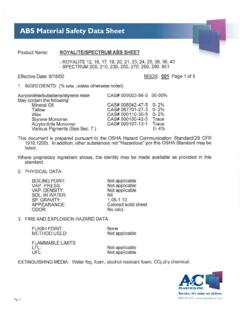
Transcription of MATERIAL SAFETY DATA SHEET - hmlindia.com
1 MATERIAL SAFETY data SHEET . Methanol Section 1 - Chemical Product and Company Identification msds Name: Methanol Synonyms: methyl alcohol Company Identification: (INDIA) Veritas House, 70 Mint Road, Fort, Mumbai - 400 001. INDIA. For information in the INDIA, call: Tel: +91 - 22 - 2275 5555 / 6184 0000, Fax: +91 - 22 - 2275 5556 / 6184 0001. Section 2 - Composition, Information on Ingredients CAS# Chemical Name: % EINECS#. 67-56-1 Methanol 200-659-6. Hazard Symbols: TF. Risk Phrases: 11 23/24/25 39/23/24/25. Section 3 - Hazards Identification EMERGENCY OVERVIEW. Highly flammable. Toxic by inhalation, in contact with skin and if swallowed. Toxic : danger of very serious irreversible effects through inhalation, in contact with skin and if swallowed. Potential Health Effects Eye: Produces irritation, characterized by a burning sensation, redness, tearing, inflammation, and possible corneal injury. May cause painful sensitization to light.
2 Skin: Causes moderate skin irritation. May be absorbed through the skin in harmful amounts. Prolonged and/or repeated contact may cause defatting of the skin and dermatitis. Ingestion: May be fatal or cause blindness if swallowed. Cannot be made non-poisonous. May cause gastrointestinal irritation with nausea, vomiting and diarrhea. May cause systemic toxicity with acidosis. May cause central nervous system depression, characterized by excitement, followed by headache, dizziness, drowsiness, and nausea. Advanced stages may cause collapse, unconsciousness, coma and possible death due to respiratory failure. May cause cardiopulmonary system effects. Inhalation: May cause adverse central nervous system effects including headache, convulsions, and possible death. May cause visual impairment and possible permanent blindness. Causes irritation of mucous membrane. Chronic: Prolonged or repeated skin contact may cause dermatitis. Chronic inhalation and ingestion may cause effects similar to those of acute inhalation and ingestion.
3 Chronic exposure may cause reproductive disorders and teratogenic effects. Laboratory experiments have resulted in mutagenic effects. Copyright Groupe Veritas. All rights reserved. Section 4 - First Aid Measures Eyes: Immediately flush eyes with plenty of water for at least 15 minutes, occasionally lifting the upper and lower eyelids. Get medical aid immediately. Skin: Get medical aid immediately. Immediately flush skin with plenty of water for at least 15. minutes while removing contaminated clothing and shoes. Ingestion: If victim is conscious and alert, give 2-4 cupfuls of milk or water. Never give anything by mouth to an unconscious person. Get medical aid immediately. Wash mouth out with water. Inhalation: Get medical aid immediately. Remove from exposure and move to fresh air immediately. If not breathing, give artificial respiration. If breathing is difficult, give oxygen. Notes to Physician: Effects may be delayed. Ethanol may inhibit methanol metabolism.
4 Treat symptomatically and supportively. Section 5 - Fire Fighting Measures General Information: Containers can build up pressure if exposed to heat and/or fire. As in any fire, wear a self-contained breathing apparatus in pressure-demand, MSHA/NIOSH (approved or equivalent), and full protective gear. Water runoff can cause environmental damage. Dike and collect water used to fight fire. Vapors can travel to a source of ignition and flash back. During a fire, irritating and highly toxic gases may be generated by thermal decomposition or combustion. Flammable Liquid. Can release vapors that form explosive mixtures at temperatures above the flashpoint. Water may be ineffective. MATERIAL is lighter than water and a fire may be spread by the use of water. Vapors may be heavier than air. They can spread along the ground and collect in low or confined areas. Extinguishing Use water spray to cool fire-exposed containers. Use foam, dry chemical, or carbon Media: dioxide.
5 Use flooding quantities of water as spray. Section 6 - Accidental Release Measures General Information: Use proper personal protective equipment as indicated in Section 8. Spills/Leaks: Use water spray to disperse the gas/vapor. Remove all sources of ignition. Absorb spill using an absorbent, non-combustible MATERIAL such as earth, sand, or vermiculite. Do not use combustible materials such as sawdust. Use a spark-proof tool. Provide ventilation. A vapor suppressing foam may be used to reduce vapors. Water spray may reduce vapor but may not prevent ignition in closed spaces. Section 7 - Handling and Storage Handling: Wash thoroughly after handling. Ground and bond containers when transferring MATERIAL . Use spark-proof tools and explosion proof equipment. Do not breathe dust, vapor, mist, or gas. Do not get in eyes, on skin, or on clothing. Empty containers retain product residue, (liquid and/or vapor), and can be dangerous. Keep away from heat, sparks and flame.
6 Do not ingest or inhale. Use only in a chemical fume hood. Do not pressurize, cut, weld, braze, solder, drill, grind, or expose empty containers to heat, sparks or open flames. Storage: Keep away from heat, sparks, and flame. Keep away from sources of ignition. Store in a cool, dry place. Store in a tightly closed container. Flammables-area. Copyright Groupe Veritas. All rights reserved. Section 8 - Exposure Controls, Personal Protection Engineering Controls: Facilities storing or utilizing this MATERIAL should be equipped with an eyewash facility and a SAFETY shower. Use adequate general or local explosion-proof ventilation to keep airborne levels to acceptable levels. Exposure Limits CAS# 67-56-1: United Kingdom, WEL - TWA: 200 ppm TWA; 266 mg/m3 TWA United Kingdom, WEL - STEL: 250 ppm STEL; 333 mg/m3 STEL. United States OSHA: 200 ppm TWA; 260 mg/m3 TWA. Belgium-TWA: 200ppm VLE; 266mg/m3 VLE Belgium-STEL: 250ppm VLE; 333 mg/m3 VLE.
7 France-VME: 200ppm VME; 260mg/m3 VME France-VLE: 1000ppm VLE; 1300mg/m3 VLE. Germany: 200 ppm TWA; 270 mg/m3 TWA Germany: skin notation Japan: 200 ppm OEL; 260 mg/m3 OEL. Malaysia: 200 ppm TWA; 262 mg/m3 TWA. Netherlands: 200 ppm MAC; 260 mg/m3 MAC. Russia: 5 mg/m3 TWA (vapour). Spain: 200ppm VLA-ED; 266mg/m3 VLA-ED Spain: 250ppm VLA-EC; 333mg/m3 VLA-EC. Personal Protective Equipment Eyes: Wear chemical splash goggles. Skin: Wear appropriate protective gloves to prevent skin exposure. Clothing: Wear appropriate protective clothing to prevent skin exposure. Respirators: Follow the OSHA respirator regulations found in 29 CFR or European Standard EN. 149. Use a NIOSH/MSHA or European Standard EN 149 approved respirator if exposure limits are exceeded or if irritation or other symptoms are experienced. Section 9 - Physical and Chemical Properties Physical State: Clear liquid Color: APHA: 10 max Odor: alcohol-like pH: Not available Vapor Pressure: 128hPa @20 deg C.
8 Viscosity: cP @20 deg C. Boiling Point: deg C @760mmHg ( F). Freezing/Melting Point: -98 deg C ( F). Autoignition Temperature: 455 deg C ( deg F). Flash Point: 12 deg C ( deg F). Explosion Limits: Lower: 6 Vol %. Explosion Limits: Upper: 31 Vol %. Decomposition Temperature: Not available Solubility in water: Miscible Specific Gravity/Density: g/cc Molecular Formula: CH4O. Molecular Weight: Copyright Groupe Veritas. All rights reserved. Section 10 - Stability and Reactivity Chemical Stability: Stable under normal temperatures and pressures. Conditions to Avoid: Incompatible materials, ignition sources, exposure to moist air or water. Incompatibilities with Other Oxidizing agents, reducing agents, acids, acid chlorides, alkali metals, Materials magnesium, potassium, sodium, metals as powders ( hafnium, raney nickel), and acid anhydrides. Hazardous Decomposition Carbon monoxide, carbon dioxide, formaldehyde. Products Hazardous Polymerization Will not occur.
9 Section 11 - Toxicological Information RTECS#: CAS# 67-56-1: PC1400000. LD50/LC50: RTECS: CAS# 67-56-1: Draize test, rabbit, eye: 40 mg Moderate;. Draize test, rabbit, eye: 100 mg/24H Moderate;. Draize test, rabbit, skin: 20 mg/24H Moderate;. Inhalation, rabbit: LC50 = 81000 mg/m3/14H;. Inhalation, rat: LC50 = 64000 ppm/4H;. Oral, mouse: LD50 = 7300 mg/kg;. Oral, rabbit: LD50 = 14200 mg/kg;. Oral, rat: LD50 = 5600 mg/kg;. Skin, rabbit: LD50 = 15800 mg/kg;. Carcinogenicity: Methanol - Not listed as a carcinogen by ACGIH, IARC, NTP, or CA Prop 65. Other: See actual entry in RTECS for complete information. Section 12 - Ecological Information Other: Avoid entering into waters or underground water. Do not empty into drains. Section 13 - Disposal Considerations Dispose of in a manner consistent with federal, state, and local regulations. Section 14 - Transport Information IATA IMO RID/ADR. Shipping Name: METHANOL METHANOL METHANOL. Hazard Class: 3 ( ) 3 ( ) 3 ( ).
10 UN Number: 1230 1230 1230. Packing Group: II II II. USA RQ: CAS# 67-56-1: 5000 lb final RQ; 2270 kg final RQ. Copyright Groupe Veritas. All rights reserved. Section 15 - Regulatory Information European/International Regulations European Labeling in Accordance with EC Directives Hazard Symbols: T F. Risk Phrases: R 11 Highly flammable. R 23/24/25 Toxic by inhalation, in contact with skin and if swallowed. R 39/23/24/25 Toxic: danger of very serious irreversible effects through inhalation, in contact with skin and if swallowed. SAFETY Phrases: S 7 Keep container tightly closed. S 16 Keep away from sources of ignition - No smoking. S 36/37 Wear suitable protective clothing and gloves. S 45 In case of accident or if you feel unwell, seek medical advice immediately (show the label where possible). WGK (Water Danger/Protection). CAS# 67-56-1: 1. Canada CAS# 67-56-1 is listed on Canada's DSL List US Federal TSCA. CAS# 67-56-1 is listed on the TSCA Inventory.