Transcription of MATERIAL SAFETY DATA SHEET IDENTITY- ABC …
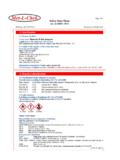
1 MATERIAL SAFETY data SHEET IDENTITY- abc dry chemical Page 1 of 4 SECTION I. chemical Product and Company Identification Product Name: abc dry chemical Fire Extinguishant Synonym: Multi-purpose Dry chemical Manufacturer: Buckeye Fire Equipment Company 110 Kings Road Kings Mountain, NC 28086 Telephone: Emergency: CHEMTREC Revision Date: 6/13 SECTION II. Hazard Identification and Emergency Overview Emergency Overview: Product is a light yellow, fine solid powder that is odorless. Adverse Health Effects and Symptoms: Product is a moderate irritant to the respiratory system and eyes; a mild irritant to the skin. Symptoms may include shortness of breath, coughing, and irritation to the eyes, lungs, and skin. Ingestion may cause gastric irritation, nausea, and diarrhea.
2 Exposure Guidelines: OSHA PEL ACGIH TLV Monoamonium phosphate Particulates Not Otherwise Classified Total Dust- 15 mg/m Respirable Fraction- 5 mg/m Particulates Not Otherwise Classified Total Dust- 10 mg/m Respirable Fraction- 3 mg/m Barium sulfate Mica Silica Stannous octoate Particulates Not Otherwise Classified Total Dust- 15 mg/m Respirable Fraction- 5 mg/m 6 mg/m 6 mg/m .1 mg/m Particulates Not Otherwise Classified Total Dust- 10 mg/m Respirable Fraction- 3 mg/m 3 mg/m 10 mg/m .1 mg/m Silicone Not Regulated Not Regulated Pigment Not Regulated Not Regulated Hazard Symbols: HMIS RATINGS: Health 1 Flammability 0 Reactivity 0 Personal Protective Equipment: use N-95 dust mask (See Section 8) WHMIS (Canadian Workplace Hazardous Materials Identification) D2B- May irritate eyes, mucous membranes, and/or skin SECTION III.
3 Composition/Information on Ingredients Weight %* CAS # Monoammonium phosphate Barium Sulfate Mica Silica Stannous octoate Silicone Pigment 85 10 < 3 < 2 < .3 < .1 < .1 7722-76-1 7727-43-7 12001-26-2 7631-86-9 301-10-0 63148-57-2 6358-31-2 * % is rounded to the nearest appropriate number. Values are not to be considered product specifications MATERIAL SAFETY data SHEET IDENTITY- abc dry chemical Page 2 of 4 SECTION IV. First Aid Measures Eye Exposure- Flush eyes with water until pain-free. If irritation develops or persists, seek medical attention. Skin Exposure- Wash with plenty of soap and water. If irritation develops or persists, seek medical attention. Inhalation- Move victim to fresh air. If irritation develops or persists, seek medical attention.
4 Ingestion- If victim is conscious and alert, give 2-3 glasses of water to drink. Do not induce vomiting. If vomiting occurs and the victim is conscious, give additional water to further dilute the chemical . Prevent aspiration of swallowed product by laying victim on side with head lower than their waist. Seek medical attention. Do not leave victim unattended. Medical Conditions Possibly Aggravated by Exposure- Inhalation of the product may aggravate existing chronic respiratory conditions such as asthma, emphysema, or bronchitis. Contact with the skin may aggravate an existing skin disease. Chronic overexposure may cause pneumoconiosis ( Dusty Lung disease). SECTION V. Firefighting Measures Extinguishing Media: N/A. This product is an extinguishing agent.
5 It is nonflammable and noncombustible. Special Firefighting Procedures: N/A Unusual Fire and Explosion Hazards: This product may decompose in fire and release oxides of carbon, potassium, and nitrogen (Refer to Section X). Sensitivity to Mechanical Impact or Static Discharge: None SECTION VI. Accidental Release Measures In case of accidental release, use the appropriate respiratory protection. Clean up the product using a vacuum or wet sweep and shovel to minimize the generation of dust. Bag or drum the product for disposal. If the product is used and/or contaminated, use personal protective equipment and containment means that are appropriate for the composition of the mixture. Product should be prevented from entering waterways. SECTION VII.
6 Handling and Storage Avoid eye, respiratory, and skin exposure. Use the appropriate personal protective equipment when handling. Wash thoroughly after handling (Refer to Section VIII). Product should be stored in its original container or extinguisher. When the product is contained under pressure ( , an extinguisher), inspect the container for rust or damage that may compromise the container integrity. Do not store the product in high humidity and do not mix with other extinguishing agents, particularly potassium bicarbonate based agents. SECTION VIII. Exposure Controls and Personal Protection During the use of this product on fires, exhaust gases and products of incomplete combustion are the main respiratory hazards. In the manufacture of this product, employers and employees must use their collective judgment in determining the on-the-job settings where the use of a dust mask or respirator is prudent.
7 The need for respiratory protection is not likely for short-term use in well-ventilated areas. Respiratory Protection: Use an N-95 dust mask for limited exposures and use air-purifying respirators with high efficiency particulate air filters (HEPA filters) for prolonged exposures. Eye Protection: Wear chemical goggles or full-face air-purifying respirator. Skin Protection: Use nitrile, latex, or similar gloves and coveralls. Good personal hygiene practices are essential. After handling the product, avoid food, tobacco products, or other means of transferring the product from hand to mouth until after thoroughly washing. MATERIAL SAFETY data SHEET IDENTITY- abc dry chemical Page 3 of 4 SECTION IX. Physical and chemical Properties Appearance and Odor: Light yellow fine powder that is odorless.
8 Apparent Density: Solubility: The product is coated with water repellant silicone. Not immediately soluble in water. pH: Approximately 4 -5 Flash Point: N/A Flammability: N/A Vapor Pressure: N/A Boiling Point: N/A Explosive or Oxidizing Properties: None SECTION X. Stability and Reactivity Stability: Stable Incompatibles: Magnesium, strong oxidizers such as calcium hypochlorite (pool chlorine), strong alkalis, and isocyanuric acids. Decomposition Products: This product may decompose in fire and release carbon monoxide, carbon dioxide, and sulfur dioxide. Oxides of phosphorous and ammonia have been reported. Hazardous Polymerization: Will not occur Hazardous Reactions: None SECTION XI. Toxicological Information Acute Toxicity: Monoammonium phosphate LD50 (rat): > 1000mg/kg body weight.
9 Target organs in humans: respiratory system, eyes, and skin. This product is an irritant to epithelial tissue and may aggravate dermatitis. No indication that the product causes sensitization. Chronic Toxicity: Pneumoconiosis, or Dusty Lung disease, may result from chronic exposure to any dust. Reproductive Toxicity: This product is not known to have any reproductive effects. SECTION XII. Ecological Information Ecotoxicity: Negative effects are unknown. Provides nutrient nitrogen and phosphorous to plant life. Degradability: Degrades rapidly in wet or humid environment. Bioaccumulation: Unknown extent. Mobility in Soil: Water-soluble. May leech in to groundwater. SECTION XIII. Considerations for Disposal This product is not a RCRA characteristically hazardous or listed hazardous waste.
10 Dispose of according to state or local laws, which may be more restrictive than federal regulations. Be aware that product used on a fire may be altered or contaminated and thereby require different disposal considerations. SECTION XIV. Transportation Information This product is not defined as a hazardous MATERIAL under Department of Transportation 49 CFR 172, or by Transport Canada Transportation of Dangerous Goods regulations. Please Note: Although this MATERIAL is not considered hazardous, when contained in a stored pressure fire extinguisher pressurized with a nonflammable gas, the extinguisher itself is considered hazardous MATERIAL by the Department of Transportation (USDOT) and Transport Canada (TC). Packaging of the fire extinguisher shall be identified with the Proper Shipping Name (Fire Extinguisher) and the UN Identification Number (UN 1044).