Transcription of Material Safety Data Sheet - JP Dyechem
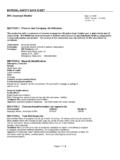
1 Material Safety Data SheetEpichlorohydrin MSDSS ection 1: Chemical ProductProduct Name:EpichlorohyrinCatalog Codes:SLE1588 CAS#:160-89-8 RTECS:TX4900000 TSCA:TSCA 8(b) inventory: EpichlorohyrinCI#:Not :(Chloromethyl)ethylene oxideChemical Name:EpichlorohyrinChemical Formula:C3-H5-C10 Section 2: Composition and Information on IngredientsComposition:NameCAS #% by WeightEpichlorohyrin160-89-8100 Toxicological Data on Ingredients:Epichlorohyrin: ORAL (LD50): Acute: 90 mg/kg [Rat]. 195 mg/kg [Mouse]. 345 mg/kg[Rabbit]. DERMAL (LD50): Acute: 250 mg/kg [Mouse].Section 3: Hazards IdentificationPotential Acute Health Effects:Hazardous in case of skin contact (irritant), of eye contact (irritant), of ingestion, of inhalation (lung irritant).Corrosive to skin and eyes on contact. Liquid or spray mist may produce tissue damage particularly on mucousmembranes of eyes, mouth and respiratory tract. Skin contact may produce burns.
2 Inhalation of the spray mistmay produce severe irritation of respiratory tract, characterized by coughing, choking, or shortness of over-exposure can result in Chronic Health Effects:CARCINOGENIC EFFECTS: Classified + (PROVEN) by OSHA+ (PROVEN) by NIOSH. Classified A3 (Provenfor animal.) by ACGIH. Classified 2A (Probable for human.) by IARC, 2 (Reasonably anticipated.) by EFFECTS: Classified POSSIBLE for EFFECTS: Not TOXICITY: Classified Reproductive system/toxin/female, Reproductive system/toxin/male,Development toxin [POSSIBLE].p. 1 The substance is toxic to kidneys, lungs, liver, or prolonged exposure to the substance can produce target organs damage. Repeated or prolongedcontact with spray mist may produce chronic eye irritation and severe skin irritation. Repeated or prolongedexposure to spray mist may produce respiratory tract irritation leading to frequent attacks of bronchial exposure to an highly toxic Material may produce general deterioration of health by an accumulation inone or many human 4: First Aid MeasuresEye Contact:Check for and remove any contact lenses.
3 Immediately flush eyes with running water for at least 15 minutes,keeping eyelids open. Cold water may be used. Do not use an eye ointment. Seek medical Contact:If the chemical got onto the clothed portion of the body, remove the contaminated clothes as quickly as possible,protecting your own hands and body. Place the victim under a deluge shower. If the chemical got on the victim'sexposed skin, such as the hands : Gently and thoroughly wash the contaminated skin with running water andnon-abrasive soap. Be particularly careful to clean folds, crevices, creases and groin. If irritation persists, seekmedical attention. Wash contaminated clothing before Skin Contact:Wash with a disinfectant soap and cover the contaminated skin with an anti-bacterial cream. Seek immediatemedical :Allow the victim to rest in a well ventilated area. Seek immediate medical Inhalation:Evacuate the victim to a safe area as soon as possible.
4 Loosen tight clothing such as a collar, tie, belt orwaistband. If breathing is difficult, administer oxygen. If the victim is not breathing, perform mouth-to-mouthresuscitation. WARNING: It may be hazardous to the person providing aid to give mouth-to-mouth resuscitationwhen the inhaled Material is toxic, infectious or corrosive. Seek immediate medical :Do not induce vomiting. Examine the lips and mouth to ascertain whether the tissues are damaged, a possibleindication that the toxic Material was ingested; the absence of such signs, however, is not conclusive. Loosentight clothing such as a collar, tie, belt or waistband. If the victim is not breathing, perform mouth-to-mouthresuscitation. Seek immediate medical Ingestion:Not 5: Fire and Explosion DataFlammability of the Temperature:411 C ( F)Flash Points:CLOSED CUP: 31 C ( F).Flammable Limits:LOWER: UPPER: 21%Products of Combustion:These products are carbon oxides (CO, CO2).
5 Fire Hazards in Presence of Various Substances:Flammable in presence of shocks, of Hazards in Presence of Various Substances:Risks of explosion of the product in presence of mechanical impact: Not of explosion of the product in presence of static discharge: Not Fighting Media and Instructions:p. 2 Flammable liquid, soluble or dispersed in FIRE: Use DRY chemical FIRE: Use alcohol foam, water spray or fog. Cool containing vessels with water jet in order to preventpressure build-up, autoignition or Remarks on Fire Hazards:Not Remarks on Explosion Hazards:Not 6: Accidental Release MeasuresSmall Spill:Absorb with an inert Material and put the spilled Material in an appropriate waste Spill:Flammable liquid. Corrosive away from heat. Keep away from sources of ignition. Stop leak if without risk. Absorb with DRY earth,sand or other non-combustible Material . Do not get water inside container.
6 Do not touch spilled Material . Usewater spray curtain to divert vapor drift. Prevent entry into sewers, basements or confined areas; dike if all ignition sources. Call for assistance on disposal. Be careful that the product is not present at aconcentration level above TLV. Check TLV on the MSDS and with local 7: Handling and StoragePrecautions:Keep locked up Keep container dry. Keep away from heat. Keep away from sources of ignition. Ground allequipment containing Material . Do not ingest. Do not breathe gas/fumes/ vapour/spray. Never add water to thisproduct Wear suitable protective clothing In case of insufficient ventilation, wear suitable respiratory equipmentIf ingested, seek medical advice immediately and show the container or the label. Avoid contact with skin andeyes Keep away from incompatibles such as acids, :Flammable materials should be stored in a separate Safety storage cabinet or room.
7 Keep away from heat. Keepaway from sources of ignition. Keep container tightly closed. Keep in a cool, well-ventilated place. Ground allequipment containing Material . A refrigerated room would be preferable for materials with a flash point lower C (100 F).Section 8: Exposure Controls/Personal ProtectionEngineering Controls:Provide exhaust ventilation or other engineering controls to keep the airborne concentrations of vapors below theirrespective threshold limit value. Ensure that eyewash stations and Safety showers are proximal to thework-station Protection:Splash goggles. Lab coat. Vapor respirator. Be sure to use an approved/certified respirator or Protection in Case of a Large Spill:Splash goggles. Full suit. Vapor respirator. Boots. Gloves. A self contained breathing apparatus should beused to avoid inhalation of the product. Suggested protective clothing might not be sufficient; consult a specialistBEFORE handling this Limits:United States: TWA: (ppm) from ACGIH (TLV) SKINU nited States: TWA: (ppm) from OSHA (PEL)Denmark: TWA: (ppm) SKINH ungary: STEL: 1 (mg/m3) SKINC onsult local authorities for acceptable exposure 3 Section 9: Physical and Chemical PropertiesPhysical state and :Irritanting Chloroform-likeTaste:Not g/moleColor:Clear (1% soln/water):Not Point:115 C (239 F)Melting Point:-48 C ( F)Critical Temperature:Not Gravity:Not Pressure:13 mm of Hg (@ 20 C)Vapor (Air = 1)Volatility:Not Threshold:Not Dist.
8 Coeff.:The product is more soluble in oil; log(oil/water) = (in Water):Not Properties:Dispersed in methanol, diethyl dispersed in slightly dispersed in cold water, hot solubility in methanol, diethyl ether, :Soluble in methanol, diethyl soluble in slightly soluble in cold water, hot 10: Stability and Reactivity DataStability:The product is Temperature:Not of Instability:Not with various substances:Reactive with acids, :Not Remarks on Reactivity:Expolsive reactions with aniline, trichlorochloroethylene, potassium tert-butoxide, sulfuricacid or isopropylamineSpecial Remarks on Corrosivity:Not 4 11: Toxicological InformationRoutes of Entry:Absorbed through skin. Dermal contact. Eye contact. Inhalation. to Animals:Acute oral toxicity (LD50): 90 mg/kg [Rat].Acute dermal toxicity (LD50): 250 mg/kg [Mouse].Chronic Effects on Humans:CARCINOGENIC EFFECTS: Classified + (PROVEN) by OSHA+ (PROVEN) by NIOSH.
9 Classified A3 (Provenfor animal.) by ACGIH. Classified 2A (Probable for human.) by IARC, 2 (Reasonably anticipated.) by EFFECTS: Classified POSSIBLE for TOXICITY: Classified Reproductive system/toxin/female, Reproductive system/toxin/male,Development toxin [POSSIBLE].The substance is toxic to kidneys, lungs, liver, Toxic Effects on Humans:Hazardous in case of skin contact (irritant), of ingestion, of inhalation (lung irritant).Special Remarks on Toxicity to Animals:Not Remarks on Chronic Effects on Humans:Not Remarks on other Toxic Effects on Humans:Not 12: Ecological InformationEcotoxicity:Ecotoxicity in water (LC50): 11104 ppm 96 hour(s) [Goldfish].BOD5 and COD:Not of Biodegradation:Possibly hazardous short term degradation products are not likely. However, long term degradation products of the Products of Biodegradation:The products of degradation are less toxic than the product Remarks on the Products of Biodegradation:Not 13: Disposal ConsiderationsWaste Disposal:Section 14: Transport InformationDOT Classification:CLASS : Poisonous pollutantIdentification:: Epichlorohydrin : UN2023 PG: IISpecial Provisions for Transport:Not 15: Other Regulatory Informationp.
10 5 Federal and State Regulations:California prop. 65: This product contains the following ingredients for which the State of California has found tocause cancer, birth defects or other reproductive harm, which would require a warning under the statute:EpichlorohyrinCalifornia prop. 65: This product contains the following ingredients for which the State of California has found tocause birth defects which would require a warning under the statute: EpichlorohyrinCalifornia prop. 65: This product contains the following ingredients for which the State of California has found tocause cancer which would require a warning under the statute: EpichlorohyrinPennsylvania RTK: EpichlorohyrinFlorida: EpichlorohyrinMinnesota: EpichlorohyrinMassachusetts RTK: EpichlorohyrinNew Jersey: EpichlorohyrinTSCA 8(b) inventory: EpichlorohyrinTSCA 12(b) one time export: EpichlorohyrinTSCA 12(b) annual export notification: EpichlorohyrinOther Regulations:OSHA: Hazardous by definition of Hazard Communication Standard (29 CFR ).