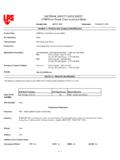
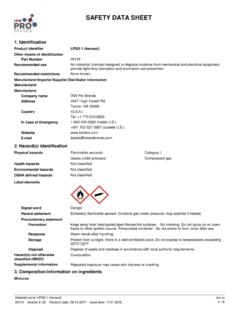
Transcription of MATERIAL SAFETY DATA SHEET LPS 1 Greaseless …
1 MATERIAL SAFETY data SHEET LPS 1 Greaseless Lubricant Current Revision 8/29/05 Previous Revision: 5/10/05 page 1 of 7 Section 1 Product and Company Identification Manufacturer's Name: LPS Laboratories Chemical Family: Petroleum Distillates Trade Name: LPS 1 Greaseless Lubricant Telephone Number: 770-243-8800 Part Numbers: 00116(aerosol) 00122, 01128, 00105, 00155 Address: 4647 Hugh Howell Road Tucker, GA USA 30085-5052 Emergency Telephone Number: 1-800-424-9300 Chemtrec; Outside : (703) 527-3887 Website: PLAIN LANGUAGE HAZARD SUMMARY MATERIAL SAFETY data Sheets can be confusing. Federal and State laws require us to include a great deal of technical information that probably won t help the non-professional. LPS includes this PLAIN LANGUAGE HAZARD SUMMARY to address the questions and concerns of the average worker.
2 If you have additional health, SAFETY or product questions, don t hesitate to call us at 800/241-8334. Worker Toxicity LPS 1 Greaseless LUBRICANT is a specialized light duty lubricant designed to displace moisture and prevent rust and corrosion on steel, aluminum and other metals. LPS 1 also reduces friction, heat, noise, or wear between moving parts. It contains petroleum distillates and mineral oil that can be irritating to skin. Avoid extended exposure to unprotected skin. Don t get it in your eyes (it stings), or breath the vapor (if working on hot surfaces or heated tanks). Vapors from heated LPS 1 can make you dizzy and even sick. For more exposure and first aid information, refer to MSDS Sections 2, 8 and 11. Flammability LPS 1 Greaseless LUBRICANT is combustible having a flash point typically above 170oF and an autoignition temperature over 400oF. Under normal use conditions flammability isn t a concern, but don t apply the product onto red-hot metal surfaces or near sparks.
3 Disposal LPS 1 in non-aerosol form is not hazardous for disposal; however, if it becomes contaminated with another substance, the resulting mixture may fall under a hazardous classification. See section 13 for more details. MATERIAL SAFETY data SHEET LPS 1 Greaseless Lubricant Current Revision 8/29/05 Previous Revision: 5/10/05 page 2 of 7 Section 2 Hazards Identification This MATERIAL is considered hazardous by the OSHA Hazard Communication Standard (29 CFR ). Emergency Overview: DANGER: Aerosol contents under pressure. Harmful or Fatal if Swallowed. Primary route(s) of entry: Skin and Eye contact. Inhalation. Potential Acute Health Effects: Eyes: Irritating to eyes Skin: Repeated exposure may cause skin dryness or cracking. Inhalation: Excessive inhalation of vapors can cause irritation of the respiratory tract, nausea, dizziness or headache.
4 Ingestion: Product has a low order of acute oral toxicity, but ingestion of large quantities may cause nausea, vomiting, and gastrointestinal irritation. May cause injury if aspirated into lungs. Potential Chronic Health Effects: Carcinogenic Effects: NTP: No IARC: No OSHA: No Mutagenic Effects: None Teratogenic Effects: None Medical conditions aggravated by exposure: Persons with pre-existing central nervous system (CNS) disease, neurological conditions, skin disorders, chronic respiratory diseases, or impaired liver or kidney function should avoid exposure. Signs and Symptoms Stinging in eyes. Repeated or prolonged skin contact can cause redness, irritation, and scaling of the skin (dermatitis). Breathing of high vapor concentrations may cause headaches, stupor, irritation of throat and eyes, and kidney effects.
5 Section 3 Composition / Information on Ingredients Component CASRN Percent by Weight Distillates (Petroleum), Hydrotreated Light 64742-47-8 70 - 80% Distillates (Petroleum), Hydrotreated Middle 64742-46-7 20 - 30 % Carbon Dioxide propellant (aerosol only) 124-38-9 1 - 4% Section 4 First Aid Measures Eyes: Check for and remove contact lenses. If irritation or redness develops, flush eyes with cool, clean, low-pressure water for at least 15 minutes. Hold eyelids apart to ensure complete irrigation of the eye and eyelid tissue.
6 Do not use eye ointment. Seek medical attention immediately. MATERIAL SAFETY data SHEET LPS 1 Greaseless Lubricant Current Revision 8/29/05 Previous Revision: 5/10/05 page 3 of 7 Section 4 First Aid Measures - continued Skin: Remove contaminated shoes and clothing. Clean affected area thoroughly with mild soap and water. Do not use ointments. Seek medical attention if irritation persists. Inhalation: Immediately move victim to fresh air. If victim is not breathing, immediately begin rescue breathing. If heart has stopped, immediately begin cardiopulmonary resuscitation (CPR). If breathing is difficult, seek medical attention immediately. Ingestion: Do NOT induce vomiting unless directed to do so by medical personnel. Never give anything by mouth to an unconscious person. If spontaneous vomiting is about to occur, place victim s head below knees.
7 If victim is drowsy or unconscious, place on the left side with head down. Do not leave victim unattended. Seek medical attention immediately. Section 5 Fire Fighting Measures Products of Combustion: Carbon monoxide and carbon dioxide. Firefighting media: SMALL FIRE: Use DRY chemical powder. LARGE FIRE: Use water spray, fog or foam. Cool containing vessels with water jet in order to prevent pressure build-up, autoignition or explosions. Sensitivity to Impact: None Sensitivity to Static Discharge: None Protection Clothing (Fire): Firefighters must use full bunker gear including NIOSH-approved positive pressure self-contained breathing apparatus to protect against potential hazardous combustion or decomposition products and oxygen deficiencies. Evacuate area and fight the fire from a maximum distance or use unmanned hose holders or monitor nozzles.
8 Special Remarks on Explosion Hazards: Aerosols may explode upon heating, spread fire and overcome sprinkler systems. Section 6 Accidental Release Measures Small Spill and Leak: Absorb with an inert MATERIAL and dispose of properly. Large Spill and Leak: For large spills, secure the area and control access. Dike far ahead of a liquid spill to ensure complete collection. Pick up free liquid for disposal using absorbent pads, sand, or other inert non-combustible absorbent materials. Place into appropriate waste containers for later disposal. Section 7 Handling and Storage Handling: DO NOT spray into or around ignition sources. After handling, always wash hands thoroughly with soap and water. Use only with adequate ventilation. Avoid breathing vapors or spray mists. Storage: Keep container in a cool, well-ventilated area. Avoid all sources of ignition (spark or flame).
9 Store below 120 F. Precautions to be taken in handling and storage: Store aerosols as Level 3 Aerosol (NFPA 30B). Store all materials in dry, well-ventilated area. Avoid breathing vapors. MATERIAL SAFETY data SHEET LPS 1 Greaseless Lubricant Current Revision 8/29/05 Previous Revision: 5/10/05 page 4 of 7 Section 8 Exposure Controls / Personal Protection Ingredients CASRN OSHA PEL-TWA ACGIH-TLV Other Limits Distillates (Petroleum), Hydrotreated Light 64742-47-8 Not established Not established 100 ppm (supplier recommended TWA) Distillates (Petroleum), Hydrotreated Middle 64742-46-7 5mg/m3 /8 hrs 5mg/m3 /8 hrs 10 mg/m3 UK ST EXP (15 min.) Carbon Dioxide propellant (aerosol only) 124-38-9 10,000 ppm 5,000 ppm 30,000 ppm ACGIH STEL Engineering Controls: Provide exhaust ventilation or other engineering controls to keep the airborne concentrations of vapors below their respective occupational exposure limits.
10 Personal Protection: Eyes: SAFETY glasses. Respiratory : Use appropriate respirator if ventilation is inadequate. Hands: Use solvent resistant gloves. General Hygiene Considerations: Wash thoroughly after handling. Have eye-wash facilities immediately available. Section 9 Physical and Chemical Properties Appearance: Liquid. Colour: Pale amber. Odor/Taste: Characteristic. Vapor Pressure: < @ 20 C Solubility Description: Not soluble in water. Evaporation Rate: < (BuAc=1) Boiling Point ( C): 213 @ 760mmHg Flash Point ( C): 79 C (175oF) Specific Gravity (Water=1): @ 20 C Flash Point Method: Tag-Closed Cup. Vapour Density (air=1): >1 Auto Ignition Temperature ( C): >228oC(442oF) Content: 0 g/L Partition Coefficient (octanol/water): <1 Flammable limits (estimated): LOWER: UPPER: 7% Viscosity: < cSt @ 40oC pH: Not applicable MATERIAL SAFETY data SHEET LPS 1 Greaseless Lubricant Current Revision 8/29/05 Previous Revision: 5/10/05 page 5 of 7 Section 10 Stability and Reactivity Stability and Reactivity: The product is stable.