Transcription of Material Safety Data Sheet - Martrex Inc
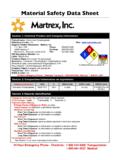
1 Material Safety data Sheet Section 1: Chemical Product and Company Information Product name: citric acid monohydrate Web: Supplier/ Further Information: Martrex , Inc. P. O. Box 1709 Phone: 952/933-5000. 14525 Highway 7 Toll Free: 800/328-3627 1. Minnetonka, Minnesota 55345-3793 FAX: 952/933-1889. EPA Registration Number: n/a CAS#: 5949-29-1. 3 0. Health Fire Reactivity Chemical Name: citric acid monohydrate Special Synonyms: 2-Hydroxy-1,2,3-propanetricarboxylic acid monohydrate Hazard Chemical Family: Carboxylic acid For Rating Explanation see Section 16. 24 Hour Emergency Phone - Chemtrec Transport: 1-800-424-9300; Medical: 1-800-441-3637. Section 2: Composition/Information on Ingredients Hazardous Components CAS# % OSHA PEL OSHA STEL OSHA TWL.
2 citric acid monohydrate 5949-29-1 >97% n/a n/a n/a OTHER LIMITS RTECS# ACGIH TLV ACGIH STEL ACGIH CEIL. See Section 15 n/a n/a n/a n/a * All concentrations are percent by weight unless ingredient is a gas. Gas concentrations are in percent by volume. Section 3: Hazards Identification Main hazards: Danger! Causes severe eye irritation and possible injury. Causes skin and respiratory tract irri- tation. Potential Health Effects Primary Routes of Exposure / Entry: Inhalation (breathing), eye contact, skin contact Target Organs: Respiratory system, eyes, skin Acute Exposure Symptoms Inhalation: Causes respiratory tract irritation. Eye Contact: Causes severe eye irritation and possible injury Skin Contact: Causes skin irritation. Some references state that citric acid has allergenic properties but, no animal or human studies were found to support this claim.
3 It does not seem likely that citric acid is a sen- sitizer since it is found in the body as an essential component of the citric acid cycle which releases en- ergy for physiological functions. citric acid is widely distributed in plants and in animal tissues and fluids. Ingestion: May cause gastrointestinal irritation with nausea, vomiting and diarrhea. Excessive intake of citric acid may cause erosion of the teeth. Chronic Exposure Symptoms: Repeated exposure may cause erosion of teeth. Chronic exposure may cause effects similar to those of acute exposure. See section 11 Toxicological Information Medical Conditions Aggravated By Long-Term Exposure: See section 11 Toxicological Information 24 Hour Emergency Phone - Chemtrec: 1-800-424-9300 Transportation 1-800-441-3637 Medical MSDS Product name: citric acid monohydrate page 2 of 6.
4 Section 4: First Aid Measures Inhalation: If inhaled, remove to fresh air. If not breathing, give artificial respiration. If breathing is difficult, give oxygen. Get medical assistance. Eye Exposure: In case of contact, immediately flush eyes with plenty of water for at least 15 minutes. Get medical aid immediately. Skin Exposure: In case of contact, flush skin with plenty of water. Remove contaminated clothing and shoes. Get medical aid if irritation develops and persists. Wash clothing before Ingestion: If swallowed, do not induce vomiting unless directed to do so by medical personnel. Never give anything by mouth to an unconscious person. Seek immediate medical attention. NOTE TO THE PHYSICIAN: Treat symptomatically and supportively. Section 5: Fire Fighting Measures Flamibility Classification: General Information: As in any fire, wear a self-contained breathing apparatus in pressure-demand, MSHA/.
5 NIOSH (approved or equivalent), and full protective gear. During a fire, irritating and highly toxic gases may be generated by thermal decomposition or combustion. This Material in sufficient quantity and re- duced particle size is capable of creating a dust explosion. NFPA= (estimated) Health: 3; Flammability: 1; Instability: 0. DOT= see Section 14. Flash Point [Method]: n/a Auto-ignition Temperature: 1010 C (1850 F). Lower explosion limit (LEL): n/a Upper explosion limit (UEL): n/a Extinguishing Media: Use water spray, dry chemical, carbon dioxide, or chemical foam. Unusual Fire and Explosive Hazards: In sufficient quantity and reduced particle size is capable of creating a dust explosion. Hazardous Decomposition Materials: Irritating and highly toxic gases may be generated by thermal de- composition or combustion.
6 Special Procedures: n/a Fire-Fighting Instructions: As in any fire, wear a self-contained breathing apparatus in pressure-demand, MSHA/NIOSH (approved or equivalent), and full protective gear. During a fire, irritating and highly toxic gases may be generated by thermal decomposition or combustion. This Material in sufficient quantity and reduced particle size is capable of creating a dust Personal Protective Equipment: Wear a self-contained breathing apparatus in pressure-demand, MSHA/. NIOSH (approved or equivalent), and full protective gear. CAUTION: no data Section 6: Accidental Release Measures General Information: Use proper personal protective equipment as indicated in Section 8. Spill and Leak Procedures: Vacuum or sweep up Material and place into a suitable disposal container.
7 Clean up spills immediately, observing precautions in the Protective Equipment section. Avoid generating dusty conditions. Provide ventilation. Spill may be carefully neutralized with lime (calcium oxide, CaO). Environmental and Regulatory Reporting: In the event of a spill or accidental release, notify relevant authori- ties in accordance with all applicable regulations. Follow local/state/national regulations. Note: Local regulations may prescribe or limit action to be taken. 24 Hour Emergency Phone - Chemtrec: 1-800-424-9300 Transportation 1-800-441-3637 Medical MSDS Product name: citric acid monohydrate page 3 of 6. Section 7: Handling and Storage Minimum/maximum Storage Temperature: n/a HANDLING: Wash thoroughly after handling. Remove contaminated clothing and wash before re- use.
8 Use with adequate ventilation. Minimize dust generation and accumulation. Keep con- tainer tightly closed. Avoid ingestion and inhalation. Do not get in eyes. Avoid contact with skin and clothing. STORAGE Store in a tightly closed container. Store in a cool, dry, well-ventilated area away from incompatible substances. Store protected from moisture. REGULATORY REQUIREMENTS: See Section 8 for employee exposure controls and Section 15 for other regulatory requirements. Section 8: Exposure Controls / Personal Protection Exposure Limits: Hazardous Component NIOSH ACGIH OSHA - Final PELs Note citric acid monohydrate n/a n/a n/a *NOTE: Limits/standards shown for guidance only. Follow applicable regulations. Engineering Controls: Facilities storing or utilizing this Material should be equipped with an eyewash facility and a Safety shower.
9 Use adequate ventilation to keep airborne concentrations low. Respiratory Protection: Follow the OSHA respirator regulations found in 29 CFR or European Stan- dard EN 149. Use a NIOSH/MSHA or European Standard EN 149 approved respirator if exposure limits are exceeded or if irritation or other symptoms are experienced. Eye Protection: Wear appropriate protective eyeglasses or chemical Safety goggles as described by OSHA's eye and face protection regulations in 29 CFR or European Standard EN166. Hand Protection: Wear appropriate protective gloves to prevent skin exposure. Skin and Body Protection: Wear appropriate protective clothing to prevent skin exposure. Other Protective Clothing and Equipment: n/a Hygienic Work Practices: Always observe good personal hygiene measures, such as washing after handling the Material and before eating, drinking, and/or smoking.
10 Routinely wash work clothing and protective equipment to remove contaminants. Discard contaminated clothing and footwear that cannot be cleaned. Practice good housekeeping. Environmental Controls: See Sections 6, 7, 12, 13. Section 9: Physical and Chemical Properties Chemical Name: citric acid monohydrate Physical State: Crystalline powder Color and Appearance: White Odor: Odorless pH (in water): ( soln). Vapor Pressure: mm Hg @ 25 C. Vapor Density (Air = 1): n/a Evaporation Rate: n/a Viscosity: n/a Boiling Point / Range: 175 C. Freezing/Melting Point: 100 C. Decomposition Temperature: 175 C. Solubility: Freely Soluble Specific Gravity/Density: g/cm3. Chemical Formula: Formula Wt: 24 Hour Emergency Phone - Chemtrec: 1-800-424-9300 Transportation 1-800-441-3637 Medical MSDS Product name: citric acid monohydrate page 4 of 6.