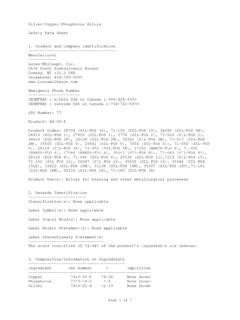
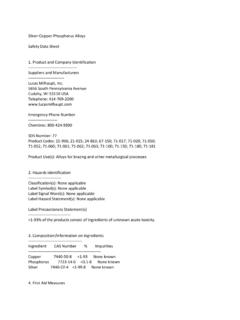
Transcription of MATERIAL SAFETY DATA SHEET Melpat Copper …
1 Page 1 of 7 MATERIAL SAFETY data SHEET Melpat Copper Sulphate 1. CHEMICAL PRODUCT PRODUCT IDENTIFICATION Product Name : Copper SULPHATE PENTAHYDRATE Chemical family : Inorganic Salt Structural Formula : CAS N : 7758-99-8 2. COMPOSITION/ INFORMATION ON INGREDIENTS Component Name %by Wt. CAS# ACGIH TLV OSHA PEL Copper 25 7440-50-8 1 rng/m3* 1 mg/m3* * As Copper dusts or mists. Components not precisely identified are proprietary or not hazardous. 3. HAZARDS IDENTIFICATION EMERGENCY OVERVIEW Copper dust is eye, skin, and mucous membrane irritant.
2 Copper Sulphate is toxic. Poisoning may affect the liver and/or kidneys and gastrointestinal tract. Persons with a history of chronic respiratory or skin disease may be at increased risk from exposure. See below for route-specific details. POTENTIAL HEALTH EFFECTS Inhalation: Slightly toxic by inhalation. Acute exposure inhalation of dusts and mist of Copper salts may cause irritation of upper respiratory tract. Workers exposed to Copper salts in dust form complained of metallic taste with irritation of nasal and oral mucous.
3 Eye Contact: May cause mild irritation to the eyes. Acute exposure Copper salts splashed in the eyes may cause conjunctivitis, corneal ulceration and turbidity. Skin Contact: Slight skin irritant. Excessive exposure, especially if prolonged, may produce skin irritation. Repeated exposure may cause allergic contact dermatitis. Page 2 of 7 Ingestion: Copper sulfate is only moderately toxic upon acute oral exposure. Ingestion of Copper sulfate is often not toxic because vomiting is automatically triggered by its irritating effect on the gastrointestinal tract.
4 Some of the signs of poisoning of Copper sulfate was swallowed include a metallic taste in the mouth, burning pain in the chest and abdomen, intense nausea, vomiting, diarrhea, headache, sweating, shock, discontinued urination leading to yellowing of the skin. Symptoms of over-exposure may include nausea and vomiting, abdominal pain, and central nervous system depression, which, if severe enough, may lead to death. 4. FIRST AID MEASURES Inhalation: Remove victim to fresh air.
5 If not breathing, give artificial respiration preferably mouth-to-mouth. Get medical attention immediately. Eye Contact: Hold eyelids open and flush with water, until no evidence of chemical remains (at least 15 - 20 minutes). Get medical attention. Skin Contact: Remove contaminated clothing and shoes. Wash with plenty of soap and water until no evidence of chemical remains (approximately 15 - 20 minutes). Get medical attention. Ingestion: Drink promptly a large quantity of milk, egg white, gelatin solution or if these are not available, large quantities of water.
6 Unless extensive vomiting has occurred, empty the stomach by gastric lavage. Administration of gastric lavage should be performed by qualified medical personnel. Probable mucosal damage may contraindicate use of gastric lavage. 5. FIRE FIGHTING MEASURES Flash Point & Method: Not applicable. Flammable Limits: No data . Autoignition Temperature: No data . HEALTH 2 FLAMMABILITY 0 REACTIVITY 0 PROTECTIVE EQUIPMENT Page 3 of 7 NFPA RATING HMIS RATING FIRE FIGHTING HAZARDS & PROCEDURES General Hazard: Negligible fire and explosion hazard when exposed to heat or flame.
7 Extinguishing Media: Use dry chemical, carbon dioxide, water spray, or foam. Fire Fighting Equipment: Wear protective clothing and self-contained breathing apparatus. Hazardous Combustion Thermal decomposition products include highly toxic Products: oxides of sulfur. 6. ACCIDENTAL RELEASE MEASURES Solid Spill: Dig holding area such as lagoon, pond or pit for containment. Use protective cover such as a plastic SHEET to prevent MATERIAL from dissolving fire extinguisher water or rain. Water Spill: Add suitable agent neutralize spilled MATERIAL .
8 Use dredges or lifts to extract inmobilized masses of pollution and precipitates. 7. HANDLING AND STORAGE General Information: Average shelf life under proper storage conditions is at least two(2) years. Handling : Wash thoroughly after handling. Use with adequate ventilation. Minimize dust generation and accumulation. Do not get in eyes, on skin, or on clothing. Do not ingest or inhale. Storage: Store in a clean, dry, well-ventilated area. Do not store near feed, food or within the reach of children. 8.
9 EXPOSURE CONTROLS/ PERSONAL PROTECTION PESTICIDE APPLICATORS & WORKERS These workers must refer to the Product Label and Directions For Use in accordance with the Worker Protection Standard 40 CFR part 170. MANUFACTURING, COMMERCIAL BLENDING, & PACKAGING WORKERS Ventilation: Control enclosed spaces with adequate ventilation to prevent exceedance of ACGIH TLV (1mg/m3). Respiratory Protection: In enclosed spaces where the TLV may be exceeded, wear NIOSH/MSHA approved dust or mist respirator. Eye Protection: Employee must wear splashproof of dust resistant SAFETY goggles to prevent eyes contact with this substance.
10 Page 4 of 7 Protective Clothing: Employees must wear appropiate protective (impervious) clothing, gloves and equipment to prevent repetead or prolonged skin contact with this substan 9. PHYSICAL AND CHEMICAL PROPERTIES Molecular Weight : Vapor Pressure: No data . Specific Gravity(H20 = 1): Solubility in Water: Soluble. pH: 4,0 +/- 0,5 (water suspension 5%) Boiling Point: 250 C (water suspension) Melting Point: 200 C (water suspension) Viscosity: No data Odor: None Color: Blue Physical State: Crystals or powder 10.