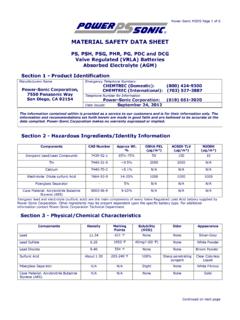
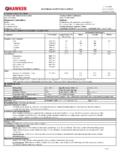
Transcription of MATERIAL SAFETY DATA SHEET - MK Battery
1 MATERIAL SAFETY data SHEET Revision Date:Oct. 2008 1 Section I Product and Manufacturer Identity Product Name sealed Lead- acid Battery Manufacturer s Name and Address MK Batteries 8997-C YELLOWBRICK ROAD. BALTIMORE, MD 21237 Telephone 410-238-1526 Fax: 410-238-1047 Web-site Section II Composition/Information On Ingredients Identification of single or mixed substance product Mixed substance product. PBB spices or PBDE spices is not involved Components CAS # Hazard Category OSHA PELACGIH TLV % (By weight) Lead 7439-92-1 Acute-Chronic mg/m3 45 ~ 60% Lead Dioxide 1309-60-0 Acute-Chronic mg/m3 15 ~ 25% Sulfuric acid Electrolyte 7664-93-9 Acute-ChronicReactive -Oxidizer mg/m3 15 ~ 20% Non-Hazardous Materials N/A Not applicableN/A N/A 5 ~ 10% Section III Physical / Chemical Properties Boiling Point 110 C ~ 112 C Vapor Pressure 21 mm Hg.
2 At 25 C Vapor Density (AIR = 1) Electrolyte Specific Gravity (H2O = 1) ~ Solubility in Water Sulfuric acid is 100% soluble in water. Appearance and Odor A Battery is a solid article consisting of an opaque plastic case with two lead terminals; no apparent odor. Electrolyte is a liquid absorbed in glass mat MATERIAL , a little pungent odor. MATERIAL SAFETY data SHEET Revision Date:Oct. 2008 2 Section IV Fire - Fighting Measures Flash Point Flammable Limits Extinguishing Media Auto Ignition Temperature : Not Applicable Lower limit (Hydrogen gas in air) Upper limit Class ABC, Dry chemical, CO2 or halon, or water spray 357 C(polypropylene), 245 C(ABS) Special Fire Fighting Procedures If batteries are on charge, turn off power. Use positive pressure, self-contained breathing apparatus in fighting fire. Water applied to electrolyte generates heat and causes it to spatter. Wear acid resistant clothing. Ventilate area well.
3 Unusual Fire and Explosion Hazards Hydrogen gas may be produced and may explode if ignited. Remove all sources of ignition. Sulfuric acid vapors are generated upon overcharge and case failure. Avoid open flames/sparks/other sources of ignition near Battery . Section V Stability and Reactivity Stability Stable under normal conditions Conditions to Avoid Avoid shorting circuit or sparks near Battery . Avoid prolonged over-charging. Use only approved charging methods. Do not charge in gas tight containers. Sparks, open flames, keep Battery away from strong oxidizers. Section VI First - Aid Measures Battery Electrolyte Inhalation Remove to fresh air. Give oxygen or artificial respiration if needed. Get immediate medical attention. Eye Contact Flush with plenty of water for at least 15 minutes. Get immediate medical attention. Skin Contact Remove contaminated clothing and flush affected areas with plenty of water for at least 15 minutes.
4 Ingestion Do not induce vomiting. Dilute by giving large quantities of water. If available give several glass of milk. Do not give anything by mouth to an unconscious person. Give CPR if breathing has stopped. Get immediate medical attention. MATERIAL SAFETY data SHEET Revision Date:Oct. 2008 3 Routes of Entry Electrolyte: Harmful by all routes of entry. Inhalation Electrolyte: Breathing of sulfuric acid vapors or mists may cause severe respiratory irritation. Ingestion Electrolyte: May cause severe irritation of mouth, throat, esophagus, and stomach. Skin Contact Electrolyte: Severe irritation, burns, and ulceration. Eye Contact Electrolyte: Severe irritation, burns, cornea damage, and blindness. Effects of Overexposure Acute Electrolyte: Severe skin irritation, damage to cornea may cause blindness, upper respiratory irritation. Effects of Overexposure Chronic Electrolyte: Possible erosion of tooth enamel; inflammation of nose, throat, and bronchial tubes.
5 Carcinogenic Electrolyte: The International Agency for Research on Cancer (IARC) has classified strong inorganic acid mist containing sulfuric acid as a Category 1 carcinogen, a substance that is carcinogenic to humans. This classification does not apply to liquid forms of sulfuric acid or sulfuric acid solutions contained within the Battery . Inorganic acid mist (sulfuric acid mist) is not generated under normal use of this product. Misuse of the product, such as overcharging, may result in the generation of sulfuric acid mist. Medical Conditions Generally Aggravated by Exposure Overexposure to sulfuric acid mist may cause lung damage and aggravate pulmonary conditions. Contact of electrolyte with skin may aggravate skin diseases such as eczema and contact dermatitis. Contact of electrolyte with eyes may damage cornea and/or cause blindness.
6 Lead and its compounds can aggravate some forms of kidney, liver, and neurological and diseases. Section VII Accidental Release Measures MATERIAL SAFETY data SHEET Revision Date:Oct. 2008 4 Steps to be Taken in Case of Broken Battery Case or Electrolyte Leakage Avoid contact with acid materials. Use soda ash or lime to neutralize. Flush with water. Dispose of clean-up materials as a hazardous waste. Waste Disposal Method Dispose of in accordance with Federal, State and Local Regulations. Do not incinerate. Batteries should be shipped to a reclamation facility for recovery of the metal and plastic components as the proper method of waste management. Contact distributors for appropriate product return procedures. Other Precautions Do not charge in unventilated areas. Do not use organic solvents or other than recommended chemical cleaners on Battery . Procedures for cleanup. Avoid contact with any spilled MATERIAL .
7 Contain spill, isolate hazard area, and deny entry. Limit site access to emergency responders. Neutralize with sodium bicarbonate, soda ash, lime or other neutralizing agent. Place Battery in suitable container for disposal. Dispose of contaminated MATERIAL in accordance with applicable local, state and federal regulations. Sodium bicarbonate, soda ash, sand, lime or other neutralizing agent should be kept on-site for spill remediation. Personal Precautions: acid resistant aprons, boots and protective clothing. ANSI approved SAFETY glasses with side shields/face shield recommended. Environmental Precautions: Lead and its compounds and sulfuric acid can pose a severe threat to the environment. Contamination of water, soil and air should be prevented. Section VIII Exposure Controls/ Personal Protection General Normal room ventilation is sufficient during normal use and handling. Personal Protective Equipment (in the Event of Battery Case Breakage) Always wear SAFETY glasses with side shields or full-face shield.
8 Use rubber or neoprene glove. Wear acid resistant boots, apron or clothing. Work / Hygienic Practices Remove jewelry, rings, watcher and any other metallic objects while working on batteries. All tools should be adequately insulated to avoid the possibility of shorting connections. Do not lay tools on top of Battery . Be sure to discharge static electricity from tools and individual person by touching a grounded surface in the vicinity of the batteries, but away from cells. Batteries are heavy. Serious injury can result from improper lifting or installation. Do not lift, carry, install or remove cells by lifting or pulling the terminal posts for SAFETY reasons and because terminal posts and post seals may be damaged. Do not wear nylon clothes or overalls as they can create static electricity. Do keep a fire extinguisher and emergency communications device in the work area. Hazardous Decomposition Products Combustion can produce carbon dioxide and carbon monoxide.
9 MATERIAL SAFETY data SHEET Revision Date:Oct. 2008 5 Hazardous Polymerization Hazardous Polymerization has not been reported. Section IX Transport Information NFPA Hazard Rating for Sulfuric acid Flammability (Red) = 0 Health (Blue) = 3 Reactivity (Yellow) = 2 Transportation Information Proper shipping name: Batteries, Wet, Non-Spillable, Electric Storage. DOT DOT-Unregulated, meets the requirements of 49 CFR (d). They do not have an assigned UN number nor do they require additional DOT hazard labeling. IATA / ICAO IATA/ICAO-Unregulated, meets the requirements of Special Provision A67. They are exempt from hazardous goods unregulations, and classified as a Non-Spillable Battery . The batteries have been tested according to packing instruction no. 806 The MK batteries are securely packaged, protected from short circuits and labled Non-Spillable . MK s sealed lead- acid batteries are exempt from DOT Hazardous MATERIAL Regulation and IATA Dangerous Goods Regulations For all modes of transportation, each Battery and outer package must be labeled Non-Spillable or Non-Spillable Battery .
10 This label must be visible during transportation. IMDG: Our batteries are authorized for transportation on deck or under deck storage on either a passenger or cargo vessel by passing the Vibration and Pressure Differential Tests as described in the International Maritime Dangerous Goods Regulations (IMDG). Applied Standard JIS C8702-1 8702-2 8702-3 IEC61056-1 61056-2 61056-3 Section X Additional Information MATERIAL SAFETY data SHEET Revision Date:Oct. 2008 6 The MATERIAL SAFETY data SHEET is supplied for informational purposes only. The information and recommendations contained herein have been compiled from sources believed to be reliable and represent current opinion on the subject. No warranty, guarantee, or representation is made by MK Battery as to the absolute correctness or sufficiency of any representation contained herein and MK Battery assumes no responsibility in connection therewith, nor can it be assumed that all acceptable SAFETY measures are contained herein, or that additional measures may not be required under particular or exceptional conditions or circumstances.