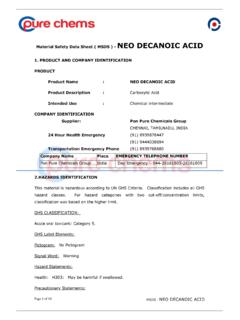
Transcription of Material Safety Data Sheet (MSDS) - Oxalic acid
1 MSDS - Oxalic acid Page 1 of 8 Material Safety Data Sheet (MSDS) - Oxalic acid 1. Chemical Product and Company Identification Product Name : Oxalic acid Catalog Codes : SLO1429, SLO1054 CAS# : 6153-56-6 RTECS : Not available. TSCA : TSCA 8(b) inventory: No products were found. It is a hydrate and exempt from TSCA inventory requirements. CI# : Not applicable. Synonym : Ethanedioic Acid, dihydrate Chemical Name : Oxalic Acid, dihydrate Chemical Formula : (COOH) COMPANY IDENTIFICATION Supplier: Pon Pure Chemicals Group CHENNAI, TAMILNADU, INDIA 24 Hour Health Emergency (91) 8939878447 (91) 9444038694 Transportation Emergency Phone (91) 8939768680 Company Name Place EMERGENCY TELEPHONE NUMBER Pon Pure Chemicals Group India Day Emergency 044-26161803-26161809 2. Composition and Information on Ingredients Composition: Name CAS # % by Weight Oxalic acid dihydrate 6153-56-6 100 Toxicological Data on Ingredients: Oxalic acid dihydrate LD50: Not available.
2 LC50: Not available. 3. Hazards Identification Potential Acute Health Effects: Very hazardous in case of skin contact (irritant), of eye contact (irritant), of ingestion, of inhalation. Hazardous in case of skin contact (permeator), of eye contact (corrosive). Slightly hazardous in case of skin contact (corrosive). The amount of tissue damage depends on length of contact. Eye contact can result in corneal damage or blindness. Skin contact can produce inflammation and blistering. MSDS - Oxalic acid Page 2 of 8 Inhalation of dust will produce irritation to gastro-intestinal or respiratory tract, characterized by burning, sneezing and coughing. Severe over-exposure can produce lung damage, choking, unconsciousness or death. Inflammation of the eye is characterized by redness, watering, and itching. Skin inflammation is characterized by itching, scaling, reddening, or, occasionally, blistering. Potential Chronic Health Effects: CARCINOGENIC EFFECTS: Not available.
3 MUTAGENIC EFFECTS: Not available. TERATOGENIC EFFECTS: Not available. DEVELOPMENTAL TOXICITY: Not available. The substance may be toxic to kidneys, the nervous system, mucous membranes, heart, brain, skin, eyes. Repeated or prolonged exposure to the substance can produce target organs damage. Repeated exposure of the eyes to a low level of dust can produce eye irritation. Repeated skin exposure can produce local skin destruction, or dermatitis. Repeated inhalation of dust can produce varying degree of respiratory irritation or lung damage. 4. First Aid Measures Eye Contact: Check for and remove any contact lenses. In case of contact, immediately flush eyes with plenty of water for at least 15 minutes. Cold water may be used. Get medical attention immediately. Skin Contact: In case of contact, immediately flush skin with plenty of water for at least 15 minutes while removing contaminated clothing and shoes. Cover the irritated skin with an emollient.
4 Cold water may be clothing before reuse. Thoroughly clean shoes before reuse. Get medical attention immediately. Serious Skin Contact: Wash with a disinfectant soap and cover the contaminated skin with an anti-bacterial cream. Seek immediate medical attention. Inhalation: If inhaled, remove to fresh air. If not breathing, give artificial respiration. If breathing is difficult, give oxygen. Get medical attention. Serious Inhalation: Evacuate the victim to a safe area as soon as possible. Loosen tight clothing such as a collar, tie, belt or waistband. If breathing is difficult, administer oxygen. If the victim is not breathing, perform mouth-to-mouth resuscitation. WARNING: It may be hazardous to the person providing aid to give mouth-to-mouth resuscitation when the inhaled Material is toxic, infectious or corrosive. Seek immediate medical attention. MSDS - Oxalic acid Page 3 of 8 Ingestion: Do NOT induce vomiting unless directed to do so by medical personnel.
5 Never give anything by mouth to an unconscious person. If large quantities of this Material are swallowed, call a physician immediately. Loosen tight clothing such as a collar, tie, belt or waistband. Serious Ingestion: Not available. 5. Fire and Explosion Data Flammability of the Product : May be combustible at high temperature. Auto-Ignition Temperature : Not available. Flash Points : Not available. Flammable Limits : Not available. Products of Combustion : These products are carbon oxides (CO, CO2). Fire Hazards in Presence of Various Substances: Slightly flammable to flammable in presence of heat. Non-flammable in presence of shocks. Explosion Hazards in Presence of Various Substances: Slightly explosive in presence of open flames and sparks. Non-explosive in presence of shocks. Fire Fighting Media and Instructions: SMALL FIRE: Use DRY chemical powder. LARGE FIRE: Use water spray, fog or foam. Do not use water jet. Special Remarks on Fire Hazards: As with most organic solids, fire is possible at elevated temperatures Special Remarks on Explosion Hazards: Fine dust dispersed in air in sufficient concentrations, and in the presences of an ignition source is a potential dust explosion hazard.
6 6. Accidental Release Measures Small Spill: Use appropriate tools to put the spilled solid in a convenient waste disposal container. If necessary: Neutralize the residue with a dilute solution of sodium carbonate. Large Spill: Corrosive solid. Stop leak if without risk. Do not get water inside container. Do not touch spilled Material . Use water spray to reduce vapors. Prevent entry into sewers, basements or confined areas; dike if needed. Eliminate all ignition sources. Call for assistance on disposal. Neutralize the residue with a dilute solution of sodium carbonate. Be careful that the product is not present at a concentration level above MSDS - Oxalic acid Page 4 of 8 TLV. Check TLV on the MSDS and with local authorities. 7. Handling and Storage Precautions: Keep container dry. Keep away from heat. Keep away from sources of ignition. Empty containers pose a fire risk, evaporate the residue under a fume hood.
7 Ground all equipment containing Material . Do not ingest. Do not breathe dust. Never add water to this product. In case of insufficient ventilation, wear suitable respiratory equipment. If ingested, seek medical advice immediately and show the container or the label. Avoid contact with skin and eyes. Keep away from incompatibles such as oxidizing agents, metals, alkalis. Storage: Keep container tightly closed. Keep container in a cool, well-ventilated area. 8. Exposure Controls/Personal Protection Engineering Controls: Use process enclosures, local exhaust ventilation, or other engineering controls to keep airborne levels below recommended exposure limits. If user operations generate dust, fume or mist, use ventilation to keep exposure to airborne contaminants below the exposure limit. Personal Protection: Splash goggles. Synthetic apron. Vapor and dust respirator. Be sure to use an approved/certified respirator or equivalent.
8 Gloves. Personal Protection in Case of a Large Spill: Splash goggles. Full suit. Vapor and dust respirator. Boots. Gloves. A self contained breathing apparatus should be used to avoid inhalation of the product. Suggested protective clothing might not be sufficient; consult a specialist BEFORE handling this product. Exposure Limits: TWA: 1 STEL: 2 (mg/m3) from ACGIH (TLV) [United States] TWA: 1 STEL: 2 (mg/m3) from OSHA (PEL) [United States] TWA: 1 STEL: 2 (mg/m3) from NIOSH [United States] TWA: 1 STEL: 2 (mg/m3) [United Kingdom (UK)] TWA: 1 STEL: 2 (mg/m3) [Canada]Consult local authorities for acceptable exposure limits. 9. Physical and Chemical Properties Physical state and appearance : Solid. (Crystalline solid ) Odor : Odorless. Taste : Not available. Molecular Weight : g/mole Color : Colorless. White. MSDS - Oxalic acid Page 5 of 8 pH (1% soln/water) : Not available Boiling Point : Not available. Melting Point : C ( F) Critical Temperature : Not available.
9 Specific Gravity : Density: @ eg. C(Water = 1) Vapor Pressure : Not applicable. Vapor Density : (Air = 1) Volatility : Not available. Odor Threshold : Not available. Water/Oil Dist. Coeff. : Not available. Ionicity (in Water) : Not available. Dispersion Properties : See solubility in water, diethyl ether. Solubility: Soluble in cold water, diethyl ether. Soluble in alcohol, glycerol. Insoluble in benzene, petroleum ether. Solubility in cold water: 1g/7ml. Solubility in hot water: 1g/2ml 10. Stability and Reactivity Data Stability : The product is stable. Instability Temperature : Not available. Conditions of Instability : Excess heat, incompatible materials, dust generation. Incompatibility with various substances: Reactive with oxidizing agents, metals, alkalis. Corrosivity : Non-corrosive in presence of glass. Special Remarks on Reactivity: Incompatible with chlorites, hypochlorites, silver and silver compounds, furfuryl alcohol.
10 Hygroscopic; keep container tightly closed. Special Remarks on Corrosivity: Not available. Polymerization: Will not occur. 11. Toxicological Information Routes of Entry : Absorbed through skin. Dermal contact. Inhalation. Ingestion. Toxicity to Animals: LD50: Not available. LC50: Not available. Chronic Effects on Humans: May cause damage to the following organs: kidneys, the nervous system, mucous membranes, heart, brain, skin, eyes. Other Toxic Effects on Humans: Very hazardous in case of skin contact (irritant), of ingestion, of inhalation. Hazardous in case of skin contact (permeator), of eye contact (corrosive). Slightly hazardous in MSDS - Oxalic acid Page 6 of 8 case of skin contact (corrosive). Special Remarks on Toxicity to Animals: LD50 data for Oxalic acid, ahydrous (CAS no. 144-62-7): LD50[rat] - Route: oral; Dose: 7500 mg/kg Special Remarks on Chronic Effects on Humans: May cause adverse reproductive effects based on animal test data.