Transcription of Material Safety Data Sheet (MSDS) - RW Sidley
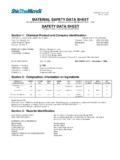
1 Material Safety data Sheet ( msds ) Revised October 8, 1999 For additional copies call 1-800-237-SANDI. Product Identification Trade Name: Silica Sand - All Grades Manufacturer's Name: Manley Bros. of Indiana, Inc. Manufacturer's Address: Box 80, Vermillion Road Troy Grove, IL 61372 Manufacturer's Telephone: (815) 539-7486 Date Revised: 10/99 II. Hazardous Ingredients Chemical Names CAS Number 14808-60-7 Silica, Quartz, SiO2 Exposure Limits in Air ACGIH-TLV mg/cubic meter Percentage >95 OSHA-PEL mg/cubic meter NIOSH * mg/cubic meter (* Recommended Standard) Exposure Limits refer to the respirable fraction III. Physical Properties Vapor Density: Not Applicable Specific Gravity: Crystalline Solubility in Water: Insoluble Vapor Pressure, mmHg at 20' C: Essentially Zero Melting Point or Range, F: Above 2000 F Boiling Point or Range, F: Above 3500 F Evaporation Rate: None Appearance and Odor: Light Buff to White Sand, No Odor How to Detect This Substance: Detect sand by appearance.
2 The dangerous respirable dust may only be detected using special measuring equipment. It should be assumed that wherever silica sand is re-handled some dust will be generated and routine measuring performed to detect and determine the level.. Manley Bros. Silica Sand msds 10/99 Page 1 of 4 IV. Fire and Explosion Flash Point: None Auto Ignition Temperature: None Flammable Limits in Air: Not Combustible Special Fire Fighting Procedures: None, may be used to extinguish fire Unusual Fire and Explosion Hazards: None V. Health Hazard Information Health Effects or Risks from Exposure Silicosis PROLONGED INHALATION OF RESPIRABLE SILICA (DUST) WILL RESULT IN PERMANENT LUNG DAMAGE. A Condition known as Silicosis. To prevent its occurrence, dust levels must be monitored and personnel exposed to respirable silica at or above the Permitted Exposure Level, MUST wear OSHA approved respirators.
3 Cancer Agent: YES NTP: Yes IARC: Yes Federal OSHA: No NTP: Respirable crystalline silica has been listed by The National Toxicology Program in the 6th Annual Report on Carcinogens to Humans (1992) as an anticipated carcinogen. IARC: The International Agency for Research on Cancer Monographs on the Evaluation of Carcinogenic Risk of Chemicals to Humans, in Vol. 68, concludes that there is sufficient evidence of the carcenogenicity of inhaled crystalline silica to humans. EXPOSURE TO RESPIRABLE SILICA CAN CAUSE CANCER. Personnel exposed to respirable silica MUST wear OSHA approved respirators. Symptoms of Overexposure Inhaled: Coughing, shortness of breath, reduced pulmonary function. Effects may be delayed, the disease usually being contracted over an extended period of exposure.
4 Contact with Skin or Eyes: Irritation Absorbed through Skin: Not Applicable Swallowed: May Cause Nausea First Aid - Emergency Procedures Eye Contact: Flush with water for 15 minutes. Seek medical attention. Skin Contact: Wash with soap and water. If irritation persists seek medical attention. Inhaled: Remove to fresh air at once. Apply artificial respiration if breathing has stopped. Seek immediate medical attention. Swallowed: If discomfort persists seek medical attention. All other pulmonary medical conditions are aggravated by exposure to respirable quartz.. Manley Bros. Silica Sand msds 10/99 Page 2 of 4 VI. Reactivity data Stability: Stable Incompatibility (materials to avoid): Strong Oxidizing Agents Hazardous Decomposition Products (Including combustion products): None Hazardous Polymerization: Will not occur VII.
5 Spill, Leak and Disposal Procedures Spill Response Procedures: Clean up using approved dustless methods (flush with water, or vacuum) to minimize generation of airborne respirable dust. Waste Disposal: Dispose of all waste in accordance with federal, state and local regulations in a facility approved for silica disposal. VIII. Special Handling Information Ventilation and Engineering Controls: Local mechanical ventilation where necessary to keep below safe levels (PEL) Use NIOSH approved respiratory protection equipment for respirable quartz (supplied air types are strongly recommended) Eye Protection: Safety goggles Gloves: Not normally necessary Other Clothing and Equipment: Provide eye wash Work Practices, Hygienic Practices: Minimize dust generation.
6 Clean up spills promptly. Monitor respirable quartz in workplace on a frequent regular basis. Other Handling and Storage Requirements: Avoid dust generation during handling. Clean up spills. Practice good housekeeping. No special storage requirements. Train all employees in all aspects of this msds before they work with this product. See OSHA Hazard Communication Rule CFR , , , , , , state and local worker or community "right to know" laws and regulations. Familiarize and train your employees with the requirements of the msds . WARN YOUR EMPLOYEES, AND YOUR CUSTOMERS IF YOU MERCHANT OR RE-SELL THE PRODUCTS, OF THE HAZARD AND THE OSHA PRECAUTIONS TO BE USED. IX. Other Information Rating: Health Hazard Rating: 1 Chronic exposure to respirable silica will result in silicosis exposure to respirable silica can cause cancer Flammability Hazard Rating: 0 Reactivity Hazard Rating: 0 Personal Protective Equipment E Comply with special OSHA respiratory protection if sandblasting Not Regulated SARA Title III.
7 Not Listed Manley Bros. Silica Sand msds 10/99 Page 3 of 4 CAUTION! PROLONGED INHALATION OF RESPIRABLE QUARTZ WILL CAUSE LUNG DAMAGE. A CONDITION KNOWN AS SILICOSIS. Silica sands may generate respirable dust during use. Examples of conditions which promote the generation of respirable dust include, thermal shock, sandblasting, grinding, machining or operations were abrasion with silica takes place. Monitor work area on a frequent regular basis for respirable quartz (silica). Use appropriate ventilation and/or respiratory protection unless exposure levels are known to be below permitted exposure levels. INHALATION OF RESPIRABLE QUARTZ CAN CAUSE CANCER! The International Agency for Research on Cancer (IARC) has determined that there is evidence for the carcinogenicity of crystalline silica to humans.
8 The department of Health and Human Services National Toxicology Program (NTP), in its Sixth Annual Report on Carcinogens, has listed respirable crystalline silica in a category of substances which may 'reasonably be anticipate d to be carcinogenous.' Such substances are defined as those for which there is limited evidence of carcinogenicityin experimental animals. Monitor work area on a frequent regular basis for respirable quartz (silica). Use appropriate ventilation and/or respiratory protection unless exposure levels are known to be below permitted exposure levels. It is extremely important that your company follow OSHA standards for respiratory protection as they exist or are hereafter modified or amended. As part of your training program, please distribute this information to all employees.
9 Manley Bros. Silica Sand msds 10/99 Page 4 of 4 Manley Bros. of Indiana, Inc. 300 South Vermillion Street, Troy Grove, IL 61372 Phone: (800) 237-SAND Fax: (815) 539-7741