Transcription of MATERIAL SAFETY DATA SHEET (MSDS) - SOLVENT C 9
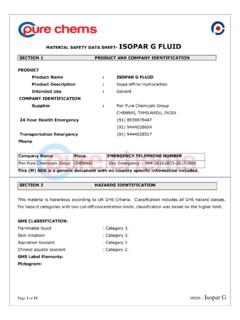
1 msds - SOLVENT C 9 Page 1 of 14 MATERIAL SAFETY DATA SHEET ( msds ) - SOLVENT C 9 1. PRODUCT AND COMPANY IDENTIFICATION PRODUCT Product Name : SOLVENT C 9 Product Description : Aromatic Hydrocarbon Intended Use : SOLVENT COMPANY IDENTIFICATION Supplier: Pon Pure Chemicals Group CHENNAI, TAMILNADU, INDIA 24 Hour Health Emergency (91) 8939878447 (91) 9444038694 Transportation Emergency Phone (91) 8939768680 Company Name Place EMERGENCY TELEPHONE NUMBER Pon Pure Chemicals Group India Day Emergency 044-26161803-26161809 This (M)SDS is a generic document with no country specific information included.
2 2. COMPOSITION / INFORMATION ON INGREDIENTS Reportable Hazardous Substance(s) or Complex Substance(s) Name CAS# Concentration* SOLVENT NAPHTHA (PETROLEUM), LIGHT AROMATIC 64742-95-6 100% Hazardous Constituent(s) Contained in Complex Substance(s) Name CAS# Concentration* CUMENE 98-82-8 < PSEUDOCUMENE (1,2,4-TRIMETHYLBENZENE) 95-63-6 < XYLENES 1330-20-7 < * All concentrations are percent by weight unless MATERIAL is a gas. Gas concentrations are in percent by volume. 3. HAZARDS IDENTIFICATION This MATERIAL is considered to be hazardous according to regulatory guidelines (see (M)SDS Section 15).
3 POTENTIAL PHYSICAL / CHEMICAL EFFECTS Combustible. MATERIAL can release vapors that readily form flammable mixtures. msds - SOLVENT C 9 Page 2 of 14 Vapor accumulation could flash and/or explode if ignited. MATERIAL can accumulate static charges which may cause an ignition. POTENTIAL HEALTH EFFECTS Repeated exposure may cause skin dryness or cracking. If swallowed, may be aspirated and cause lung damage. May be irritating to the eyes, nose, throat, and lungs.
4 May be irritating to the respiratory tract - effects are reversible. May cause central nervous system depression. ENVIRONMENTAL HAZARDS Toxic to aquatic organisms, may cause long-term adverse effects in the aquatic environment. NFPA Hazard ID: Health: 1 Flammability: 2 Reactivity: 0 HMIS Hazard ID: Health: 1 Flammability: 2 Reactivity: 0 NOTE: This MATERIAL should not be used for any other purpose than the intended use in Section 1 without expert advice. Health studies have shown that chemical exposure may cause potential human health risks which may vary from person to person.
5 4. FIRST AID MEASURES Inhalation Remove from further exposure. For those providing assistance, avoid exposure to yourself or others. Use adequate respiratory protection. If respiratory irritation, dizziness, nausea, or unconsciousness occurs, seek immediate medical assistance. If breathing has stopped, assist ventilation with a mechanical device or use mouth-to-mouth resuscitation. SKIN CONTACT Wash contact areas with soap and water. Remove contaminated clothing. Launder contaminated clothing before reuse.
6 EYE CONTACT Flush thoroughly with water. If irritation occurs, get medical assistance. Ingestion Seek immediate medical attention. Do not induce vomiting. NOTE TO PHYSICIAN If ingested, MATERIAL may be aspirated into the lungs and cause chemical pneumonitis. Treat appropriately. 5. FIRE FIGHTING MEASURES EXTINGUISHING MEDIA Appropriate Extinguishing Media: Use water fog, foam, dry chemical or carbon msds - SOLVENT C 9 Page 3 of 14 dioxide (CO2) to extinguish flames. Inappropriate Extinguishing Media: Straight Streams of Water FIRE FIGHTING Fire Fighting Instructions: Evacuate area.
7 Prevent runoff from fire control or dilution from entering streams, sewers, or drinking water supply. Firefighters should use standard protective equipment and in enclosed spaces, self-contained breathing apparatus (SCBA). Use water spray to cool fire exposed surfaces and to protect personnel. Unusual Fire Hazards: Vapors are flammable and heavier than air. Vapors may travel across the ground and reach remote ignition sources causing a flashback fire danger. Hazardous MATERIAL : Firefighters should consider protective equipment indicated in Section 8.
8 Hazardous Combustion Products: Smoke, Fume, Incomplete combustion products, Oxides of carbon FLAMMABILITY PROPERTIES Flash Point [Method]: >42C (108F) [ ASTM D-56] Flammable Limits (Approximate volume % in air): LEL: UEL: Auto ignition Temperature: 479 C (894 F) 6. ACCIDENTAL RELEASE MEASURES NOTIFICATION PROCEDURES In the event of a spill or accidental release, notify relevant authorities in accordance with all applicable regulations. US regulations require reporting releases of this MATERIAL to the environment which exceed the applicable reportable quantity or oil spills which could reach any waterway including intermittent dry creeks.
9 The National Response Center can be reached at (800)424-8802. PROTECTIVE MEASURES Avoid contact with spilled MATERIAL . Warn or evacuate occupants in surrounding and downwind areas if required due to toxicity or flammability of the MATERIAL . See Section 5 for fire fighting information. See the Hazard Identification Section for Significant Hazards. See Section 4 for First Aid Advice. See Section 8 for Personal Protective Equipment. SPILL MANAGEMENT Land Spill: Eliminate all ignition sources (no smoking, flares, sparks or flames in immediate area).
10 Stop leak if you can do it without risk. All equipment used when handling the product must be grounded. Do not touch or walk through msds - SOLVENT C 9 Page 4 of 14 spilled MATERIAL . Prevent entry into waterways, sewer, basements or confined areas. A vapor suppressing foam may be used to reduce vapors. Use clean non-sparking tools to collect absorbed MATERIAL . Absorb or cover with dry earth, sand or other non-combustible MATERIAL and transfer to containers.