Transcription of Material Safety Data Sheet - OUCC
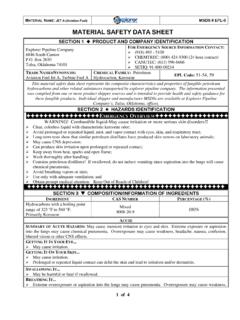
1 1 Material Safety data Sheet I. Identification of the Substance/ Preparation and Company Product Information: Polyoxyethylene Lauryl Ether AEO 9 Other Information: - Suggested Use and Prohibitions: Polyoxyethylene Lauryl Ether is a kind of nonionic surfactant. AEO2/3 conveys surfactant characteristics in the sulfonation process, which can be used as ingredient of shampoo. AEO7/9 are used as ingredient in the formula of detergent, as wetting agent and leveling agent in textile industry. Other grades are used as wetting agent in leather industry anti-electrostatic agent in producing synthetic fiber and diversifying agent in metal working. Information on Producer/Supplier Name, Addresses, Phone: Lin Yuan Plant, Oriental Union Chemical Corporation Industrial 3rd Rd., Industrial Zone Lin-Yuan, Kaohsiung, +886 7 641-3101 ~ 9 Emergency Phone: +886 7 641-3101 ~ 9 Fax: -886 7 641-9504 II. Hazard Identification: Hazard Category: Class 4 acute toxic substance (ingestion), class 3 skin corrosive/irritating substance ,Class 2 serious eye injury/irritation substance Labeled Contents: Symbols: Warning sign: Warning Hazard Warning Information: Harmful if ingested Causes mild skin irritation Causes eye irritation Hazard Prevention Measures: Avoid contact with skin and eyes.
2 In case of contact with eyes, wash immediately with large amount of water and seek medical care. Wear proper protective outfits, gloves, goggles/face mask. Other Hazards: III. Composition / Information on Ingredients (Single) English Name: Polyoxyethylene Lauryl Ether 2 Synonyms: Chemical Abstracts Number (CAS NO.): 9002-92-0 Percentage for Chemical Ingredient (%): Min C12H25O(C2H4O)9H IV. First Aid Measures Emergency and First Aid Procedures: Inhalation: 1. Remove pollution sources or move the patient to area with plenty of fresh air. 2. If the patient has stopped breathing, let trained personnel apply artificial respiration If there is difficulty in breathing, let trained personnel provide oxygen supply under the doctor s supervision. 3. Seek medical attention immediately. Skin contact: 1. Remove contaminated clothes, shoes and leather items (such as watch straps, belts). 2. Use gentle running water to wash the afflicted part for over 10 minutes.
3 3. If irritation persists, wash repeatedly. 4. Seek medical attention immediately. 5. Make sure to remove the dirt completely from the contaminated clothes, shoes and leather items before re-use or disposal. Eye contact: 1. Immediately lift the eyelids, use warm running water to wash contaminated eye(s) for 10 minutes. 2. If there is irritation after washing, wash repeatedly. 3. Seek medical attention immediately. Ingestion: 1. If the patient is about to lose consciousness, is unconscious or in convulsion, do not feed anything through the mouth.) 2. Do not induce vomiting. Let the patient drink 240~300 ml of water. 3. If the patient is vomiting spontaneously, give water repeatedly and rinse mouth. 4. If breathing has stopped, perform CPR by a trained personnel; if the heart has stopped beating, apply CPR. 5. Quickly send the patient to emergency room. Major Disease and Harm Effects: Causes mild skin eye irritation First-Aid Personal Protection: Prompt to Doctor: 3 V.
4 Fire Fighting Measure Suitable Extinguishing Media: Dry Chemical, carbon dioxide, water mist or spray. Special Exposure Hazards: Special Extinguishing Procedure: Withdraw from all personne Special Protection Equipment: Fire fighters must wear air respirators, protective gloves and fire-fighting outfits. VI. Accidental Release Measures Personal Protection: 1. Restrict personnel from entering the leaking area until completely cleaned. 2. Make sure that only trained personnel are allowed to clean up. 3. Wear appropriate personal protection equipment. Environmental Protection: 1. Ventilate and change the air in the leakage area. 2. Remove all ignition sources. 3. Notify the relevant government Safety , hygiene and environmental protection agencies. Methods for Cleaning Up: 1. Do not touch the leaking substance. 2. Prevent the spilled substances from entering the drainage, canals or closed spaces. 3. If Safety permits, try to stop or reduce the spillage.
5 4. Surround the leakage with sand, soil or other adsorbing substances that will not react with the leaking substance. 5. For small amount of leakage: absorb using absorbents that will not react with the leaking substance. Contaminated absorbents are as dangerous as the spillage and must be kept in properly covered and labeled containers. Wash the spilled area with water. Small amount of leakage can be diluted with large amount of water. 6. Large leakage: Contact the fire department, emergency rescue agency and supplier for assistance. VII. Handling and Storage Handling: 1. The storage area must be installed with the proper protective equipment. The work personnel must be properly trained and notified of the danger and safe usage of this substance. 2. If this substance is released in the storage site, immediately wear the respirator and perform the proper disposal. 4 3. Before operation, check if the container is leaking.
6 4. The personnel should be positioned at upwind position for all opening, reversal and mixing operations. 5. Do not store contaminated liquid back into the original storage container. Storage: 1. Store in areas that are dry, well ventilated and without direct exposure to sunlight, far from heat, ignition sources and incompatible substances. 2. Empty vessels, containers and pipes may still contain hazardous residues. Clean properly before soldering, cutting, drilling or heating. 3. Apply minimum amount for operation in specified area with excellent ventilation and separate from the storage area. VIII. Exposure Control / Personal Protection: Engineering Control: 1. Overall gas exchange installation. 2. Local exhaust ventilation system may be required during heating and formation of condensation. 3. Provide sufficient fresh air supply to supplement the air discharged by the exhaust ventilation system.
7 Control Factor TWA STEL CEILING BEIs Personal Protection Equipment: Respiratory Protection: No special requirements. Hand Protection: Leak-proof gloves made of natural rubber, neoprene rubber, polyvinyl chloride, butyl rubber, Viton, Teflon, Saranex, Barricade, 4H, Terllchem HPS, polyvinyl and nitrile rubber. Eye Protection: Chemical Safety goggles and masks. Skin & Body Protection: Above-mentioned whole-body protective outfit, work pants, apron and work boots made of rubber. Hygiene Procedures: 1. After work, remove the contaminated clothes as quickly as possible. Throw away or wash clothes thoroughly before wearing again. Notify the laundry personnel of the danger of the contaminated clothes. 2. Smoking and eating are strictly prohibited in work areas. 3. Wash hands thoroughly after handling this substance. 5 4. Keep the work area clean. IX. Physical and Chemical Properties / Characteristics Appearance: Blurred 30 C Odor: Similar alcohol flavor Odor threshold: Melting point: pH value: 5~7 (1 aq.)
8 Boiling Point / Boiling Range: 100 C Flammability: Decomposition Temperature: Flash Point: 170 C Test Method: Close Cup Spontaneous Temperature: Exposure Limits: Vapor Pressure: Vapor Density: Specific Gravity: ~ (40 C) Solubility: Soluble in water Log kow: Percent volatile: X. Stability and Reactivity Stability: Stable under normal conditions. Special Conditions of Hazardous Reaction: Conditions to Avoid: Incompatibility: Strong oxidizers Organic peroxides Hazardous Decomposition Products: XI. Toxicological Information Exposure route: skin contact, eye contact Symptoms: Irritation Acute Toxicity: Skin contact Liquid,vapour,droplet will cause irritation. Eye contact : Liquid,vapour,droplet will cause irritation. LD50 (test animal, absorption route): 1,200 mg/kg (Rat, ingestion) Chronic: XII. Ecological Information Eco-toxicity: Durability and Degradability: Biological Accumulation: The resolving of organism in water is good.
9 Fluidity in soil: Other adverse effects: XIII. Disposal Information Disposal Information: 6 1. Dispose according to the waste substance clearing laws and regulations. 2. Follow the warehouse conditions in storing waste substances waiting for disposal. 3. Dispose according to special incinerating or hygienic landfill laws. XIV. Transport Information UN Transport Name: Other controlled substances, liquidliquidliquidliquid The United Nations Number (Un-No): 3082 Transport Hazard Classification:9 Packaging Category: Packing Group IIIP acking Group IIIP acking Group IIIP acking Group III Low dangerLow dangerLow dangerLow danger Marine Pollutant (Yes/No) : No Special Transport Way and Note: No special transport way The principles of emergencyThe principles of emergencyThe principles of emergencyThe principles of emergency 171171171171 XV. Regulation Information Apply Regulation: 1. Enforcement Rules of the Labor Safety and Health Act 2.
10 Regulations of Hazard Communication on Dangerous and Harmful Material 3. Traffic Safety Regulations 4. Standards for the Storage, Clearance, and Disposal of Industrial Waste XVI. Other Information Reference 1. Council of Labor Affairs, Executive Yuan, Taiwan, GHS in Taiwan website. 2. Oriental Union Chemical Corporation website 3. Emergency Response GuideEmergency Response GuideEmergency Response GuideEmergency Response Guide (ERG 2000) (ERG 2000) (ERG 2000) (ERG 2000) Name: Oriental Union Chemical Corporation Responsible Department Address Address Tel 886 7 641-3101 ext. 2307 Prepared by Title Title Name (Signature) Yeh, Wei-Lun Date 2011/11/01 Note The "-" symbol in the text above indicates that there is no current available data while the "/" symbol indicates that this field is not applicable to this substance.