Transcription of MATERIAL SAFETY DATA SHEET - Pfizer
1 Page 1 of 6 Revision date: 04-Jan- 2007 MATERIAL SAFETY data SHEET Version: IDENTIFICATION OF THE SUBSTANCE/PREPARATION AND THE COMPANY/UNDERTAKING MATERIAL Name: Lymphocyte immune globulin, anti-thymocyte globulin (equine) sterile solution Trade Name: Atgam Sterile Solution Chemical Family: Mixture Intended Use: Pharmaceutical product used as immunosuppressive agent 2. COMPOSITION/INFORMATION ON INGREDIENTS HazardousIngredientCAS NumberEU EINECS List%Lymphocyte immune globulin, anti-thymocyte globulin (equine)Not assignedNot listed5 Hydrochloric Acid7647-01-0231-595-7**Sodium hydroxide1310-73-2215-185-5** IngredientCAS NumberEU EINECS List%Glycine56-40-6200-272-2*Water for Injection7732-18-5231-791-2* Additional Information:* Proprietary ** to adjust pH Ingredient(s) indicated as hazardous have been assessed under standards for workplace SAFETY .
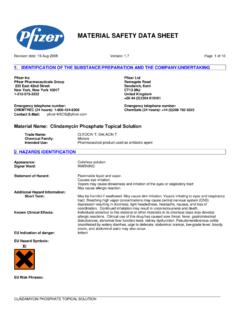
2 3. HAZARDS IDENTIFICATION Appearance:Pink or brown sterile solution Signal Word:DANGER Statement of Hazard:Suspected of damaging the unborn child. Causes damage to immune Hazard Information: Short Term: May cause irritation : skin, eye (based on components) May produce allergic reactions after systemic Clinical Effects: Adverse effects most commonly reported in clinical use include fever, chills, skin reaction, blood cell changes, systemic toxicity. Serious allergic reactions, including anaphylaxis, have been reported. EU Indication of danger:Toxic to Reproduction; Category 3 EU Hazard Symbols: Pfizer Inc Pfizer Pharmaceuticals Group 235 East 42nd Street New York, New York 10017 1-212-573-2222 Pfizer Ltd, Kent CT13 9NJ United Kingdom +00 44 (0)1304 616161 Emergency telephone number:CHEMTREC (24 hours): 1-800-424-9300 Emergency telephone number: ChemSafe (24 hours): +44 (0)208 762 8322 MATERIAL SAFETY data SHEET _____ MATERIAL Name: Lymphocyte immune globulin, anti-thymocyte globulin (equine) sterile solutionRevision date: 04-Jan- 2007 Page 2 of 6 Version: EU Risk Phrases: R63 - Possible risk of harm to the unborn child.
3 Note: This document has been prepared in accordance with standards for workplace SAFETY , which require the inclusion of all known hazards of the active substance or its intermediates regardless of the potential risk. The precautionary statements and warnings included may not apply in all cases. Your needs may vary depending upon the potential for exposure in your workplace. 4. FIRST AID MEASURES Eye Contact:Flush with water while holding eyelids open for at least 15 minutes. Seek medical attention immediately. Skin Contact:Remove contaminated clothing. Flush area with large amounts of water. Use soap. Seek medical attention. Ingestion:Never give anything by mouth to an unconscious person. Wash out mouth with water. Do not induce vomiting unless directed by medical personnel. Seek medical attention immediately. Inhalation:Remove to fresh air and keep patient at rest. Seek medical attention immediately. 5. FIRE FIGHTING MEASURES Extinguishing Media: Use carbon dioxide, dry chemical, or water spray.
4 Hazardous Combustion Products: Not applicable Fire Fighting Procedures: During all fire fighting activities, wear appropriate protective equipment, including self-contained breathing apparatus. Fire / Explosion Hazards: Not applicable 6. ACCIDENTAL RELEASE MEASURES Health and SAFETY Precautions: Personnel involved in clean-up should wear appropriate personal protective equipment (see Section 8). Minimize exposure. Measures for Cleaning / Collecting: Contain the source of spill if it is safe to do so. Collect spill with absorbent MATERIAL . Clean spill area thoroughly. Measures for Environmental Protections: Place waste in an appropriately labeled, sealed container for disposal. Care should be taken to avoid environmental release. Additional Consideration for Large Spills: Non-essential personnel should be evacuated from affected area. Report emergency situations immediately. Clean up operations should only be undertaken by trained personnel.
5 7. HANDLING AND STORAGE MATERIAL SAFETY data SHEET _____ MATERIAL Name: Lymphocyte immune globulin, anti-thymocyte globulin (equine) sterile solutionRevision date: 04-Jan- 2007 Page 3 of 6 Version: Handling: Prevent inhalation, contact with eye, skin and clothing. When handling, use appropriate personal protective equipment (see Section 8). Use adequate ventilation. Wash thoroughly after handling. Storage Conditions: Store in a cool, dry place away from light. Keep refrigerated. Storage Temperature:2 - 8 C 8. EXPOSURE CONTROLS / PERSONAL PROTECTION Analytical Method: No method available . Engineering Controls: Engineering controls should be used as the primary means to control exposures. Personal Protective Equipment: Hands:Wear impervious gloves if skin contact is possible. Eyes: SAFETY glasses or goggles Skin:Use protective clothing (uniforms, lab coats, disposable coveralls, etc.) in both production and laboratory areas.
6 Respiratory protection:If the applicable Occupational Exposure Limit (OEL) is exceeded, wear an appropriate respirator with a protection factor sufficient to control exposures to below the OEL. 9. PHYSICAL AND CHEMICAL PROPERTIES: Solubility:Soluble: Water 10. STABILITY AND REACTIVITY Stability:Stable under normal conditions of use. Conditions to Avoid:Exposure to Materials:As a precautionary measure, keep away from strong oxidizers. 11. TOXICOLOGICAL INFORMATION General Information:The information included in this section describes the potential hazards of the individual ingredients. Acute Toxicity: (Species, Route, End Point, Dose) ACGIH Ceiling Threshold Limit:= 2 mg/m3 Ceiling ACGIH Ceiling Threshold Limit:= 2 ppm Ceiling Australia PEAK = 2 mg/m3 Peak Australia PEAK = 5 ppm Peak = mg/m3 PeakSodium hydroxidePhysical State: Sterile solution Hydrochloric AcidColor:Pink to brownMolecular Formula: Mixture OSHA - Final PELS - TWAs:Molecular Weight:Mixture2 mg/m MATERIAL SAFETY data SHEET _____ MATERIAL Name: Lymphocyte immune globulin, anti-thymocyte globulin (equine) sterile solutionRevision date: 04-Jan- 2007 Page 4 of 6 Version: / Sensitization: (Study Type, Species, Severity) Repeated Dose Toxicity: (Duration, Species, Route, Dose, End Point, Target Organ)Reproduction & Developmental Toxicity: (Study Type, Species, Route, Dose, End Point, Effect(s))Genetic Toxicity: (Study Type, Cell Type/Organism, Result) Carcinogen Status.
7 None of the components of this formulation are listed as a carcinogen by IARC, NTP or OSHA. See below 12. ECOLOGICAL INFORMATION Environmental Overview: Environmental properties of the formulation have not been thoroughly investigated. Releases to the environment should be avoided. Bacterial Mutagenicity (Ames) Salmonella NegativeIn Vitro Chromosome Aberration Chinese Hamster Ovary (CHO) cells NegativeEye Irritation SevereIn Vitro Chromosome Aberration Human Lymphocytes NegativeMouse IP LD50 40 mg/kgRat Oral LD 50 7930 mg/kgLymphocyte immune globulin, anti-thymocyte globulin (equine)Hydrochloric Acid IARC:Group 314 Day(s) Monkey Intravenous 40 mg/kg/day NOAEL No effects at maximum doseSodium hydroxideEye Irritation Rabbit SevereMouse Oral LD 50 4920 mg/kgLymphocyte immune globulin, anti-thymocyte globulin (equine)Skin Irritation Rabbit SevereEmbryo / Fetal Development Monkey Intravenous 10 mg/kg/day NOAEL Fetotoxicity, Not TeratogenicReproductive & Fertility Monkey Intravenous 40 mg/kg/day NOAEL No effects at maximum doseHydrochloric AcidSodium hydroxideLymphocyte immune globulin, anti-thymocyte globulin (equine)GlycineSkin Irritation Severe MATERIAL SAFETY data SHEET _____ MATERIAL Name: Lymphocyte immune globulin, anti-thymocyte globulin (equine) sterile solutionRevision date: 04-Jan- 2007 Page 5 of 6 Version: DISPOSAL CONSIDERATIONS Disposal Procedures.
8 Dispose of waste in accordance with all applicable laws and regulations. 14. TRANSPORT INFORMATIONNot regulated for transport under USDOT, EUADR, IATA, or IMDG regulations. 15. REGULATORY INFORMATION EU Symbol:Xn EU Indication of danger:Toxic to Reproduction; Category 3 EU Risk Phrases: R63 - Possible risk of harm to the unborn child. EU SAFETY Phrases: S36/37 - Wear suitable protective clothing and gloves. S53 - Avoid exposure - obtain special instructions before use. OSHA Label: DANGERS uspected of damaging the unborn child. Causes damage to immune system. Canada - WHMIS: Classifications WHMIS hazard class:Class D, Division 2, Subdivision A CERCLA/SARA - Section 302 Extremely Hazardous TPQs= 500 lb TPQ gas onlyHydrochloric Acid CERCLA/SARA - Section 302 Extremely Hazardous Substances EPCRA RQs = 5000 lb EPCRA RQ gas only Inventory - United States TSCA - Sect. 8(b)T CERCLA/SARA 313 Emission reporting= % de minimis concentration acid aerosols including mists, vapors, gas, fog, and other airborne forms of any particle size Australia (AICS):Present Standard for the Uniform Scheduling for Drugs and Poisons: Schedule 5 Schedule 6 EU EINECS List231-595-7 CERCLA/SARA Hazardous Substances and their Reportable Quantities:= 2270 kg final RQ = 5000 lb final RQ MATERIAL SAFETY data SHEET _____ MATERIAL Name: Lymphocyte immune globulin, anti-thymocyte globulin (equine) sterile solutionRevision date: 04-Jan- 2007 Page 6 of 6 Version: 16.
9 OTHER INFORMATION Reasons for Revision:Corrected Section 1. Prepared by: Toxicology and Hazard Communication Pfizer Global Environment, Health, and SAFETY Pfizer Inc believes that the information contained in this MATERIAL SAFETY data SHEET is accurate, and while it is provided in good faith, it is without warranty of any kind, expressed or implied. End of SAFETY data SHEET EU EINECS List200-272-2 Water for Injection Australia (AICS): Inventory - United States TSCA - Sect. 8(b)PresentPresentSodium hydroxide Australia (AICS):Present EU EINECS List231-791-2 Standard for the Uniform Scheduling for Drugs and Poisons: Schedule 5 Schedule 6 EU EINECS List215-185-5 CERCLA/SARA Hazardous Substances and their Reportable Quantities:= 1000 lb final RQ = 454 kg final RQGlycine Inventory - United States TSCA - Sect. 8(b)Present Australia (AICS):PresentInventory - United States TSCA - Sect. 8(b)Present