Transcription of MATERIAL SAFETY DATA SHEET - Pfizer
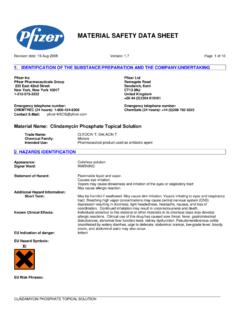
1 1. IDENTIFICATION OF THE SUBSTANCE/PREPARATION AND THE COMPANY/UNDERTAKINGM aterial Name: Bupivacaine Hydrochloride (Anhydrous) for InjectionTrade Name:Bupivacaine InjectionChemical Family:Not determinedIntended Use:Pharmaceutical product used as anesthetic agent2. HAZARDS IDENTIFICATIONA ppearance:Clear, colorless solutionSignal Word:WARNINGS tatement of Hazard:Harmful if Hazard Information:Short Term:May cause mild eye irritation. May cause slight skin irritation. (based on components) .Anesthetic drug: may cause central nervous system and cardiovascular systemKnown Clinical Effects:Adverse effects associated with therapeutic use include dizziness, nervousness, agitation,drowsiness, apprehension, euphoria, blurred/double vision, slurred speech, tremors,convulsions, and seizure.
2 Respiratory depression and arrest may follow. Other, more seriouseffects seen with IV use of this drug, particularly when it is administered rapidly, arecardiovascular collapse, central nervous system depression, and/or ClassificationEU Indication of danger:HarmfulEU Hazard Symbols:EU Risk Phrases:R22 - Harmful if Hazard Classification(NOHSC):Hazardous Substance. Non-Dangerous LtdRamsgate RoadSandwich, KentCT13 9 NJUnited Kingdom+00 44 (0)1304 616161 Emergency telephone number:CHEMTREC (24 hours): 1-800-424-9300 Revision date: 02-Aug-2012 Emergency telephone number:International CHEMTREC (24 hours): +1-703-527-3887 Contact MATERIAL SAFETY data SHEETPage 1 of 6 Pfizer IncPfizer Pharmaceuticals Group 235 East 42nd StreetNew York, New York 100171-212-573-2222 MATERIAL SAFETY data SHEET_____2.
3 HAZARDS IDENTIFICATIONNote:This document has been prepared in accordance with standards for workplace SAFETY , whichrequire the inclusion of all known hazards of the active substance or its intermediatesregardless of the potential risk. The precautionary statements and warnings included may notapply in all cases. Your needs may vary depending upon the potential for exposure in COMPOSITION/INFORMATION ON INGREDIENTSH azardousIngredientCAS NumberEU EINECS/ELINCS List EU Classification%Sodium chloride7647-14-5231-598-3 Not Listed*Bupivacaine Hydrochloride14252-80-3 Not ListedT; NumberEU EINECS/ELINCS List EU Classification%Water for injection7732-18-5231-791-2 Not Listed*Additional Information:* ProprietaryIngredient(s) indicated as hazardous have been assessed under standards for the full text of the R phrases mentioned in this Section, see Section 164.
4 FIRST AID MEASURESEye Contact:Flush with water while holding eyelids open for at least 15 minutes. Seek medical Contact:Remove contaminated clothing. Flush area with large amounts of water. Use soap. Seekmedical :Never give anything by mouth to an unconscious person. Wash out mouth with water. Do notinduce vomiting unless directed by medical personnel. Seek medical attention :Remove to fresh air and keep patient at rest. Seek medical attention and Effects of Exposure:For information on potential signs and symptoms of exposure, See Section 2 - HazardsIdentification and/or Section 11 - Toxicological FIRE FIGHTING MEASURESE xtinguishing Media:Use carbon dioxide, dry chemical, or water Combustion Products:Formation of toxic gases is possible during heating or Fighting Procedures:During all fire fighting activities, wear appropriate protective equipment, including self-contained breathing / Explosion Hazards:Not date: 02-Aug-2012 MATERIAL Name.
5 Bupivacaine Hydrochloride (Anhydrous) forInjectionVersion: 2 of 6 MATERIAL SAFETY data SHEET_____6. ACCIDENTAL RELEASE MEASURESH ealth and SAFETY Precautions:Personnel involved in clean-up should wear appropriate personal protective equipment (seeSection 8). Minimize for Cleaning / Collecting:Contain the source of spill if it is safe to do so. Collect spill with absorbent MATERIAL . Clean spillarea for EnvironmentalProtections:Place waste in an appropriately labeled, sealed container for disposal. Care should be taken toavoid environmental Consideration for LargeSpills:Contain the source of the spill or leak if it is safe to do so.
6 Collect spill with a non-combustibleabsorbent MATERIAL and transfer to labeled container for HANDLING AND STORAGEG eneral Handling:Avoid breathing vapor or mist. Avoid contact with eyes, skin and clothing. When handling, useappropriate personal protective equipment (see Section 8). Wash thoroughly after to the environment should be avoided. Review and implement appropriate technicaland procedural waste water and waste disposal measures to prevent occupational exposure orenvironmental releases. Potential points of process emissions of this MATERIAL to theatmosphere should be controlled with dust collectors, HEPA filtration systems or otherequivalent Conditions:Store as directed by product EXPOSURE CONTROLS / PERSONAL PROTECTIONR efer to available public information for specific member state Occupational Exposure Controls:Engineering controls should be used as the primary means to control exposures.
7 Generalroom ventilation is adequate unless the process generates dust, mist or fumes. Keep airbornecontamination levels below the exposure limits listed above in this Exposure Controls:Refer to specific Member State legislation for requirements under Community Protective Equipment:Refer to applicable national standards and regulations in the selection and use of personalprotective equipment (PPE).Hands:Impervious gloves are recommended if skin contact with drug product is possible and for bulkprocessing :Wear SAFETY glasses or goggles if eye contact is :Impervious protective clothing is recommended if skin contact with drug product is possible andfor bulk processing protection:If airborne exposures are within or exceed the Occupational Exposure Band (OEB) range, wearan appropriate respirator with a protection factor sufficient to control exposures to the bottom ofthe OEB : HydrochloridePage 3 of 6 Pfizer Occupational ExposureBand (OEB).
8 OEB 3 (control exposure to the range of 10ug/m3 to < 100ug/m3)Sodium chlorideLatvia OEL - TWA5 mg/m3 Revision date: 02-Aug-2012 MATERIAL Name: Bupivacaine Hydrochloride (Anhydrous) forInjectionLithuania OEL - TWA5 mg/m3 MATERIAL SAFETY data SHEET_____9. PHYSICAL AND CHEMICAL PROPERTIES10. STABILITY AND REACTIVITYC hemical Stability:Stable under normal conditions of to Avoid:Fine particles (such as dust and mists) may fuel Materials:As a precautionary measure, keep away from strong oxidizers11. TOXICOLOGICAL INFORMATIONG eneral Information:There are no data for this formulation.
9 The information included in this section describes thepotential hazards of the individual Toxicity: (Species, Route, End Point, Dose)Irritation / Sensitization: (Study Type, Species, Severity)Repeated Dose Toxicity: (Duration, Species, Route, Dose, End Point, Target Organ)Reproduction & Developmental Toxicity: (Study Type, Species, Route, Dose, End Point, Effect(s))Carcinogen Status:None of the components of this formulation are listed as a carcinogen by IARC, NTP or ECOLOGICAL INFORMATIONE nvironmental Overview:Environmental properties have not been thoroughly investigated.
10 Releases to the environmentshould be : chlorideEye Irritation Rabbit ModerateMolecular Weight:Skin Irritation Rabbit MildMixtureRat Oral LD50 3000 mg/kgPage 4 of 6 Mouse Oral LD50 4000 mg/kgBupivacaine HydrochloridePrenatal & Postnatal Development Intravenous mg/kg LOAEL Neonatal toxicityBupivacaine HydrochloridePhysical State:Rabbit Oral LD50 18 mg/kgSolutionRevision date: 02-Aug-2012 Rat Para-periosteal LD50 6 mg/kgColor:Rat Subcutaneous LD50 43 mg/kgClear, colorlessMaterial Name: Bupivacaine Hydrochloride (Anhydrous) forInjectionMouse Intravenous LD50 mg/kgMolecular Formula:MixtureSodium chloride MATERIAL SAFETY data SHEET_____13.