Transcription of MATERIAL SAFETY DATA SHEET - Spill Kit
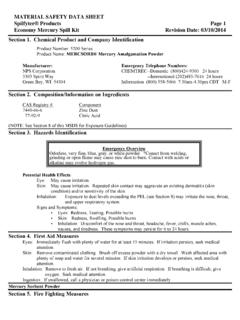
1 MATERIAL SAFETY data SHEET Page 1 of 4 SECTION 1: PRODUCT AND COMPANY IDENTIFICATION PRODUCT TRADE NAME Floor Dry , solid -A-Sorb , Celatom MP grades MANUFACTURER EP Minerals, LLC., 9875 Gateway Dr., Suite 1000, Reno, NV 89521 TELEPHONE NO. (775) 824 7600 (Monday Friday 8:00 am PST 5:00 pm PST) CHEMICAL NAME Diatomaceous Earth, Calcined CHEMICAL FAMILY Silica MATERIAL USE Industrial Absorbent DATE OF PREPARATION April 1, 2010 SECTION 2: HAZARDS IDENTIFICATION EMERGENCY OVERVIEW: Appearance//Color/Odor A buff to off-white, low density granular product. There is no distinctive odor. OSHA REGULATORY STATUS This MATERIAL is considered hazardous by the OSHA Hazard Communication Standard (29 CFR ) POTENTIAL HEALTH EFFECTS See below and Section 11 for additional information Likely Routes of Exposure See below EYE May cause irritation (tear formation and redness) if dust gets in eyes.
2 SKIN Not absorbed by the skin, but may cause dryness if prolonged exposure. INGESTION Ingestion of small to moderate quantities is not considered harmful, but may cause irritation of the mouth, throat and stomach. INHALATION Acute inhalation can cause dryness of the nasal passage and lung congestion, coughing and general throat irritation. Chronic inhalation of dust should be avoided. CHRONIC EFFECTS Chronic inhalation of crystalline silica dust in excess of the Threshold Limit Value (TLV) recommended by the American Conference of Governmental Industrial Hygienists (ACGIH)(.025mg/m ) or in excess of the Permissible Exposure Limit (PEL) established by OSHA ( ), over a prolonged number of years may contribute to silicosis. Crystalline silica, when inhaled as respirable dust, has been classified in a 1997 monograph (Volume 68, Silica ) of the International Agency for Research on Cancer (IARC) as carcinogenic to humans over prolonged and sustained exposure.
3 CONDITIONS AGGRAVATED BY EXPOSURE Pre-existing diseases of the upper respiratory tract and lung such as bronchitis, emphysema, and asthma. ENVIRONMENTAL EFFECTS There are no significant environmental effects. SECTION 3: COMPOSITION / INFORMATION ON INGREDIENTS INGREDIENT IDENTIFICATION APPROXIMATE CONCENTRATION (%) NUMBERS EINECS R Factors Diatomaceous Earth, Calcined (kieselguhr) Crystalline Silica (Cristobalite) Crystalline Silica (Quartz) 100% < 1% < 1% 91053-39-3 14464-46-1 14808-60-7 293-303-4 238-455-4 238-78-4 R48/20 R48/20 SECTION 4: FIRST AID MEASURES EYE Flush eyes with generous quantities of water or eye rinse solution. Consult physician if irritation persists. SKIN Use moisture renewing lotions if dryness occurs. INGESTION Drink generous amounts of water to reduce bulk and drying effects. INHALATION Remove to fresh air.
4 Blow nose to evacuate dust. NOTE TO PHYSICIANS No special notes. ANTIDOTE Not applicable MATERIAL NAME Floor Dry , solid -A-Sorb , Celatom MP grades Page 2 of 4 SECTION 5: FIRE FIGHTING MEASURES FLAMMABILITY This MATERIAL is not flammable. EXTINGUISHING MEDIA Not applicable, the MATERIAL is not flammable. FIRE-FIGHTING PROCEDURES Not applicable, the MATERIAL is not flammable. PROTECTIVE EQUIPMENT Not applicable, the MATERIAL is not flammable HAZARDOUS COMBUSTION PRODUCTS Not applicable, the MATERIAL does not combust. SPECIFIC PHYSICAL AND CHEMICAL HAZARDS Not applicable, the MATERIAL is not flammable. EXPLOSION data Not applicable, the MATERIAL is not explosive. SECTION 6: ACCIDENTAL RELEASE MEASURES PERSONAL PRECAUTIONS If dust is present, use respirator fitted with particulate filter as specified in Section 8. Protect eyes with goggles.
5 ENVIRONMENTAL PRECAUTIONS This MATERIAL is not a significant environmental concern. CONTAINMENT AND CLEANUP Vacuum clean spillage, wet sweep or wash away. Avoid creating dust. SECTION 7: HANDLING AND STORAGE HANDLING Minimize dust generation. Avoid contact with eyes. Avoid breathing dust. Repair or dispose of broken bags. STORAGE Store in a dry place to maintain packaging integrity and product quality. Do not store near hydrofluoric acid. Observe all label precautions and warnings. SECTION 8: EXPOSURE CONTROLS / PERSONAL PROTECTION EXPOSURE GUIDELINES: Component OSHA PEL ACGIH TLV MSHA PEL NIOSH REL Diatomaceous Earth, Calcined (kieselguhr) Crystalline Silica (Quartz) Crystalline Silica (Cristobalite) See below mg/m3 mg/m3 See below mg/m3 mg/m3 See below 10/(% respirable crystalline silica +2) *10/(% respirable crystalline silica +2) See below mg/m3 mg/m3 ENGINEERING CONTROLS Local Control dust within recommended TLV/PEL.
6 Refer to ACGIH publication Industrial Ventilation or similar publications for design of ventilation systems. PERSONAL PROTECTIVE EQUIPMENT: See below EYE / FACE Goggles to protect from dust SKIN No special equipment is needed. RESPIRATORY Respirators fitted with filters certified to standard 42 CFR84 under series N95 should be worn when dust is present. If the dust concentration is less than ten (10) times the Permissible Exposure Limit (PEL) use a quarter or half-mask respirator with a N95 dust filter or a single use dust mask rated N95. If dust concentration is greater than ten (10) times and less than fifty (50) times the PEL, a full-face piece respirator fitted with replaceable N95 filters is recommended. If dust concentration is greater than fifty (50) and less than two hundred (200) times the PEL use a power air-purifying (positive pressure) respirator with a replaceable N95 filter.
7 If dust concentration is greater than two hundred (200) times the PEL use a type C, supplied air respirator (continuous flow, positive pressure), with full face piece, hood or helmet. GENERAL HYGIENE Avoid breathing dust. Avoid contact with eyes. Wash hands after handling and before eating or drinking. For sampling silica dusts refer to NIOSH Analytical Method 7500 or OSHA method ID 142 MATERIAL NAME Floor Dry , solid -A-Sorb , Celatom MP grades Page 3 of 4 SECTION 9: PHYSICAL AND CHEMICAL PROPERTIES APPEARANCE, COLOR Buff to off white granules ODOR Odorless PHYSICAL STATE solid pH (10% SUSPENSION) 7 VAPOR PRESSURE Not applicable VAPOR DENSITY Not applicable BOILING POINT Not applicable MELTING POINT > 1300 oC FLASH POINT Not applicable FLAMMABILITY Not applicable FLAMMABILITY LIMITS Not applicable AUTOIGNITION TEMPERATURE Not applicable DECOMPOSITION TEMPERATURE > 1300 oC SPEC.
8 GRAVITY / REL. DENSITY EVAPORATION RATE Not applicable COEFF. WATER / OIL Not applicable ODOR THRESHOLD Not applicable SOLUBILITY WATER < 1% PARTITION COEFFICIENT Not applicable SECTION 10: STABILITY AND REACTIVITY CHEMICAL STABILITY MATERIAL is stable. PHYSICAL HAZARDS MATERIAL is not reactive. CONDITIONS TO AVOID Not applicable INCOMPATIBLE MATERIALS Hydrofluoric acid. Products containing silica may react violently with hydrofluoric acid. HAZARDOUS DECOMPOSITION PRODUCTS Not applicable SECTION 11: TOXICOLOGICAL INFORMATION CHRONIC EFFECTS / CARCINOGENICITY This granular product can contain respirable dust, composed primarily of amorphous silica but possibly with a small fraction of crystalline silica. Amorphous silica is not classifiable as carcinogenic to humans. Crystalline silica, when inhaled as respirable dust, has been classified as carcinogenic to humans over prolonged and sustained exposure.
9 Long-term inhalation of respirable crystalline silica may contribute to the respiratory disease silicosis , a non-cancerous lung disease. In a 1997 monograph (Volume 68, Silica ), the International Agency for Research on Cancer (IARC) concluded that overall the epidemiological findings support increased risk of lung cancer from inhaled crystalline silica resulting from occupational exposure (classified in Group 1), while there was inadequate evidence in humans for the carcinogenicity of amorphous silica (classified in Group 3). ROUTE OF EXPOSURE Inhalation (chronic) SYMPTOMS Not available LD50 Not available IMMEDIATE AND DELAYED EFFECTS No immediate effects. See CHRONIC EFFECTS for potential long-term effects when prolonged exposure to levels of crystalline silica in excess of OSHA PEL and ACGIH TLV. CORROSIVENESS, SENSITIZATION, IRRITANCY Not applicable REPRODUCTIVE TOXICITY Not available TERATOGENICITY, MUTAGENICITY Not available TOXICOLOGICALLY SYNERGISTIC PRODUCTS Inhaled smoke from tobacco products (chronic).
10 SECTION 12: ECOLOGICAL INFORMATION CHARACTERISTICS Non-biodegradable, inert, with little potential for bioaccumulation. POSSIBLE EFFECTS Diatomaceous earth products have shown some efficacy as a natural insecticide, but otherwise have no demonstrated toxicity in regards to aquatic or terrestrial life. MATERIAL NAME Floor Dry , solid -A-Sorb , Celatom MP grades Page 4 of 4 SECTION 13: DISPOSAL CONSIDERATIONS WASTE DISPOSAL If this MATERIAL as supplied becomes a waste, use solid waste disposal common to landfill type operations or in slurry to sumps. Not considered a hazardous waste under RCRA (4 OCFR Part 261). PACKAGING DISPOSAL Dispose of in accordance with applicable laws and regulations, typically solid waste disposal common to landfill type operations. SECTION 14: TRANSPORT INFORMATION BASIC SHIPPING INFORMATION DOT shipping classification 55 (no restrictions).