Transcription of MATERIAL SAFETY DATA SHEET Syngenta Crop …
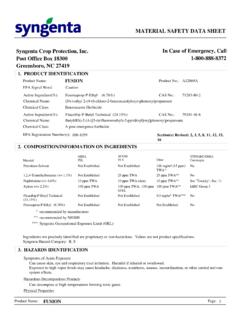
1 MATERIAL SAFETY data SHEET 1. PRODUCT IDENTIFICATION 2. COMPOSITION/INFORMATION ON INGREDIENTS 3. HAZARDS IDENTIFICATIONP roduct No.: A11815 BEPA Signal Word:CautionSymptoms of Acute ExposureIrritating to Decomposition ProductsCan decompose at high temperatures forming toxic PropertiesAppearance:Grey to brown granulesOdor:PhenolicProduct Name:RAVE EPA Registration Number(s):100-927 Ingredients not precisely identified are proprietary or non-hazardous. Values are not product specifications. Syngenta Hazard Category: B, SSection(s) Revised: 1 Syngenta Crop Protection, Office Box 18300In Case of Emergency, Call1-800-888-8372 Greensboro, NC 27419 CAS No.:1982-69-0 Chemical Name:3,6-dichloro-o-anisic acidChemical Class:Substituted Benzoic Acid HerbicideActive Ingredient(%):Dicamba (Sodium Salt) ( )CAS No.
2 :82097-50-5 Chemical Name:3-(6-methoxy-4-methyl-1,3,5-triazin -2-yl)-1-[2-(2-chloroethoxy)phenylsulfon yl]-ureaChemical Class:Sulfonylurea HerbicideActive Ingredient(%):Triasulfuron ( )MaterialNTP/IARC/OSHA CarcinogenOtherOSHAPELACGIHTLVIARC Group 3 Amorphous Silica 80 mg/m /%SiO2 TWA (total dust)10 mg/m TWA (inhalable dust)Not EstablishedNoStabilizer 15 mg/m particulates not otherwise regulated (total particulates); 5 mg/m (respirable)10 mg/m particulates not otherwise classified (inhalable); 3 mg/m (respirable)Not EstablishedNoCorn Starch 15 mg/m (total) TWA; 5 mg/m (respirable) TWA10 mg/m TWA10 mg/m (total) TWA; 5 mg/m (respirable) TWA**NoTriasulfuron ( )Not EstablishedNot Established3 mg/m TWA**NoDicamba (Sodium Salt) ( )Not EstablishedNot EstablishedNot Established**recommended by NIOSH** Syngenta Occupational Exposure Limit (OEL)Page:1 Product Name: RAVE Upper: % Not ApplicableLower: % Not Applicable 4.
3 FIRST AID MEASURES 5. FIRE FIGHTING MEASURESU nusual Fire, Explosion and Reactivity HazardsDuring a fire, irritating and possibly toxic gases may be generated by thermal decomposition or the product container, label or MATERIAL SAFETY data SHEET with you when calling Syngenta (800-888-8372), a poison contol center or doctor, or going for swallowed: Call Syngenta (800-888-8372), a poison control center or doctor immediately for treatment advice. Have the person sip a glass of water if able to swallow. Do not induce vomiting unless told to do so after calling 800-888-8372 or by a poison control center or doctor. Do not give anything by mouth to an unconscious in eyes: Hold eye open and rinse slowly and gently with water for 15-20 minutes.
4 Remove contact lenses, if present, after 5 minutes, then continue rinsing eye. Call Syngenta (800-888-8372), a poison control center or doctor for treatment on skin or clothing: Take off contaminated clothing. Rinse skin immediately with plenty of water for 15-20 minutes. Call Syngenta (800-888-8372), a poison control center or doctor for treatment inhaled: Move person to fresh air. If person is not breathing, call 911 or an ambulance, then give artificial respiration, preferably mouth-to-mouth if possible. Call Syngenta (800-888-8372), a poison control center or doctor for further treatment to PhysicianMedical Condition Likely to be Aggravated by ExposureNone and ExplosionUnusual Fire, Explosion and Reactivity HazardsDuring a fire, irritating and possibly toxic gases may be generated by thermal decomposition or Case of FireUse dry chemical, foam or CO2 extinguishing media.
5 Wear full protective clothing and self-contained breathing apparatus. Evacuate nonessential personnel from the area to prevent human exposure to fire, smoke, fumes or products of combustion. Prevent use of contaminated buildings, area, and equipment until decontaminated. Water runoff can cause environmental damage. If water is used to fight fire, dike and collect :Not FlammableNot Applicable Not AvailableFlash Point (Test Method):Flammable Limits (% in Air):Autoignition Temperature:Ingestion:Eye Contact:Skin Contact:Inhalation: 6. ACCIDENTAL RELEASE MEASURES 7. HANDLING AND STORAGEIn Case of Spill or LeakStore the MATERIAL in a well-ventilated, secure area out of reach of children and domestic animals.
6 Do not store food, beverages or tobacco products in the storage area. Prevent eating, drinking, tobacco use, and cosmetic application in areas where there is a potential for exposure to the MATERIAL . Wash thoroughly with soap and water after the spill at its source. Contain the spill to prevent from spreading or contaminating soil or from entering sewage and drainage systems or any body of water. Clean up spills immediately, observing precautions outlined in Section 8. Sweep up MATERIAL and place in a compatible disposal container. Scrub area with hard water detergent ( commercial products such as Tide, Joy, Spic and Span). Pick up wash liquid with additional absorbent and place into compatible disposal container.
7 Once all MATERIAL is cleaned up and placed in a disposal container, seal container and arrange for is no specific antidote if this product is symptomatically. 8. EXPOSURE CONTROLS/PERSONAL PROTECTIONPage:2 Product Name: RAVE 11. TOXICOLOGICAL INFORMATIONA cute Toxicity/Irritation Studies (Finished Product)Reproductive/Developmental EffectsIngestion:Dermal:Inhalation:Eye Contact:Skin Contact:Skin Sensitization:Slightly ToxicSlightly ToxicPractically Non-ToxicOral (LD50 Rat) : Moderately Irritating (Rabbit)Non-Irritating (Rabbit)Not a Sensitizer (Guinea Pig)Dermal (LD50 Rabbit) : Inhalation (LC50 Rat) : 4,541 mg/kg body weight> 2,000 mg/kg body weight> mg/l air - 4 hours 9. PHYSICAL AND CHEMICAL PROPERTIESGrey to brown granulesPhenolic 10.
8 STABILITY AND REACTIVITYS tability:Stable under normal use and storage Polymerization:Will not to Avoid:None decompose at high temperatures forming toxic Point:Boiling Point:Specific Gravity/Density:Not AvailableNot g/cm Appearance:Odor: (1% suspension in water)Solubility in H2 OVapor PressurePrevent eating, drinking, tobacco usage and cosmetic application in areas where there is a potential for exposure to the MATERIAL . Wash thoroughly with soap and water after eye contact is likely, use chemical splash goggles. Facilities storing or utilizing this MATERIAL should be equipped with an eyewash facility and a SAFETY contact is likely, wear chemical-resistant (such as nitrile or butyl) gloves, coveralls, socks and chemical-resistant footwear.
9 For overhead exposure, wear chemical-resistant respirator is not normally required when handling this substance. Use effective engineering controls to comply with occupational exposure case of emergency spills, use a NIOSH approved respirator with any N, R, or P or HE :Eye Contact:Skin Contact:Inhalation:THE FOLLOWING RECOMMENDATIONS FOR EXPOSURE CONTROLS/PERSONAL PROTECTION ARE INTENDED FOR THE MANUFACTURE, FORMULATION, PACKAGING AND USE OF THIS PRODUCT. FOR COMMERCIAL APPLICATIONS AND/OR ON-FARM APPLICATIONS CONSULT THE PRODUCT Decomposition Products:Materials to Avoid:None (Sodium Salt):None g/l @ 77 F (25 C)Dicamba (Sodium Salt): 815 mg/l @ 77 F (25 C)Triasulfuron: Dicamba (Sodium Salt): Not AvailableTriasulfuron: < x 10(-8) mmHg @ 77 F (25 C)Page:3 Product Name: RAVE 12.
10 ECOLOGICAL INFORMATIONC hronic/Subchronic Toxicity StudiesCarcinogenicityToxicity of Other ComponentsSummary of EffectsEco-Acute Toxicity Target OrgansOther Toxicity InformationNoneActive IngredientsInert IngredientsEco-Chronic ToxicityTriasulfuron:None (Sodium Salt):None :Liver, kidney, spleen and blood (Sodium Salt):None :None Silica is listed as an IARC (Group 3) carcinogen not classifiable as a human carcinogen (No data Available) with limited animal evidence. Prolonged exposure to amorphous silica may cause damage to respiratory system and irritation to skin and Silica May cause eye and skin irritation. May cause respiratory tract irritation. Low hazard for usual industrial handling.