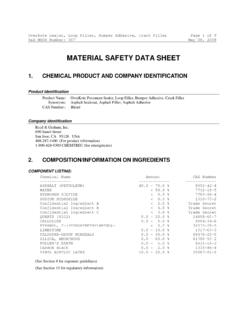
Transcription of Material Safety Data Sheet - Varouh Oil, Inc.
1 Material Safety data Sheet SECTION 1 PRODUCT AND COMPANY IDENTIFICATION Fire Resist ant Hydraulic Fluid Product Use: Hydraulic Fluid Fire Resistant Synonyms: FR W G 200D,W ater Glycol Hydraulic Company Identification Varouh Oil, Inc. 970 Griswold Road Elyria, Ohio 44035 United States of America Transportation Emergency Response CHEMTREC: (800) 424-9300 or (703) 527-3887 Health Emergency Varouh Oil, Inc. (440) 324-5025 Product Information email : Product Information: 440-324-5025 MSDS Requests: 440-324-5025 SECTION 2 COMPOSITION/ INFORMATION ON INGREDIENTS COMPONENTS CAS NUMBER AMOUNT Diethylene glycol 111-46-6 30 - 50 %weight Polyalkalene glycol Proprietary 5 - 13 %weight Diisopropylamino 96-80-0 0 - 3 %weight water 7732-18-5 35-45 %weight SECTION 3 HAZARDS IDENTIFICATION ** EMERGENCY OVERVIEW - MAY BE HARMFUL OR FATAL IF SW ALLOW ED - CAUSES EYE IRRITATION - MAY CAUSE DAMAGE TO: - LIVER - KIDNEY ** IMMEDIATE HEALTH EFFECTS Eye: Contact with the eyes causes irritation.
2 Symptoms may include pain, tearing, reddening, swelling and impaired vision. Skin: Contact with the skin is not expected to cause prolonged or significant irri tation. Contact with the skin is not expected to cause an allergic skin response. Not expected to be harmful to internal organs if absorbed through the skin. High-Pressure Equipment Information: Accidental high-velocity injection under the skin of materials of this type may result in serious injury. Seek medical attention at once should an accident like this occur. The initial wound at the injection site may not appear to be serious at first; but, if left untreated, could result in disfigurement or amputation of the affected part. Ingestion: Toxic; may be harmful or fatal if swallowed. Inhalation: Not expected to be harmful if inhaled. If this Material is heated, fumes may be unpleasant and produce nausea and irri tation of the eye and upper respiratory tract.
3 DELAYED OR OTHER HEALTH EFFECTS: Target Organs: Contains Material that may cause damage to the following organ(s) follo wing repeated ingestion based on animal data : Kidney Liver See Section 11 for additional information. Risk depends on duration and level of exposure. SECTION 4 FIRST AID MEASURES Eye: Flush eyes with water immediately while holding the eyelids open. Remove contact lenses, if worn, after initial flushing, and continue flushing for at least 15 minutes. Get medical att ention if irri tation persists. Skin: No specific first aid measures are required. As a precaution, remove clothing and shoes if contaminated. To remove the Material from skin, use soap and water . Discard contaminated clothing and shoes or thoroughly clean before reuse. Ingestion: If swallowed, get immediate medical att ention. Do not induce vomiting.
4 Never give anything by mouth to an unconscious person. Inhalation: Move the exposed person to fresh air. If not breathing, give artificial respiration. If breathing is diffi cult, give oxygen. Get medical attention if breathing diffi culties continue. Note to Physicians: In an accident involving high-pressure equipment, this product may be injected under the skin. Such an accident may result in a small, sometimes bloodless, puncture wound. However, because of its driving force, Material injected into a fingertip can be deposited into the palm of the hand. Within 24 hours, there is usually a great deal of swelling, discoloration, and intense throbbing pain. Immediate treatment at a surgical emergency center is recommended. SECTION 5 FIRE FIGHTING MEASURES FIRE CLASSIFICATION: OSHA Classification (29 CFR ): Not classified by OSHA as flammable or combustible.
5 NFPA RATINGS: Health: 1 Flammability: 0 Reactivity: 0 FLAMMABLE PROPERTIES: Flashpoint: Not Applic able Autoignition: No data Availa ble Flammability (Explosive) Limits (% by volume in air): Lower: No data available Upper: No data available PROTECTION OF FIRE FIGHTERS: Fire Fighting Instructions: This Material will not burn. SECTION 6 ACCIDENTAL RELEASE MEASURES Spill Management: Stop the source of the release if you can do it without risk. Contain release to prevent further contamination of soil, surface water or groundwater. Clean up spill as soon as possible, observing precautions in Exposure Controls/Personal Protection. Use appropriate techniques such as applying non-combustible absorbent materials or pumping. Where feasible and appropriate, remove contaminated soil. Place contaminated materials in disposable containe rs and dispose of in a manner consistent with applic able regulations.
6 Reporting: Report spills to local authorities and/or the Coast Guard's National Response Center at (800) 424-8802 as appropriate or required. SECTION 7 HANDLING AND STORAGE Precautionary Measures: Avoid extreme temperatures. Operating temperatures should be maintained as low as possible and should not exceed 66C (150F). Loss of water through evaporation during use can reduce Safety and performance effi ciency. To ensure fire resistance, water content must be maintained above 35%. Do not breathe vapor or fumes from heated Material . Do not taste or swallow. W ash thoroughly after handling. Do not get in eyes. Static Hazard: Electrostatic charge may accumulate and create a hazardous condition when handling this Material . To minimize this hazard, bonding and grounding may be necessary but may not, by themselves, be sufficient.
7 Review all operations which have the potential of generating and accumulating an electrostatic charge and/or a flammable atmosphere (including tank and container fillin g, splash filling, tank cleaning, samplin g, gauging, switch loading, filtering, mixing, agitation, and vacuum truck operations) and use appropriate mitigating procedures. For more information, refer to OSHA Standard 29 CFR , 'Flammable and Combustible Liquids', National Fire Protection Association (NFPA 77, 'Recommended Practice on Static Electricity', and/or the American Petroleum Institute (API) Recommended Practice 2003, 'Protection Against Ignitions Arising Out of Static, Lightning, and Stray Currents'. Container Warnings: Container is not designed to contain pressure. Do not use pressure to empty container or it may rupture with explosive force. Empty containers retain product residue (solid, liquid, and/or vapor) and can be dangerous.)
8 Do not pressurize, cut, weld, braze, solder, drill, grind, or expose such containers to heat, flame, sparks, stat ic electricity, or other sources of ignition. They may explode and cause injury or death. Empty containers should be completely drained, properly closed, and promptly returned to a drum reconditioner or disposed of properly. SECTION 8 EXPOSURE CONTROLS/PERSONAL PROTECTION GENERAL CONSIDERATIONS: Consider the potential hazards of this Material (see Section 3), applicable exposure limits, job activities, and other substances in the work place when designing engineering controls and selecting personal protective equipment. If engineering controls or work practices are not adequate to prevent exposure to harmful levels of this Material , the personal protective equipment lis ted below is recommended. The user should read and understand all instructions and limitat ions supplied with the equipment since protection is usually provided for a limited time or under certain circumstances.
9 ENGINEERING CONTROLS: Use in a well- ventilated area. Use process enclosures, local exhaust ventilation, or other engineering controls to control airborne levels below the recommended exposure limits. PERSONAL PROTECTIVE EQUIPMENT Eye/Face Prot ection: W ear protective equipment to prevent eye contact. Selection of protective equipment may include Safety glasses, chemical goggles, face shields, or a combination depending on the work operations conducted. Skin Protection: No special protective clothing is normally required. W here splashing is possible, select protective clothing depending on operations conducted, physical requirements and other substances in the workplace. Suggested materials for protective gloves include: Butyl, Polyvinyl Chloride (PVC or Vinyl). Respiratory Protection: No respiratory protection is normally required.
10 Determine if airborne concentrations are below the recommended occupational exposure limits for jurisdiction of use. If airborne concentrations are above the acceptable limits, wear an approved respirator that provides adequate protection from this Material , such as: Air-Purifying Respirator for Organic Vapors, Dusts and Mists. If user operations generate harmful levels of airborne Material that is not adequately controlled by ventilation, wear an approved respirator that provides adequate protection. Use the following respirators: Use a positive pressure air-supplying respirator in circumstances where air-purifying respirators may not provide adequate protection. Occupational Exposure Limits: Component Agency TWA STEL Ceiling Notation SECTION 9 PHYSICAL AND CHEMICAL PROPERTIES Attention: the data below are typical values and do not constitute a specification.