Transcription of MATERIALS SCIENCE PREPARATION FOR …
1 MATERIALS SCIENCE PREPARATION FOR FUNDAMENTALS OF ENGINEERING EXAMPROFESSOR MIKE RIGSBEEMATERIALS SCIENCE AND SOLUTIONS TO MATERIALS ENGINEERING PRACTICE PROBLEMS TYPICAL OF THOSE ON THE FUNDAMENTALS OF ENGINEERING AND DISCUSS MATERIALS ENGINEERING MATERIALS IN THE FUNDAMENTALS OF ENGINEERING SUPPLIED-REFERNCE HANDBOOK, 8 THEDITIONSTRUCTURES OF MATERIALSM aterials are composed of atoms, which are bonded together by:-metallic bonds (for metals like gold or aluminum)-covalent bonds (for ceramic MATERIALS like silicon or diamond)-ionic bonds (for ceramic MATERIALS like sodium chloride, NaCl)Polymers are special in that they consist of chains of atoms with strong covalent bonds between carbon atoms along the chain and weak vanderWaals bonds between the chains (thermoplastics) or strong covalent bonds between chains (thermoset palstics) MATERIALS may be crystalline(all metals, most ceramics) where the atoms are arranged in a regular, periodic, 3-dimensional array or amorphous(not crystalline: most polymers, some ceramics like glass) where the atomic arrangement is not regular and periodicSTRUCTURES OF MATERIALSCRYSATALLINEAMORPHOUSSTRUCTURES OF MATERIALS1.
2 Amorphous MATERIALS like glass:(a) are composed of a single element.(b) have no apparent crystal structures.(c) are electrically conductive.(d) are composed of large rectangular OF MATERIALS2. Interatomic distances in crystals can be determined by:(a) nuclear magnetic resonance.(b) x-ray diffraction.(c) chemical analysis.(d) tensile OF has an atomic weight of This is not a whole number primarily because of the:(a) presence of chemical impurities(b) nuclear binding energy(c) mixture of isotopes(d) mass of orbital electronsSTRUCTURES OF of the following MATERIALS has ionic bonds?(a) Sodium fluoride(b) Iron(c) Carbon (diamond)(d) Silicon crystalCORROSIONEMF SERIES: STANDARD OXIDATION POTENTIALS FOR CORROSION REACTIONSANODIC = OXIDATIONREACTION (DISSOLUTION)CATHODIC = an aluminum crimp connector were used to connect a copper wire to a battery, what would you expect to happen?
3 (a) The copper wire only will corrode(b) The aluminum connector only will corrode(c) Both will corrode(d) the zinc coating on galvanized steel is scratched and the steel below it exposed to a corrosive environment, the steel is not attacked. Which of the following mechanisms is responsible for this?(a) The Zn coating acts as an inhibitor.(b) The Zn coating acts as the cathode and provides anodic protection.(c) The Zn coating acts as a sacrificial anode and provides cathodic protection.(d) The steel becomes activation energy, Q, for Al in a Cu solvent at 575oC is x 108J/kmol. What is the diffusion coefficient, D, if the constant of proportionality, D0, is 7 x 10⁻⁶m2/s?(a) x 10-47m2/s (b) x 10-20m2/s (c) x 10-16m2/s (d) x 10-5m2/s Hints-Convert temperature from degrees Centigrade to degrees Kelvin (add 273)-Convert activation energy from J/kmole to J/moleDIFFUSIONMECHANICAL PROPERTIESMECHANICAL PROPERTIESI mportant terminology for engineering stress-strain TENSILE strain3.
4 Elastic versus plastic of point and offset yield s (not directly from stress-strain diagram but related)MECHANICAL primary factor in determining if sheet metal can be bent and formed without experiencing stress fractures and other undesirable effects is:(a) modulus of electricity (should be elasticity)(b) martensitic structure(c) ductility(d) surface hardnessMECHANICAL PROPERTIES9. A metal with high hardness will generally have (a) high yield strength.(b) high ductility.(c) good formability.(d) high impact PROPERTIES10. The mechanical deformation of a material at a temperature above its recrystallization temperature is called: (a) hot working.(b) grain growth.(c) cold working.(d) strain to a cold-worked steel part, an equally deformed hot-worked steel part will have:(a) greater hardness(b) greater toughness(c) higher yield strength(d) less ductility MECHANICAL of the following properties describes martensite?
5 1. high hardness 2. formed by quenching austenite 3. high ductility(a) 2 only (b) 2 and 3 (c) 1 and 2 (d) 3 onlyMECHANICAL PROPERTIES13. Normally, numerical values of the engineering properties of MATERIALS , like the yield and tensile strengths are:(a) independent of the microstructure of the material .(b) based on many theoretical calculations.(c) dependent on the testing method and the prior processing of the material .(d) definite, fixed numbers for all MATERIALS of the same PROPERTIES14. Which of the following is not a property of a material ?(a) flexural rigidity(b) modulus of elasticity(c) Poisson s ratio(d) endurance limitMECHANICAL PROPERTIESQUESTIONS 15 20 APPLY TO THIS TENSILE TESTFIGUREMECHANICAL PROPERTIES15.
6 The relationship indicated by is directly related to a measure of the: (a) offset yield point.(b) modulus of elasticity.(c) Poisson ration.(d) shear PROPERTIES16. The modulus of elasticity in GPa for the above material is most nearly(A) 50 GPa (B) 100 GPa(C) 150 GPa (D) 200 GPaMECHANICAL PROPERTIES17. The test depicted above is called a (A) Compression test(B) Resilience testB) Toughness test(C) Tensile testMECHANICAL PROPERTIES18. The yield strength MPa at strain offset of .005 is most nearly(A) 300 MPa (B) 400 MPa (C) 500 MPa (D) 600 MPaMECHANICAL PROPERTIES19. The maximum load in Newtons that can be sustained by a cylindrical specimen whose diameter is mm is(A) 10,000 N(B) 60,000 N (C) 100,000 N (D) 140,000 NMECHANICAL PROPERTIES20.
7 If the length of the specimen before being stressed is 280 mm, its length in mm when stressed by 300 MPa is most nearly(A) 281 mm (B) 282 mm (C) 283 mm (D) 284 mmMECHANICAL PROPERTIES FRACTURE MECHANICSMECHANICAL PROPERTIES FRACTURE MECHANICS21. An alumina (ceramic) sample is loaded in tension. On the exterior of the sample is a mm deep sharp crack. What is the maximum stress that the sample can sustain without failure?(A) 25 MPa(B) 50 MPa(C) 75 MPa(D) 100 MPaSTEEL and Fe C PHASE DIAGRAM22. An Fe-C alloy with weight % carbon is austenitizedat 1000 C and very slowly cooledto 728 C. What is the amount (weight percent) of austenite present in the microstructure at 728 C?(A) 25(B) 40(C) 50(D) 100 steel and Fe C PHASE DIAGRAMSTEEL and Fe C PHASE DIAGRAMSTEEL and Fe C PHASE DIAGRAM22.
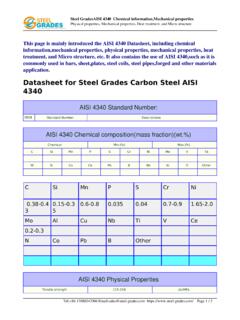
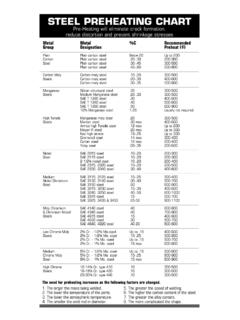
8 An Fe-C alloy with weight % carbon is austenitizedat 1000 C and very slowly cooledto 728 C. What is the amount (weight percent) of austenite present in the microstructure at 728 C?(A) 25(B) 40(C) 50(D) 100 steel ---HARDENABILITYH ardenability for steel is directly related to the formation of martensite, which is the hardest phase that steel can form. The more martensite, the harder the steel will be. The level of carbon in the steel determines the hardness of the martensite phase, so the higher the carbon level, the higher the maximum hardness of the steel will is formed by quenching, very rapidly cooling, a steel from a fully austenitic state (typically about 1000C) to room temperature, without the formation of a diffusional transformation phase like pearlite, which is actually composed of two phases ferrite and is measured using a standardized Jominy quench test, hence it is sometimes referred to as Jominy HardenabilitySTEEL treatable steels generally have high hardenabilities.
9 Comparing a 1040 steel with a 4340 steel , how much deeper can the 4340 steel be hardened to level of Rc of 50?(A) 60mm(B) 45mm (C) 30mm(D) 15mmSTEEL ---HARDENABILITYSTEEL treatable steels generally have high hardenabilities. Comparing a 1040 steel with a 4340 steel , how much deeper can the 4340 steel be hardened to level of Rc of 50?(A) 60mm(B) 45mm (C) 30mm(D) 15mmCOMPOSITE rod of composite material consisting of a magnesium matrix (80 volume fraction) and continuous carbon fibers (20 volume fraction) aligned along the rod length is pulled in tension. What is the elastic modulus of the rod?(A) 159 GPa (B) 176 GPa (C) 225 GPa (D) 310 GPaIMPACT Charpy Impact Test is very useful to determine:(A) the fracture behavior of a material at different temperatures(B) the creep properties of a material as the temperature increases(C) the variation of elastic modulus with increasing temperature(D) all of the abov