Transcription of Math for the Ham Radio Operator
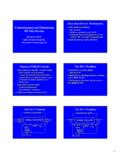
1 Math for the General Class Ham Radio OperatorA prerequisite math refresher for the math phobic hamWhat We Will CoverOhm s LawPower CircleWrite these down!What We Will CoverWrite these down!What We Will CoverHow to calculate RMS (root mean square) of an AC voltageRMS = .707 x PeakWrite this down!What We Will CoverPeak Voltage to RMSPeak-to-Peak Voltage to Peak VoltagePeak Envelope PowerWrite these down!What We Won t CoverPages 4-3 thru 4-5 Power Measurement in dBWhy? Only 1 math question on test dealing with dBYes, this is important, but will take too much class time, sorryTeach to the Test Section 5 = 3 questions out of 3 groups Section 5 = 3 groups, 1 from each group Section 5B = 1 test question out of 13 Not generally a good idea, but:Pages 11-42 thru 11-43 Math Vocabulary What are equations and formulas?
2 What do variables mean? What does solving an equation mean? Getting the final answer!Math Vocabulary What are equations and formulas? Equations are relationships between things that are exactly equivalent (have the same overall value). Two equivalent sets of things are shown equal by using the equal sign (=). The left side of the = has the same value as the right Vocabulary What do variables mean?It s all about the cheese!Math Vocabulary What do variables mean?50 x=If 50 cheese-heads can fit into 1 Vocabulary What do variables mean??=How many cheese-heads are there in 5 busses?Math Vocabulary What do variables mean?5 x 50=That s a lot of cheese-heads!
3 250 Math Vocabulary What do variables mean?E = Voltage (Volts)The electromotive force it takes to push electronsI = Current (Amps)The flow of electronsR = Resistance (Ohms)Opposition of a material to current flowMath Vocabulary What do variables mean?P = Power (Watts)The product of voltage and currentI = Current (Amps)The flow of electronsE = Voltage (Volts)The electromotive force it takes to push electronsMath Vocabulary Equations from Ohm s LawE = I x RI = E RR = E IMath Vocabulary Equations from Power CircleP = I x EI = P EE = P ILet s Put Them TogetherWhat is P if given I & R?You need E, so use Ohm s law, then you can solve for PPage 4-2 Let s Put Them TogetherWhat is P if given E & R?
4 You need I, so use Ohm s law, then you can solve for PPage 4-2G5B03P = ? E = 400 R = 800 Page 11-42 How many watts of electrical power are used if 400 VDC is supplied to an 800-ohm load?What do we want to find out and what do we know?G5B03P = ? E = 400 R = 800 You need I, so use Ohm s law, then you can solve for PPage 4-2 How many watts of electrical power are used if 400 VDC is supplied to an 800-ohm load?P = 200 WattsG5B04P = ? E = 12 I = .2 Page 4-1 How many watts of electrical power are used by a 12-VDC light bulb that draws amperes?We know that we want to solve for P (watts), we have 12 volts (E) and .2 amps (I)G5B04P = ? E = 12 I = .2 Page 11-42 How many watts of electrical power are used by a 12-VDC light bulb that draws amperes?
5 P = WattsP = I x EG5B05P = ? I = milliamps R = kilohmsPage 4-2 How many watts are being dissipated when a current of milliampers flow through kilohms?Let s first convert to amps and ohms!G5B05I = milliamps (mA)Page 4-2 How many watts are being dissipated when a current of milliampers flow through kilohms? ampstenthshundredthsthousandths1 amp = 1000 mAG5B05R = kilohmsPage 4-2 How many watts are being dissipated when a current of milliampers flow through kilohms?1250 ohmsKilo = 1,000 Meg = 1,000,000G5B05P = ? I = .007 amps R = 1,250 ohmsPage 4-2 How many watts are being dissipated when a current of milliampers flow through kilohms?Now we have converted our values, next we need E (volts)E =.
6 007 x 1250G5B05P = ? I = .007 amps R = 1,250 ohmsPage 4-2 How many watts are being dissipated when a current of milliampers flow through kilohms? volts = .007 x 1250P = x .007G5B05 Page 4-2 How many watts are being dissipated when a current of milliampers flow through kilohms? watts = x .007 Now, convert to milliwatts (1 watt = 1000 milliwatts) x 1000 = milliwattsG5B01 Page 11-42A two-times increase or decrease in power results in a change of how many dB?3 dB = twice the increase (or decrease) in power3 dB increase = P x 23 dB decrease = P x .5G5B13 Page 11-42 What percentage of power loss would result from a transmission line loss of 1 dB?1 dB =.
7 79 decrease1 dB increase = P x dB decrease = P x .79% = 100 (100 x .79)21% power lossRMS = Root Mean SquarePages 4-5 thru use the power circle or Ohm s law for AC, we must first convert AC into a DC = Peak x .707 RMS = E (volts) or RMS = I (amps)G5B07 Pages 4-5 thru 4-7 Which measurement of an AC signal is equivalent to a DC voltage of the same value?The RMS valuePeak-to-Peak vs. PeakPages 4-5 thru = Peak x 2 Peak = Peak-to-peak = Peak x .707 Peak = RMS x 4-5 thru 4-7 What is the peak-to-peak voltage of a sine wave that has an RMS voltage of 120 volts?120 x = volts (peak) volts (peak) x 2 = peak-to-peakFirst, solve for the Peak voltageThen, solve for the Peak-to-Peak voltageG5B09 Pages 4-5 thru 4-7 What is the RMS voltage of sine wave with a value of 17 volts peak?
8 G5B06 Pages 4-7 What is the output PEP from a transmitter if an oscilloscope measures 200 volts peak-to-peak across a 50-ohm dummy load connected to the transmitter output?What are we looking for? Peak Envelope Power output in WattsWhat do we know? Peak-to-Peak = 200 Volts (AC) Load Resistance = 50G5B06 Pages 4-7 What is the output PEP from a transmitter if an oscilloscope measures 200 volts peak-to-peak across a 50-ohm dummy load connected to the transmitter output?200 Peak-to-Peak Volts (AC) needs to be converted to RMS (DC) so we can use our Power Circle. RMS = Peak x .707 Peak = PtoP 2 RMS = (200 2) x .707G5B06 Pages 4-7 What is the output PEP from a transmitter if an oscilloscope measures 200 volts peak-to-peak across a 50-ohm dummy load connected to the transmitter output?
9 RMS = So that now gives us our E Voltage! E = R = 50 I = 50 I = 4-7 What is the output PEP from a transmitter if an oscilloscope measures 200 volts peak-to-peak across a 50-ohm dummy load connected to the transmitter output?Finally, let s solve for P P = x P = WattsG5B12 Pages 4-7 What would be the voltage across a 50-ohm dummy load dissipating 1200 watts?We are looking for the Voltage (E) at the loadHere is what we know: R = 50 ohms P = 1200 wattsG5B12 Pages 4-7 What would be the voltage across a 50-ohm dummy load dissipating 1200 watts?We are looking for the Voltage (E) at the loadP = E2 R 1200 = E2 50 E = 1200 x 50G5B12 Pages 4-7 What would be the voltage across a 50-ohm dummy load dissipating 1200 watts?
10 E (Voltage) = = E2 R 1200 = E2 50 E = 1200 x 50G5B14 Pages 4-7 What is the output PEP from a transmitter if an oscilloscope measures 500 volts peak-to-peak across a 50-ohm resistor connected to the transmitter output?We want to know the PEP (Watts) from the transmitterHere s what we know: Volts peak-to-peak = 500 Resistance = 50G5B14 Pages 4-7 What is the output PEP from a transmitter if an oscilloscope measures 500 volts peak-to-peak across a 50-ohm resistor connected to the transmitter output?Need to convert peak-to-peak voltage to RMSRMS = Peak x .707 Peak = P2P 2 RMS = (500 2) x .707G5B14 Pages 4-7 What is the output PEP from a transmitter if an oscilloscope measures 500 volts peak-to-peak across a 50-ohm resistor connected to the transmitter output?