Transcription of Mathematical Methods for Physicists: A concise …
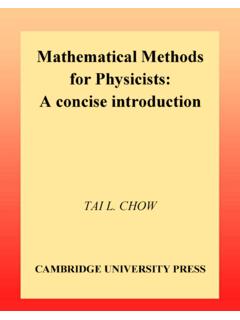
1 Mathematical Methods for Physicists: A concise introductionCAMBRIDGE UNIVERSITY PRESSTAI L. CHOWM athematical Methods for PhysicistsA concise introductionThis text is designed for an intermediate-level, two-semester undergraduate coursein Mathematical physics . It provides an accessible account of most of the current,important Mathematical tools required in physics these days. It is assumed thatthe reader has an adequate preparation in general physics and book bridges the gap between an introductory physics course and moreadvanced courses in classical mechanics, electricity and magnetism, quantummechanics, and thermal and statistical physics .
2 The text contains a large numberof worked examples to illustrate the Mathematical techniques developed and toshow their relevance to book is designed primarily for undergraduate physics majors, but couldalso be used by students in other subjects, such as engineering, astronomy L. CHOWwas born and raised in China. He received a BS degree in physicsfrom the National Taiwan University, a Masters degree in physics from CaseWestern Reserve University, and a PhD in physics from the University ofRochester. Since 1969, Dr Chow has been in the Department of physics atCalifornia State University, Stanislaus, and served as department chairman for17 years, until 1992.
3 He served as Visiting Professor of physics at University ofCalifornia (at Davis and Berkeley) during his sabbatical years. He also worked asSummer Faculty Research Fellow at Stanford University and at NASA. Dr Chowhas published more than 35 articles in physics journals and is the author of twotextbooks and a solutions manual. PUBLISHED BY CAMBRIDGE UNIVERSITY PRESS (VIRTUAL PUBLISHING) FOR AND ON BEHALF OF THE PRESS SYNDICATE OF THE UNIVERSITY OF CAMBRIDGE The Pitt Building, Trumpington Street, Cambridge CB2 IRP 40 West 20th Street, New York, NY 10011-4211, USA 477 Williamstown Road, Port Melbourne, VIC 3207, Australia Cambridge University Press 2000 This edition Cambridge University Press (Virtual Publishing)
4 2003 First published in printed format 2000 A catalogue record for the original printed book is available from the British Library and from the Library of Congress Original ISBN 0 521 65227 8 hardback Original ISBN 0 521 65544 7 paperback ISBN 0 511 01022 2 virtual (netLibrary Edition) Mathematical Methods for PhysicistsA concise introductionTAI L. CHOWC alifornia State UniversityContentsPrefacexv1 Vector and tensor analysis 1 Vectors and scalars 1 Direction angles and direction cosines 3 Vector algebra 4 Equality of vectors 4 Vector addition 4 Multiplication by a scalar 4 The scalar product 5 The vector (cross or outer)
5 Product 7 The triple scalar productA B C 10 The triple vector product 11 Change of coordinate system 11 The linear vector spaceVn13 Vector di erentiation 15 Space curves 16 Motion in a plane 17A vector treatment of classical orbit theory 18 Vector di erential of a scalar eld and the gradient 20 Conservative vector eld 21 The vector di erential operatorr22 Vector di erentiation of a vector eld 22 The divergence of a vector 22 The operatorr2, the Laplacian 24 The curl of a vector 24 Formulas involvingr27 Orthogonal curvilinear coordinates 27vSpecial orthogonal coordinate systems 32 Cylindrical coordinates ; ;z 32 Spherical coordinates (r.)
6 34 Vector integration and integral theorems 35 Gauss' theorem (the divergence theorem) 37 Continuity equation 39 Stokes' theorem 40 Green's theorem 43 Green's theorem in the plane 44 Helmholtz's theorem 44 Some useful integral relations 45 Tensor analysis 47 Contravariant and covariant vectors 48 Tensors of second rank 48 Basic operations with tensors 49 Quotient law 50 The line element and metric tensor 51 Associated tensors 53 Geodesics in a Riemannian space 53 Covariant di erentiation 55 Problems 572 Ordinary di erential equations 62 First-order di erential equations 63 Separable variables 63 Exact equations 67
7 Integrating factors 69 Bernoulli's equation 72 Second-order equations with constant coe cients 72 Nature of the solution of linear equations 73 General solutions of the second-order equations 74 Finding the complementary function 74 Finding the particular integral 77 Particular integral and the operatorD d=dx 78 Rules forDoperators 79 The Euler linear equation 83 Solutions in power series 85 Ordinary and singular points of a di erential equation 86 Frobenius and Fuchs theorem 86 Simultaneous equations 93 The gamma and beta functions 94 Problems 96 CONTENTSvi3 Matrix algebra 100De nition of a matrix 100 Four basic algebra operations for matrices 102 Equality of matrices 102 Addition of matrices 102 Multiplication of a matrix by a number 103 Matrix multiplication 103 The commutator 107 Powers of a matrix 107 Functions of matrices 107 Transpose of a matrix 108 Symmetric and skew-symmetric matrices 109 The matrix representation of a vector product 110 The inverse of a matrix 111A method for nding~A 1112 Systems of linear equations and the inverse of a matrix 113 Complex conjugate of a
8 Matrix 114 Hermitian conjugation 114 Hermitian/anti-hermitian matrix 114 Orthogonal matrix (real) 115 Unitary matrix 116 Rotation matrices 117 Trace of a matrix 121 Orthogonal and unitary transformations 121 Similarity transformation 122 The matrix eigenvalue problem 124 Determination of eigenvalues and eigenvectors 124 Eigenvalues and eigenvectors of hermitian matrices 128 Diagonalization of a matrix 129 Eigenvectors of commuting matrices 133 Cayley Hamilton theorem 134 Moment of inertia matrix 135 Normal modes of vibrations 136 Direct product of matrices 139 Problems 1404 Fourier series and integrals 144 Periodic functions 144
9 Fourier series; Euler Fourier formulas 146 Gibb's phenomena 150 Convergence of Fourier series and Dirichlet conditions 150 CONTENTSviiHalf-range Fourier series 151 Change of interval 152 Parseval's identity 153 Alternative forms of Fourier series 155 Integration and di erentiation of a Fourier series 157 Vibrating strings 157 The equation of motion of transverse vibration 157 Solution of the wave equation 158 RLCcircuit 160 Orthogonal functions 162 Multiple Fourier series 163 Fourier integrals and Fourier transforms 164 Fourier sine and cosine transforms 172
10 Heisenberg's uncertainty principle 173 Wave packets and group velocity 174 Heat conduction 179 Heat conduction equation 179 Fourier transforms for functions of several variables 182 The Fourier integral and the delta function 183 Parseval's identity for Fourier integrals 186 The convolution theorem for Fourier transforms 188 Calculations of Fourier transforms 190 The delta function and Green's function method 192 Problems 1955 Linear vector spaces 199 Euclideann-spaceEn199 General linear vector spaces 201 Subspaces 203 Linear combination 204 Linear independence, bases, and dimensionality 204 Inner product spaces (unitary spaces)