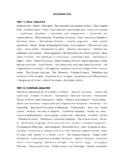
Transcription of MATHEMATICAL METHODS FOR PHYSICS
1 MATHEMATICAL METHODS FOR PHYSICS UNIT-1: LINEAR ALGEBRA AND MATRICES (PERIODS-8 Hours) Vector spaces, basis vectors, the inner product, some inequalities, linear operators and their properties, Matrices- the Eigen value problem, determination of eigenvalues Eigen functions, digonalisation, trace and normalization of matrix, Caley-Hamiltonian theorem. (Reference: Riley and Joshi) UHIT-2: SPECIAL FUNCTIONS (PERIODS-10 Hours) Legendre equation, Reylign formula, generating function, orthogonality, hermits polynomial, Rodriguez formula, recurrence relation, generating function, orthogonality, Laguerres equation, Rodriguez formula, generating function, orthogonality, Bessel equation, generating function, recurrence relation, orthogonality (Reference: Chow) UNIT-3:FOURIER SERIES AND FOURIER AND LAPLACE TRANSFORM (PERIOD-9 Hours) Fourier series- periodic function, Euler Fourier formula, Dirichilete conditions, half range Fourier series, change of interval, Parsevals identity, alternate forms of the Fourier series, application of Fourier series- vibrating string, RLC circuit (Reference.)
2 Chow) Integral transform- Fourier integral and Fourier transform, few examples, the Dirac delta function, properties of Fourier transform, odd and even function, convolution and deconvolution theorem, Parsevals therom, Laplace transform, Laplace transform of derivatives and integrals, properties of the Laplace transform, (Reference: Riley) UNIT-4: ELEMENTS OF COMPLEX ANALYSIS (PERIOD-5 Hours) Analytic functions, Cauchy Riemann condition, contour integrals , Laurent series, the residue theorem, method of finding the residues, evaluation of definite integrals (Reference: Boase) UNIT-5: ROOTS OF FUNCTION, INTERPOLATION AND EXTRAPOLATION (PERIODS-7 Hours) Roots of the functions, the bisection method, the iteration METHODS , acceleration of convergence, the false position method, interpolation: errors in polynomial interpolation, finite differences, Newton s formula for interpolation.
3 (Reference: Shashtri) UNIT-6: INTEGRATION AND SOLUTION OF DIFFERENTIAL EQUATION (PERIOD-4 Hours) Numerical integration, trapezoidal rule, error calculations, Simpson 1/3 rule, solution of first order differential equation by Runge Kutta method. (Reference: Shastri) UNIT-7: ELEMENTARY PROBABILITY THEORY (PERIOD-5 Hours) A definition of the probability sample space, permutation and combination, fundamental probability theorems, random variables, and probability distributions, special probability distribution, binomial, Poisson, normal (Reference: Chow) REFERENCE BOOKS:- 1 MATHEMATICAL METHODS for Physicists Tai L. Chow 1st Edition, 2000, Cambridge University Press 2 MATHEMATICAL METHODS For PHYSICS And Engineers- Riley, Hobson And Bence, 1st Edition, 1997, Cambridge University Presses.
4 3 MATHEMATICAL METHODS In Physical Sciences- 3rd Edition, 2006, Wily India Education 4 Matrices And Tensors In PHYSICS - Joshi 3rd Edition, New Age International (P) Ltd. 5 Complex McGraw Hill Book Company 6 MATHEMATICAL METHODS for Arfken, H. , 5th Edition, Harcourt Pvt. Ltd. (Academic Press) CLASSICAL MECHANICS UNIT-1: ENERGY AND WORK (PERIOD-6 Hours) Conservative force, potential energy, conservative momentum and angular momentum, conservative system of particles of mass, motion of CoM, conservation theorems, equation of motion under different types of forces, varial theorem UNIT-2: THE LANGRANGIAN FORMULATION OF MECHANICS (PERIOD-8 Hours) Generalized coordinates, DoF, configurational space, constraints, D Alembert s principle and Lagrange s equations, kinetic energy in generalized coordinates, generalized momentum and energy, Jacobi integral.
5 Gauge function for the Lagrangian, gauge invariance, cyclic or ignorable coordinates, integral of motion, concept of symmetry, homoginity and isotropy, invariance under Galilian transformation. UNIT-3: HAMILTONIAN DYNAMICS (PERIOD-7 Hours) Hamilton s principle and Lagrange s equations, Lagrange s equation for non-holonomic systems, few examples of Lagange s equation of motion, method of undetermined multipliers, the Hamiltonian of the dynamical system, Hamilton s canonical equations, Integrals of Hamilton s equations, canonical transformations, Poission bracket, equation of motion in Poission bracket form, phase space and Liovilles theorem, Lagrange from Hamiltonian, few application of Hamiltonian formulation. UNIT-4: CENTRAL FORCE MOTION (PERIOD-7 Hours) The two body problem and the reduced mass, general properties of central force motion, effective potential and classification of orbits, general solutions, inverse square law of the force, Kepler s law of planetary motion, applications, satellites and space craft, communication satellites, flyby mission to the outer planets, hyperbolic orbits and Rutherford scattering, elastic collisions: lab and cm system, inelastic collisions (Barger & Olsson).
6 UNIT-5: COUPLED OSCILATIONS (PERIOD-7 Hours) Coupled pendulum, normal coordinates, coupled oscillators and normal oscillators, and normal modes, equation of motion of a coupled system, normal modes of oscillation, orthogonality of Eigen vectors, normal coordinates, forced oscillations of coupled oscillator, coupled oscillator circuits, vibration of loaded string, vibrating string and the wave equations. UNIT-6: THE MOTION OF RIGID BODIES. (PERIOD-7 Hours) The independent coordinates of rigid bodies, the Eulerian angles, rotational kinetic energy and angular momentum, inertia tensor, principle axis of inertia, Euler s equation of motion, motion of a torque free symmetrical top (pseudo force). UNIT-7: THE SPECIAL THEORY OF RELATIVITY (PERIOD-6 Hours) The Michelson Morley experiment, the postulates of the special theory of relativity, the Lorentz transformations, 4-D space, relativistic Reference Books: 1.
7 Classical Mechanics- 1st Edition, 1995, John Willey and Sons Inc. 2. Classical Mechanics Takwale, Puranic 1st Edition, 2007, Tata McGraw Hill Publication 3. Classical Mechanics- 2nd, Edition, 1980, Narosa Publishing House 4. Classical Mechanics- Rana and Joag 1st Edition, Tata McGraw Hill Company Ltd. 5. Classical Mechanics: A Modern Perspective- Barger and Olsson 2ne Edition, 1995, McGraw Hill Publication ELECTRONICS UNIT-1: PHYSICS OF SEMICONDUCTORs (PERIOD 5 Hours) Density of states and and its application to the semiconductors, Fermi-Dirac distribution & its characteristics, equilibrium distribution of electrons and holes in intrinsic and extrinsic semiconductors , position of Fermi energy level, its variation with doping concentration and temperature. (Reference:NEEMAN) UNIT-2: THE P-N JUNCTION (PERIOD 7 Hours) Basic structure of p-n junction, built in potential barrier, electronic field, space charge width, reverse applied bias, junction capacitance, diode characteristics: forward, reverse regions, current voltage relations, frequency response, load lines, diode applications: rectification, clipping-clamping circuits, Zener diode (Reference: NEEMAN & MALVINO) UNIT-3 BI-JUNCTION TRANSISTORS (PERIOD 8 Hours) Introduction, working principle, current and voltage ratings, transistor characteristic curves: collector curve, transistor biasing: base bias , emitter bias, voltage divider bias, applications, BJT amplifiers, configurations: CE, CC, CB, load line analysis, amplifier AC equivalent circuits, H parameters.
8 (Reference: PAYNTER) UNIT-4 FIELD EFFECT DEVICES (PERIOD 7 Hours) The JFET biasing, working principle, drain curves, transceductance curves, JFET approximations, the depletion and enhancement mode MOSFET, basic idea and device characteristics, applications, JFET amplifiers, JFET analog switch, MOSFET amplifiers and switches, introduction to CMOS. (Reference: MALVINO) UNIT-5 OPTOELECTRONIC DEVICES (PERIOD 7 Hours) Optical absorption, photon absorption coefficient, electron hole pair generation, solar cell : the I-V characteristics, p-n junction solar cell, conversion efficiency , the hetero junction solar cell, photo detectors, photodiode, pin photodiode, avalanche photodiode, phototransistors, light emitting diodes, generation of light, internal and external quantum efficiency, laser diodes, stimulated emission and population inversion.
9 (Reference: NEEMAN) UNIT-6 OPERATIONAL AMPLIFIER (PERIOD - 7 Hours) Operation overview, differential amplifiers and OPAMP specifications, modes of operations, input output parameters, frequency response, application, inverting amplifiers, non inverting amplifiers, voltage followers, comparators, integrators, differentiator, summing negative and positive feedback. UNIT- 7 DIGITAL ELECTRONICS (PERIOD - 7 Hours) Logic gates, universal logic gates, D Morgans theorem, flip-flops: RS, D, T, JK, MS., shift resistors, counting, synchronous and asynchronous counters, binary comparison, ADC and DAC, 2-2R network, binary ladder (Reference: J. D. RYTER) Reference Books: 1. Semiconductor PHYSICS And Devices- Donald A. Neaman 3rd Edition, 2007, Tata McGraw Hill Company. 2. Electronic Principles- A. Malvino, Bates 7th Edition, 2008, Tata McGraw-Hill Publication Pvt Ltd.
10 3. Introductory Electronic Devices And Circuits- Painter 2nd Edition, 1991, New Jerky; Regents/Prentice Hall 4. Electronic Fundamentals And 5th Edition, 1990, Prentice Hall of India Pvt. Ltd. QUANTUM MECHANICS-I UNIT -1:THE ORIGINE OF QUANTUM THEORY (PERIOD - 8 Hours) Black body radiation, the photoelectric effect, the Compton effect, atomic spectra and the Bohr hydrogen atom, the Stern - Garlach experiment, angular momentum and spin, D Broglie hypothesis, wave- particle duality, interpretation of wave function, wave function for particle momentum, wave packets, the Heisenberg s uncertainty principle (Reference: BRANSDEN) UNIT-2:THE SHRODINGERS EQUATION (PERIOD - 8 Hours) The time dependent Schr dinger s equation, conservation of probability, expectation values and operator, Ehrenfest theorem, the time dependent Schr dinger s equation, stationary states, Eigen functions and Eigen values.