Transcription of Meaning THE HOLY - Amazon Web Services
1 In The UnitedMethodist ChurchE. Byron Anderson THE Meaning OFHOLYTHEMEANING OFHOLY COMMUNIONin The United Methodist ChurchBy E. Byron AndersonScripture quotations, unless otherwise indicated, are from the New Revised Standard Version of the Bible, copyright 1989 by the Division of Christian Education of the National Council of the Churches of Christ in the USA. All rights reserved. Used by permission. THE Meaning OF holy COMMUNION IN THE UNITED METHODIST church . Copyright 2014 Discipleship Resources. All rights reserved. No part of this book may be reproduced in any form whatsoever, print or electronic, without written permission, except in the case of brief quotations embodied in critical articles or reviews.
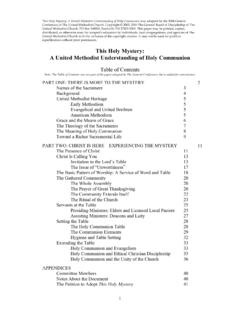
2 For information regarding rights and permissions, contact TABLE OF CONTENTSI ntroduction ..4 The Biblical Witness ..5 Names for holy Communion ..7 Word and Table ..10 The Great Thanksgiving ..12 Questions about Praying the Great Thanksgiving ..16 What Happens? ..18 Real Presence of Christ ..19 Who Can Receive? ..21 Questions about Who can Is Worthy? ..25 How Often? ..27 Questions about Frequency and Time ..29 Methods of Receiving ..30 Other Frequently Asked Questions ..33 Celebrating the Sacrament ..34 Presiding and Ministry ..39 Care of the Elements ..43A Eucharistic Spirituality ..46 For Further Reading.
3 47 About the Author ..484 INTRODUCTIONIt is a great and holy thing to be invited to feast at the Lord s table. For some people, the invitation to the table evokes memories of other holy times in life, special church relationships, and the unbounded grace of God. For others, it brings memories of the reality of the disunity of the church : the lack of welcome received in some churches, the need for reconciliation within church communities and families as well as between various churches, and sinfulness and failure. These situations invite us to examine our understanding of this holy meal. This booklet is designed to provide a brief introduction to the meanings and practices of holy Communion in The United Methodist church , especially as set forth in This holy Mystery: A United Methodist Understanding of holy Communion (hereafter THM), adopted by the 2004 General Conference of The United Methodist church and readopted in 2012.
4 We will explore several basic and common questions about the Meaning of holy Communion: What does Scripture tell us about the holy meal? What do the various names for holy Communion mean, and how do they shape our understanding of its Meaning ? How does the context and shape of the service of holy Communion (Word and Table in The United Methodist Hymnal) influence this understanding? What is the prayer of Great Thanksgiving at the Lord s table? What does holy Communion do in and for the life of the church ? Who can receive holy Communion in The United Methodist church ? How often should we celebrate or receive Communion?
5 Why do we receive Communion in so many different ways in our churches? In addition to these questions of Meaning , we also provide answers to a number of frequently asked questions concerning our practices of holy Communion, especially questions about who presides at holy Communion, how we care for the elements, and how to respond to the emerging digital church BIBLICAL WITNESS A number of Bible stories help us understand holy Communion. We most often turn to the accounts of Jesus meal with his disciples in the upper room on the night he was betrayed (Matthew 26:17-30; Mark 14:12-26; and Luke 22:7-23). Each of these gospels records how Jesus, on the night he was betrayed, took bread, blessed and broke it, and gave it to his disciples with the words: This is my body.
6 After the supper, he took a cup of wine, blessed it, and gave it to his disciples with the words: This is my blood of the covenant, which is poured out for many for the forgiveness of sins (Matthew 26:26-28). As Paul recounts the origins of the Lord s Supper in 1 Corinthians 11:23-26, he reminds the church of the tradition he received from the Lord Jesus and handed on to the church and to us. The stories recounting Jesus words at the table in the upper room are called the institution narrative. They tell how holy Communion was begun and recount Jesus command that the church continue to celebrate this meal in his name for his 1 This holy Mystery: A United Methodist Understanding of holy Communion [hereafter THM] (Nashville: General Board of Discipleship, 2004), The Meaning of holy Communion, of these stories emphasize the importance of Jesus self-giving, his faithfulness to God in the face of death, and his continued care for his disciples.
7 Set in the context of a Passover meal, these stories about the Last Supper focus our attention on the relationship between the events of the Passover (Exodus 12:1-28) and Jesus death on the cross. In the Exodus story, the blood of the lambs the Israelites use to mark their doorposts serves as a sign to God not to bring judgment upon their households. In the gospel stories of the Last Supper and crucifixion, Jesus blood serves as the sign to God not to bring judgment upon the people for their sins. These are not the only stories that help us understand the Meaning of holy Communion. Some stories, such as those of the feeding of the multitudes (Matthew 14:13-21; Mark 6:30-44 and 8:1-10; Luke 9:10-17; John 6:1-13, 25-59), are connected to the meal in the upper room by the repetition of Jesus actions of taking, blessing, breaking, and giving.
8 In each of these stories, we see Jesus caring for those who have followed him. The stories suggest that Jesus satisfied their spiritual hunger with his teaching, and their physical hunger with bread. John s account (John 6:25-51) reminds the church that this was neither the first nor the last time that God would provide food in the wilderness. John reminds us of the story of the Exodus and Israel s journey in the desert (Exodus 16:1-17). God provided for Israel in the wilderness with the gift of manna and quail, even when Israel tested God (Psalm 95:9). Other stories that also are marked by Jesus actions of taking, blessing, breaking, and giving are found in the accounts of Jesus appearances to the disciples after his resurrection.
9 In Luke 24:13-35, Jesus appears to two disciples on the road to Emmaus. Although they do not recognize Jesus while on the road, they invite him to join them in a meal. After Jesus takes, blesses, breaks, and gives bread, the disciples eyes are opened and they recognize him. In a similar manner, John records that when Jesus appeared to the disciples on the shore, he prepared a meal for them and they recognized him (John 21:4-14). 7In Acts 2:42-47, we read how the early church continued to remember Jesus in the teaching of the apostles, in the fellowship of the community, in the breaking of the bread, and in the common prayers.
10 These actions became distinguishing marks of the early Christian community. In each of these stories we hear accounts of Jesus presence with and care for the community of faith. In the story of the Last Supper in Matthew, Mark and Luke, Jesus takes the place of the sacrificial lamb (Passover story) on behalf of our sins. We are reminded of the Exodus story in Jesus teachings about the bread of life. Jesus actions are joined to God s continuing care for the covenant community, providing sustenance even in the desert. In the feeding of the multitudes, the sharing of a meal is a sign of Jesus compassion for those people who would follow him and listen to his teaching.