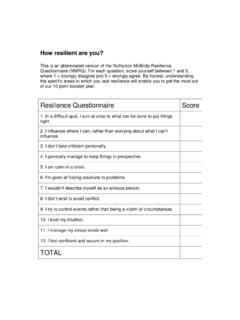
Transcription of MEASURING RESILIENCE
1 MEASURING RESILIENCE Use this resource to find out more about MEASURING RESILIENCE Hover your mouse over this box then press CTRL + Click to find out how to use the material presented. Alternatively go the contents page, pick a topic and start your journey from there. DOI: First published May 2016 CROWN COPYRIGHT MEASURING RESILIENCE Table of Contents How to use and navigate this 3 Key Contacts .. 6 1. Can we quantify RESILIENCE ? .. 7 Why measure RESILIENCE ? .. 7 Conceptual and methodological challenges .. 7 How can we quantify RESILIENCE ? .. 8 2. RESILIENCE measurement frameworks .. 15 Reviews and critiques of RESILIENCE measurement frameworks .. 17 3. MEASURING RESILIENCE in practice .. 23 Trends and learning from attempts to measure RESILIENCE .. 23 Practical guidance on MEASURING RESILIENCE .
2 27 Understanding degrees of RESILIENCE .. 29 4. Reducing adverse livelihood impacts from shocks or stresses .. 31 Evidence from Household Economy Analysis .. 31 Early action and response .. 33 5. Key messages .. 40 Glossary .. 41 Recommended Resources .. 43 Overview of resources .. 43 Bibliography .. 48 TABLE OF CONTENTS 2 MEASURING RESILIENCE HOW TO USE AND NAVIGATE THIS RESOURCE This resource is about MEASURING RESILIENCE in international development contexts. It is suitable for people who understand the fundamental concept of RESILIENCE but want to learn more about MEASURING RESILIENCE . This resource need not be read from start to finish; instead readers can jump straight to relevant sections according to interests and needs. Here are some ways that you can do this: 1. You can open a linear navigation panel if viewing in Word.
3 From here you can search key words, view by page, or use the headings to jump from one section to the other. Pull up your navigation panel by clicking Find from the Home Tab on your document. 2. You can also look out for the Quick Jump to links at the end of each section. Click the hyperlink to where you want to go. HOW TO USE AND NAVIGATE THIS RESOURCE 3 MEASURING RESILIENCE 3. Hyperlinks to web based resources or other parts of this resource are embedded throughout the text. Click on highlighted words or links to navigate your way to the materials or sections that interest you. 4. A glossary has been included at the end of this resource which will explain some of the terminology that has been used. 5. Some questions that this resource addresses are shown in the boxes below. Why measure RESILIENCE ?
4 Can we quantify RESILIENCE ? How can we measure RESILIENCE ? How has RESILIENCE been measured in practice? Where can I find guidance on MEASURING RESILIENCE ? Are DFID programmes MEASURING RESILIENCE ? What are the key messages on MEASURING RESILIENCE ? How can we reduce effects of shocks on livelihoods? What is early action and is it cost effective? Practitioners may be most interested in the following sections: Trends and learning from attempts to measure RESILIENCE Monitoring and evaluating RESILIENCE interventions Guidance on data sources Where can I find out more? There are two ways to find further information. 1. Firstly, if you are DFID staff you can contact the DFID Virtual Community of Practice on RESILIENCE , or get in touch with a key contact for specific expertise. We have started a list of key contacts which will be updated periodically.
5 This resource is available to DFID personnel. 2. Secondly, you can follow the links embedded in the text or take a look at some recommended resources and ideas for further reading (see Recommended Resources). Acknowledgements Special thanks to Christopher B n of CGIAR for his comments on drafts of this resource. To return to where you were before clicking a hyperlink press the ALT Key and the Left Arrow on your keyboard together. This acts like the back arrow on a web page. HOW TO USE AND NAVIGATE THIS RESOURCE 4 MEASURING RESILIENCE Quick navigation links BACK TO TOP - HOW TO USE THIS RESOURCE CAN WE QUANTIFY RESILIENCE ? RESILIENCE MEASUREMENT FRAMEWORKS MEASURING RESILIENCE IN PRACTICE REDUCING ADVERSE LIVELIHOODS IMPACTS KEY MESSAGES CONTENTS GLOSSARY RECOMMENDED RESOURCES BIBLIOGRAPHY HOW TO USE AND NAVIGATE THIS RESOURCE 5 MEASURING RESILIENCE KEY CONTACTS The Food Security Information Network (FSIN) has a RESILIENCE Measurement Community of Practice (RM CoP) that provides access to an online knowledge exchange platform.
6 This is aimed at people interested in the link between RESILIENCE and food security/human development. The Rockefeller Foundation has awarded a USD $800,000 grant to the Windward Fund to launch the RESILIENCE Measurement Community of Practice. This is a project to bring together leading experts and M&E practitioners to advance the practice of RESILIENCE measurement and build the evidence base for investments in RESILIENCE . Point of contact: Dr Maliha Khan, Interim Coordinator, RESILIENCE Measurement-M&E Community of Practice. FAO has established a RESILIENCE Analysis Unit (RAU) in Nairobi with the Intergovernmental Authority for Development (IGAD). The RAU aims to: i) develop RESILIENCE measurement and analysis capacities; and ii) inform policy processes and RESILIENCE programming in the Horn of Africa. BACK TO TOP KEY CONTACTS PREVIOUS SECTION HOW TO USE THIS RESOURCE CAN WE QUANTIFY RESILIENCE ?
7 RESILIENCE MEASUREMENT FRAMEWORKS MEASURING RESILIENCE IN PRACTICE REDUCING ADVERSE LIVELIHOODS IMPACTS KEY MESSAGES CONTENTS GLOSSARY RECOMMENDED RESOURCES BIBLIOGRAPHY KEY CONTACTS 6 MEASURING RESILIENCE 1. CAN WE QUANTIFY RESILIENCE ? This section considers the rationale for MEASURING RESILIENCE , conceptual and methodological challenges, and general principles for how RESILIENCE can be measured. It also provides an overview of some common methods of quantifying RESILIENCE . WHY MEASURE RESILIENCE ? The drive to justify investments and monitor the success of RESILIENCE programming is gaining momentum, in line with the prominence of the concept of RESILIENCE in post-2015 development discourse. Despite some differences in wording in definitions of RESILIENCE (see the What is RESILIENCE ? resource), there is some convergence of understanding that RESILIENCE is an intermediate rather than final outcome and a combination of capacities or assets that lead to other positive wellbeing outcomes.
8 The Food Security Information Network argues that if no clear guidelines exist on how to reliably and credibly measure RESILIENCE , decision makers will not be able to make informed choices about which RESILIENCE interventions are most effective. MEASURING food insecurity for example, drives accurate diagnosis as well as timely and appropriate response (Barrett, 2010). However, it is hampered by both conceptual and methodological challenges, as we discuss below. CONCEPTUAL AND METHODOLOGICAL CHALLENGES Conceptual challenges Conceptually, it is difficult to measure something unless we know exactly what it is that has to be measured, but definitions of RESILIENCE do not facilitate this. It is also difficult to relate RESILIENCE to thresholds even though a spectrum of RESILIENCE makes more sense than a yes/no definition.
9 Theoretical RESILIENCE frameworks are often not linked to attempts to measure RESILIENCE . While most current quantification efforts focus on household level; the links between RESILIENCE of individuals, households, communities, infrastructure and countries are not straightforward. It is hard to measure adaptive capacity (ability to deal with change) as it has psychological, cultural, technical, financial, social and political components. Other difficult questions need to be considered: What about vulnerability traps (similar to poverty traps but barriers could be economic, cultural, political or psychological)? Are there minimum preconditions for building RESILIENCE economic opportunities, governance, equity? How does this affect fragile states? What about future RESILIENCE ? Things that have contributed to RESILIENCE in the past might not do so in the future.
10 RESILIENCE is dynamic. (Summarised from Levine, 2014) RESILIENCE is not directly observable per se but must be placed in relation to a given outcome RESILIENCE to conflict or climate change and identifiable shocks. (Resilient Africa Network) RESILIENCE is necessarily specific to contexts - time, space, livelihood and shocks ( RESILIENCE of who/what? to what?), but this precludes generic indicators of RESILIENCE and therefore makes comparisons difficult. Questions of what to measure, whom to measure, how often to measure, what methods to use, and at what scale are still being debated. IFPRI international conference on RESILIENCE , 2014 1. CAN WE QUANTIFY RESILIENCE ? 7 MEASURING RESILIENCE Additionally, the multi-scale, dynamic and multi-dimensional nature of RESILIENCE means that many standard survey instruments are ill-suited to MEASURING RESILIENCE in a holistic way (B n et al.)