Transcription of MECHANICAL PROPERTIES OF MATERIALS
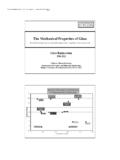
1 2002 John Wiley & Sons, Inc. M. P. Groover, Fundamentals of Modern Manufacturing 2/e MECHANICAL PROPERTIESOF MATERIALS Stress-Strain Relationships Hardness Effect of Temperature on PROPERTIES Fluid PROPERTIES Viscoelastic Behavior of Polymers 2002 John Wiley & Sons, Inc. M. P. Groover, Fundamentals of Modern Manufacturing 2/e MECHANICAL PROPERTIES inDesign and Manufacturing MECHANICAL PROPERTIES determine a material sbehavior when subjected to MECHANICAL stresses PROPERTIES include elastic modulus, ductility,hardness, and various measures of strength Dilemma: MECHANICAL PROPERTIES desirable to thedesigner, such as high strength, usually makemanufacturing more difficult The manufacturing engineer should appreciate thedesign viewpoint and the designer should beaware of the manufacturing viewpoint 2002 John Wiley & Sons, Inc.
2 M. P. Groover, Fundamentals of Modern Manufacturing 2/e Stress-Strain Relationships Three types of static stresses to which MATERIALS canbe to stretch the to squeeze to cause adjacent portions ofmaterial to slide against each other Stress-strain curve-basic relationship thatdescribes MECHANICAL PROPERTIES for all three types 2002 John Wiley & Sons, Inc. M. P. Groover, Fundamentals of Modern Manufacturing 2/e Tensile Test Most common test forstudying stress-strainrelationship, especiallymetals In the test, a force pullsthe material , elongatingit and reducing itsdiameterFigure test: (a) tensile force applied in (1) and(2) resulting elongation of material 2002 John Wiley & Sons, Inc. M. P. Groover, Fundamentals of Modern Manufacturing 2/e ASTM (American Societyfor Testing and MATERIALS )specifies preparation oftest specimenFigure test: (b) typical test specimen 2002 John Wiley & Sons, Inc.
3 M. P. Groover, Fundamentals of Modern Manufacturing 2/e Figure test: (c) setup of the tensile test 2002 John Wiley & Sons, Inc. M. P. Groover, Fundamentals of Modern Manufacturing 2/e Figure progress of a tensile test: (1) beginning of test, noload; (2) uniform elongation and reduction of cross-sectional area;(3) continued elongation, maximum load reached; (4) neckingbegins, load begins to decrease; and (5) fracture. If pieces areputback together as in (6), final length can be measured 2002 John Wiley & Sons, Inc. M. P. Groover, Fundamentals of Modern Manufacturing 2/e Engineering StressDefined as force divided by original area:oeAF where e= engineering stress,F= applied force, andAo= original area of test specimen 2002 John Wiley & Sons, Inc. M. P. Groover, Fundamentals of Modern Manufacturing 2/e Engineering StrainDefined at any point in the test aswheree= engineering strain;L= length at any pointduring elongation; andLo= original gage lengthooLLLe 2002 John Wiley & Sons, Inc.
4 M. P. Groover, Fundamentals of Modern Manufacturing 2/e Figure engineering stress-strain plotin a tensile test of a metal 2002 John Wiley & Sons, Inc. M. P. Groover, Fundamentals of Modern Manufacturing 2/e Two Regions of Stress-Strain Curve The two regions indicate two distinct forms region prior to yielding of the region after yielding of the material 2002 John Wiley & Sons, Inc. M. P. Groover, Fundamentals of Modern Manufacturing 2/e Elastic Region in Stress-Strain Curve Relationship between stress and strain is linear material returns to its original length when stress isremovedHooke's Law: e=E ewhereE=modulus of elasticity Eis a measure of the inherent stiffness of a material Its value differs for different MATERIALS 2002 John Wiley & Sons, Inc. M. P. Groover, Fundamentals of Modern Manufacturing 2/e Yield Point in Stress-Strain Curve As stress increases, a point in the linear relationshipis finally reached when the material begins to yield Yield pointYcan be identified by the change inslope at the upper end of the linear region Y= a strength property Other names for yield point =yield strength,yieldstress, andelastic limit 2002 John Wiley & Sons, Inc.
5 M. P. Groover, Fundamentals of Modern Manufacturing 2/e Plastic Region in Stress-Strain Curve Yield point marks the beginning of plastic deformation The stress-strain relationship is no longer guided byHooke's Law As load is increased beyondY, elongation proceedsat a much faster rate than before, causing the slopeof the curve to change dramatically 2002 John Wiley & Sons, Inc. M. P. Groover, Fundamentals of Modern Manufacturing 2/e Tensile Strength in Stress-Strain Curve Elongation is accompanied by a uniform reduction incross-sectional area, consistent with maintainingconstant volume Finally, the applied loadFreaches a maximum value,and engineering stress at this point is called thetensilestrengthTSorultimate tensile strengthTS=oAFmax 2002 John Wiley & Sons, Inc. M. P. Groover, Fundamentals of Modern Manufacturing 2/e Ductility in Tensile TestAbility of a material to plastically strain without fracturewhereEL= elongation;Lf= specimen length at fracture;andLo= original specimen lengthLfis measured as the distance between gage marks aftertwo pieces of specimen are put back togetheroofLLLEL 2002 John Wiley & Sons, Inc.
6 M. P. Groover, Fundamentals of Modern Manufacturing 2/e True StressStress value obtained by dividing the instantaneousarea into applied loadwhere = true stress;F= force; andA= actual(instantaneous) area resisting the loadAF 2002 John Wiley & Sons, Inc. M. P. Groover, Fundamentals of Modern Manufacturing 2/e True StrainProvides a more realistic assessment of"instantaneous" elongation per unit lengthoLLLLLdLoln 2002 John Wiley & Sons, Inc. M. P. Groover, Fundamentals of Modern Manufacturing 2/e If previous engineering stress-strain curve were plottedusing true stress and strain valuesFigure stress-strain curve for the previousengineering stress-strain plot in Figure 2002 John Wiley & Sons, Inc. M. P. Groover, Fundamentals of Modern Manufacturing 2/e Strain Hardening in Stress-Strain Curve Note that true stress increases continuously in theplastic region until necking In the engineering stress-strain curve, thesignificance of this was lost because stress wasbased on an incorrect area value What it means is that the metal is becoming strongeras strain increases This is the property calledstrain hardening 2002 John Wiley & Sons, Inc.
7 M. P. Groover, Fundamentals of Modern Manufacturing 2/e When the plastic region of the true stress-strain curve isplotted on a log-log scale, it becomes linearFigure stress-strain curve plotted onlog-log scale 2002 John Wiley & Sons, Inc. M. P. Groover, Fundamentals of Modern Manufacturing 2/e Flow CurveBecause it is a straight line in a log-log plot, therelationship between true stress and true strain in theplastic region iswhere K =strength coefficient;andn = strain hardeningexponentnK 2002 John Wiley & Sons, Inc. M. P. Groover, Fundamentals of Modern Manufacturing 2/e Categories of Stress-Strain and perfectly and strain hardening 2002 John Wiley & Sons, Inc. M. P. Groover, Fundamentals of Modern Manufacturing 2/e Behavior is definedcompletely by modulusof elasticityE It fractures rather thanyielding to plastic flow Brittle MATERIALS :ceramics, many castirons, and thermosettingpolymersFigure categories of stress-strain relationship: (a)perfectly elasticPerfectly Elastic 2002 John Wiley & Sons, Inc.
8 M. P. Groover, Fundamentals of Modern Manufacturing 2/e Stiffness defined byE OnceYreached, deformsplastically at same stresslevel Flow curve:K=Y,n= 0 Metals behave like thiswhen heated to sufficientlyhigh temperatures (aboverecrystallization)Figure categories of stress-strain relationship:(b) elastic and perfectly plasticElastic and Perfectly Plastic 2002 John Wiley & Sons, Inc. M. P. Groover, Fundamentals of Modern Manufacturing 2/e Hooke's Law in elasticregion, yields atY Flow curve:K>Y,n> 0 Most ductile metalsbehave this way whencold workedFigure categories of stress-strain relationship:(c) elastic and strain hardeningElastic and Strain Hardening 2002 John Wiley & Sons, Inc. M. P. Groover, Fundamentals of Modern Manufacturing 2/e Compression Test Applies a load thatsqueezes the ends ofa cylindrical specimenbetween two platensFigure test:(a) compression force applied to test piece in (1) and (2)resulting change in height 2002 John Wiley & Sons, Inc.
9 M. P. Groover, Fundamentals of Modern Manufacturing 2/e Figure test: (b) setup for the testwith size of test specimen exaggerated 2002 John Wiley & Sons, Inc. M. P. Groover, Fundamentals of Modern Manufacturing 2/e Engineering Stress in CompressionAs the specimen is compressed, its height is reducedand cross-sectional area is increasedoeAF where Ao= original area of the specimen 2002 John Wiley & Sons, Inc. M. P. Groover, Fundamentals of Modern Manufacturing 2/e Engineering Strain in CompressionEngineering strain is definedSince height is reduced during compression, value ofeisnegative (the negative sign is usually ignored whenexpressing compression strain)oohhhe 2002 John Wiley & Sons, Inc. M. P. Groover, Fundamentals of Modern Manufacturing 2/e Shape of plastic regionis different from tensiletest becausecross-sectionincreases Calculated value ofengineering stress ishigherFigure engineering stress-strain curve for acompression test 2002 John Wiley & Sons, Inc.
10 M. P. Groover, Fundamentals of Modern Manufacturing 2/e Tensile Test vs. Compression Test Although differences exist between engineeringstress-strain curves in tension and compression, thetrue stress-strain relationships are nearly identical Since tensile test results are more common, flowcurve values (Kandn) from tensile test data can beapplied to compression operations When using tensileKandndata for compression,ignore necking, which is a phenomenon peculiar tostraining induced by tensile stresses 2002 John Wiley & Sons, Inc. M. P. Groover, Fundamentals of Modern Manufacturing 2/e Testing of Brittle MATERIALS Hard brittle MATERIALS ( , ceramics) possesselasticity but little or no plasticity Often tested by abendingtest(also calledflexuretest) Specimen of rectangular cross-section ispositioned between two supports, and a load isapplied at its center 2002 John Wiley & Sons, Inc.