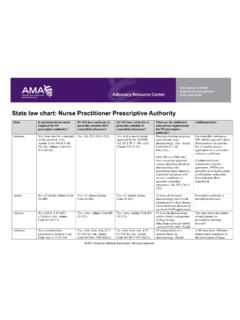
Transcription of Medication Aide / Technician Categories By State
1 Medication Aide / Technician Categories By State This document does not address the school (K-12) setting and attempts to provide a comprehensive representation of states authorizing the use of Medication aides with varying titles As of 09/15, it appears 36 states have granted permission for the practice of this category of health care worker. Details follow. If aware of an omission, please contact State Allow Description Alabama No Has been considered, no category of Medication aide exists at this time. However, the Board of nursing Administrative Code (2004) allows registered or licensed practical nurses to delegate in the school setting. Alaska No Arizona Yes House Bill 2256, passed in 2004, established a pilot program allowing certified nursing assistants, called Medication technicians, to administer pills and topical Medication to patients.
2 The State Board of nursing administered the program, limited to 6 SNFs. The participants must have worked in the facility as a certified nursing assistant for at least six months, complete 45 hours of didactic study, 15 hours of skills lab practice and 40 hours of supervised clinical, and pass a State board competency exam. The 2008 published report of the study findings are available from the Board of nursing . Arkansas Yes Medication assistive person means a person who is certified by the board of nursing to administer certain nonprescription and legend drugs in designated facilities and must be currently in good standing on the State s certified nurse aide registry and employed by the designated facility to be considered.
3 (Subchapter 7) California No Considering for assisted living, though nothing apparent to authorize for any setting at this time. Colorado Yes The Certified Nurse Aide Practice Act ( Medication aides - training - scope of duties rules) authorizes CNAs in good standing to be trained and administer medications in a nursing facility. Candidates must have spent at least 2000 hours working as a CNA in a nursing facility, complete 10 credit hours of a training course and pass a State board exam. Connecticut Yes Those trained to be " Medication technicians" may administer medications under the supervision of a registered nurse in facilities run by the Department of Children and Families, the Department of Mental Retardation, and the Department of Mental Health and Addiction Services.
4 (CT General Statute Section 20-14i) In 1999 legislation (PA 99-80) passed, authorizing trained, unlicensed personnel to administer Medication to elderly people in residential care homes (residents must be ambulatory and generally less frail than those in nursing homes). In 2006, HB 5245 Created a Medication Technician pilot program involving 30 Connecticut Continued facilities. A Medication Technician must be a current nurse s aide and have maintained good standing for at least 2 years, must be recommended by the director of nursing at the facility at which the nurse s aide is employed, must have completed a training program of45 hours of pharmacology training and 80 supervised clinical hours.
5 They must also pass a written exam and a practical exam administered by a nurse. They can administer Medication at chronic and convalescent nursing homes and rest homes with nursing supervision. The program was scheduled to end no later than September 30, 2009. No additional information available at the time of the report. Delaware Yes 1932 Limited Lay Administration of Medications. LLAM trained unlicensed assistive personnel (UAP) is an individual who has successfully completed the Board of nursing approved LLAM course, including the core course and any program specific specialized training modules required. (a) Individuals who have successfully completed a Board-approved limited lay administration of medications training program may administer prescription or nonprescription medications to patients/residents/clients in the following settings: (1) Residential child care facilities and Day Treatment Programs regulated by the State under Title 31.
6 (2) All residential or day services for persons with intellectual disabilities regulated by the State under chapter 79 of Title 29 and chapter 11 of Title 16. (3) Group homes for persons with psychiatric disabilities regulated by the State under chapter 11 of Title 16 and other community support programs certified by the Division of Substance Abuse and Mental Health. (4) Assisted living facilities regulated by the State under chapter 11 of Title 16. (5) Group homes established for persons with AIDS regulated by the State under chapter 11 of Title 16. (b) Medications must be in the original container and properly labeled. (c) An annual report to the Board of nursing , on a form developed by the Board of nursing , must be submitted no later than August 1 of each year indicating compliance with the guidelines as set forth in the approved LLAM training program.
7 Section 1. 1902, Title 24 of the Delaware Code District of Columbia No Although the category of Medication aide does not exist, chapter 61 (6100- 6199) permits trained employees to administer medications to an individual with mental retardation or other developmental disability who is enrolled in or attending a public or private program recognized within an agency licensed, certified, or approved by the District government as a child care facility, private school, day program, community based residence, or other agency providing residential services, education, habilitation, vocational, or employment training services to individuals with mental retardation or other developmental disability.
8 A District of Columbia licensed registered nurse provides general supervision and review of a trained Medication employee administering medications with at least quarterly review. The assembled curriculum encompassing all phases of Medication administration authorized under Code 21-1201 through 21-1204, Florida No Florida only permits unlicensed personnel to "assist" with self-administration of medications in the assisted living setting but it has been reported there is a blurring of the definition of "assistance". In day programs for the developmentally disabled, unlicensed personnel are permitted to administer medications. ( ) Georgia Yes Effective 2006, 434326 50 -26- The Georgia Qualified Medication Aide(QMA) Act permits nurses to delegate Medication administration to those that have meet the qualifications and training as designated by Board of nursing regulations and only to those residing in Community Living Arrangements (CLAs).
9 This law will sunset June 30th 2011. 434326 56 -26- describes activities permitted. The QMA may not administer the initial dose of a newly ordered Medication nor via the intravenous or injectable routes. Other restrictions apply. Hawaii No Idaho Yes Legislation sponsored by the Idaho Health Care Association and the Board of nursing amends the nursing Practice Act to allow the Board to develop rules to regulate Medication Assistants Certified (MA-C). Where allowed by law, MA-Cs will be permitted to administer medications prescribed by an authorized provider within the parameters set forth in rules and supervised by a licensed nurse. It is still a very new program with the rules having gone into effect in July 2008.
10 Illinois No Category of healthcare worker does not exists and practice is limited to developmentally disabled residents with the adoption of Rule 116 on February 7, 2000, enabling an RN to delegate Medication administration to non-nurse direct care staff in group homes for 16 or fewer developmentally disabled residents. Indiana Yes Indiana has allowed Medication aides in nursing homes since 1977. They have to be certified nurses' aides having completed 1,000 work hours and then complete 60 hours of classroom instruction and 40 of supervised practicum before passing a competency exam. Iowa Yes Iowa Code 81 (135C) Medication management. (1) A person may administer medications (excluding injectable medications) in nursing , residential or living facilities under the supervision of a registered nurse, having successfully completed a department-approved Medication aide course or passed a department-approved Medication aide challenge examination administered by an area community college.