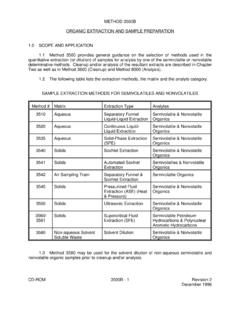
Transcription of METHOD 3550B ULTRASONIC EXTRACTION 1.0 …
1 METHOD 3550B . ULTRASONIC EXTRACTION . See Disclaimer. See manufacturer's specifications for operational settings. SCOPE AND APPLICATION. METHOD 3550 is a procedure for extracting nonvolatile and semivolatile organic compounds from solids such as soils, sludges, and wastes. The ULTRASONIC process ensures intimate contact of the sample matrix with the EXTRACTION solvent. The METHOD is divided into two sections, based on the expected concentration of organics in the sample. The low concentration METHOD (individual organic components of less than or equal to 20 mg/kg) uses a larger sample size and a more rigorous EXTRACTION procedure (lower concentrations are more difficult to extract). The medium/high concentration METHOD (individual organic components of greater than 20 mg/kg) is much simpler and therefore faster.
2 It is highly recommended that the extracts be cleaned up prior to analysis. See Chapter Four (Cleanup), Sec. , for applicable methods . ULTRASONIC EXTRACTION is not as rigorous as other EXTRACTION methods for soils/solids. Therefore, it is critical that the METHOD (including the manufacturer's instructions) be followed explicitly in order to achieve the maximum EXTRACTION efficiency. See Sec. for the critical aspects of the EXTRACTION procedure. EPA has not validated METHOD 3550 for the EXTRACTION of organophosphorous compounds from solid matrices. In addition, there are concerns that the ULTRASONIC energy may lead to breakdown of some organophosphorous compounds (see Reference 3). As a result, this EXTRACTION technique should not be used for organophosphorous compounds without extensive validation on real-world samples.
3 Such studies should assess the precision, accuracy, ruggedness, and sensitivity of the technique relative to the appropriate regulatory limits or project-specific concentrations of interest. This METHOD is restricted to use by or under the supervision of trained analysts. Each analyst must demonstrate the ability to generate acceptable results with this METHOD . This METHOD is not appropriate for applications where high EXTRACTION efficiencies of analytes at very low concentrations is necessary ( , demonstration of effectiveness of corrective action). SUMMARY OF METHOD . Low concentration METHOD - A 30-g sample is mixed with anhydrous sodium sulfate to form a free-flowing powder. This is solvent extracted three times using ULTRASONIC EXTRACTION . The extract is separated from the sample by vacuum filtration or centrifugation.
4 The extract is ready for cleanup and/or analysis following concentration. CD-ROM 3550B - 1 Revision 2. December 1996. Medium/high concentration METHOD - A 2-g sample is mixed with anhydrous sodium sulfate to form a free-flowing powder. This is solvent extracted once using ULTRASONIC EXTRACTION . A. portion of the extract is removed for cleanup and/or analysis. INTERFERENCES. Refer to METHOD 3500. APPARATUS AND MATERIALS. Apparatus for grinding dry waste samples. ULTRASONIC preparation - A horn-type device equipped with a titanium tip, or a device that will give equivalent performance, shall be used. ULTRASONIC Disrupter - The disrupter must have a minimum power wattage of 300. watts, with pulsing capability. A device designed to reduce the cavitation sound is recommended.
5 Follow the manufacturers instructions for preparing the disrupter for EXTRACTION of samples with low and medium/high concentration. Use a 3/4" horn for the low concentration METHOD and a 1/8" tapered microtip attached to a 1/2" horn for the medium/high concentration METHOD . Sonabox - Recommended with above disrupters for decreasing cavitation sound (Heat Systems - Ultrasonics, Inc., Model 432B or equivalent). Apparatus for determining percent dry weight. Drying oven - capable of maintaining 105EC. Desiccator. Crucibles - Porcelain or disposable aluminum. Pasteur glass pipets - 1-mL, disposable. Beakers - 400-mL. Vacuum or pressure filtration apparatus. Buchner funnel. Filter paper - Whatman No. 41 or equivalent. Kuderna-Danish (K-D) apparatus. Concentrator tube - 10-mL, graduated (Kontes K-570050-1025 or equivalent).
6 A ground-glass stopper is used to prevent evaporation of extracts. CD-ROM 3550B - 2 Revision 2. December 1996. Evaporation flask - 500-mL (Kontes K-570001-500 or equivalent). Attach to concentrator tube with springs, clamps, or equivalent. Snyder column - Three-ball macro (Kontes K-503000-0121 or equivalent). Snyder column - Two-ball micro (Kontes K-569001-0219 or equivalent). Springs - 1/2 inch (Kontes K-662750 or equivalent). NOTE: The following glassware is recommended for the purpose of solvent recovery during the concentration procedures requiring the use of Kuderna-Danish evaporative concentrators. Incorporation of this apparatus may be required by State or local municipality regulations that govern air emissions of volatile organics. EPA recommends the incorporation of this type of reclamation system as a METHOD to implement an emissions reduction program.
7 Solvent recovery is a means to conform with waste minimization and pollution prevention initiatives. Solvent vapor recovery system (Kontes K-545000-1006 or K-547300-0000, Ace Glass 6614-30, or equivalent). Boiling chips - Solvent-extracted, approximately 10/40 mesh (silicon carbide or equivalent). Water bath - Heated, with concentric ring cover, capable of temperature control ( 5EC). The batch should be used in a hood. Balance - Top-loading, capable of accurately weighing to the nearest g. Vials - 2-mL, for GC autosampler, with polytetrafluoroethylene (PTFE)-lined screw caps or crimp tops. Glass scintillation vials - 20-mL, with PTFE-lined screw caps. Spatula - Stainless steel or PTFE. Drying column - 20-mm ID Pyrex chromatographic column with Pyrex glass wool at bottom.
8 NOTE: Fritted glass discs are difficult to decontaminate after highly contaminated extracts have been passed through. Columns without frits may be purchased. Use a small pad of Pyrex glass wool to retain the adsorbent. Prewash the glass wool pad with 50 mL of acetone followed by 50 mL of elution solvent prior to packing the column with adsorbent. Syringe - 5-mL. REAGENTS. Reagent grade inorganic chemicals shall be used in all tests. Unless otherwise specified, it is intended that all inorganic reagents shall conform to the specifications of the Committee on CD-ROM 3550B - 3 Revision 2. December 1996. Analytical Reagents of the American Chemical Society, where such specifications are available. Other grades may be used, provided it is first ascertained that the reagent is of sufficiently high purity to permit its use without lessening the accuracy of the determination.
9 Organic-free reagent water. All references to water in this METHOD refer to organic-free reagent water, as defined in Chapter One. Sodium sulfate (granular, anhydrous), Na2SO4. Purify by heating at 400EC for 4 hours in a shallow tray, or by precleaning the sodium sulfate with methylene chloride. If the sodium sulfate is precleaned with methylene chloride, a METHOD blank must be analyzed, demonstrating that there is no interference from the sodium sulfate. EXTRACTION solvents Samples should be extracted using a solvent system that gives optimum, reproducible recovery of the analytes of interest from the sample matrix. Table 1 provides recovery data for selected semivolatile organic compounds extracted from an NIST SRM. The following sections provide guidance on the choice of solvents for various classes of analytes.
10 All solvents must be pesticide quality or equivalent. Semivolatile organics may be extracted with acetone/methylene chloride (1:1, v/v), CH3 COCH3/CH2Cl2 or acetone/hexane (1:1, v/v), CH3 COCH3/C6H14. Organochlorine pesticides may be extracted with acetone/hexane (1:1, v/v), CH3 COCH3/C6H14 or acetone/methylene chloride (1:1,v/v), CH3 COCH3/CH2Cl2. PCBs may be extracted with acetone/hexane (1:1, v/v), CH3 COCH3/C6H14, acetone/methylene chloride (1:1, v/v), CH3 COCH3/CH2Cl2 or hexane, C6H14. Other solvent systems may be employed, provided that the analyst can demonstrate adequate performance for the analytes of interest in the sample matrix (see METHOD 3500, Sec. ). Exchange solvents - All solvents must be pesticide quality or equivalent. Hexane, C6H14. 2-Propanol, (CH3)2 CHOH.