Transcription of Metric Conversion Factors
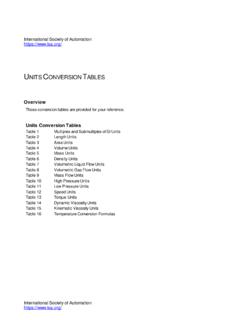
1 Metric Conversion Factors Volume Flow Rate 1 cm3 = 1 ml = .001 L 1 L/min = L/sec 1 L = 1 dm3 = .001 m3 = 60 L/hr = 1440 L/day 1 L = Gallon Liquid US 1 L/min = m3/hr 1 m3 = API bbl 1 L/min = gpm (US) 1 L/min = API bbl/day Length Velocity 1 m = 10 3 km = 102 cm = 103 mm = 106 1 cm/sec = 10 2 m/sec = 36 m/hr 1 cm = in = km/hr 1 m = ft = in 1 m/sec = knots (US) 1 m = fathom 1 km/hr = knots (US) 1 km = mile = 3273 ft 1 km/hr = mph (US) 1 km = nautical mile (NM) Area Mass/Weight 1 hectare = 10,000 m2 = km2 1g = 10 3 kg = 103 mg 1 m2 = ft2 = yd2 1 Metric tonne = 1000 kg 1 hectare = acres = sq mile 1 kg = lbs = slug Surface Tension Force 1 kg-f/m = N/m = 9807 dyne/cm 1 newton (N) = 105 dyne 1 kg-f/m = lbs/ft = lb/in 1 newton = kg-f 1 N/m = lb/ft 1 newton = lb 1 N/mm = lb/in 1 newton = pdl Pressure Application Rates 1 N/m2 = kg-f/m2 = 1 pascal (Pa)
2 1 L/m2 = thickness in mm 1 bar = 106 dyne/cm2 = 1 L/hectare = m3/km2 1 mm Hg = 133 Pa 1 L/hectare = gal/acre 1 Pa = x 10 4 psi 1 tonne/hectare = bbl/acre 1 kg-f/m2 = lb/ft2 1 MPa = atm Miscellaneous 1 tonne of oil = 1000 L = 1 m3 = gal storage volume for boom, volume/length: ft3/ft x = m3/m mg/L = parts per million (ppm) = % x 10 2 x 106 = ppmice density = g/cm3 = 800 kg/m3 viscosity in centipoise (cp) = viscosity in centistokes (cSt) x density temperature centigrade = (temperature Fahrenheit 32)
3 X Oil Spill ResponseField ManualRevised 2014 Copyright 2014, ExxonMobil Research and Engineering Company,All Rights Reserved, Printed in grateful recognition of years of service to the petroleum industry through tireless efforts to improve response technology and minimize environmental impacts, this Edition of the ExxonMobil Oil Spill Response Field Manual is dedicated to all the ExxonMobil employees, consultants, and government officials, who have contributed to this document over the past 30 Acknowledgements Acknowledgements ACKNOWLEDGEMENTS ExxonMobil acknowledges the services of employees, peers and government officials, and contractors who helped make this Field Manual a success.
4 Those who have contributed to the preparation of this edition are noted Edition (2014, English)Thomas Coolbaugh/EMRE DispersantsWill Darbonne/EMIT communications Erik DeMicco/EMRE technical input, project manager Paul Foley/OSRL communications Rusty Freeman/EMIT communications Anita George-Ares/EMBSI, now retired Oiled WildlifeRuss Hayward/ExxonMobil Corporation industrial hygieneBrian Higgins/USCG communications John Hoban/EMES Waste ManagementDaniel Kagan/EMIT communications Wolfgang Konkel/EMBSI technical input esp.
5 Introduction and Surveillance and TrackingAlex Leonard/OSRL communications Luke Morgan/EMIT communications Tim Nedwed/URC review of Dispersants, In Situ BurningAndy Nicoll/OSRL Waste ManagementDavid Palandro/URC review of Surveillance/TrackingRobert Pond/USCG Waste ManagementWalter Putman/Marine Pollution Control Waste ManagementJennifer Sheffer/EM Industrial HygieneAlexis Steen/EMRE technical input, ISB, and project managerDave Sweeten/BP Waste ManagementRobert Williams/EM Aviation input on AviationRichard Woods/EMBSI review of Oiled WildlifeJohnnie Young/EMIT communications Michael Ziccardi/UCDavis technical input on Oiled Wildlife HBP printing and reproductionAcknowledgements Previous Editions Contributors to Previous Editions (1984, 1992, 2000, 2002, 2005, and 2008)
6 Vitaly Aizenberg/EMBSIAlan Allen/SpiltecChristine Borgfeldt/EPRS teven Bower/EMBSIJean Bruney/EPRA ndrie Chen/EPRJim Clark/EMRE Tom Cook/EPRJoe Czarnecki/EMREBill Dahl/EMRERob Dragnich/Alaska Interest Bob Fiocco/EMRE Stuart Gair/OSRLL inda Garner/EMAnita George-Ares/EMBSI Ronald Goodman/Imperial OilBob Goodrich/EMREDave Goodridge/Esso PetroleumMark Gregory/USCGRuss Hayward/Exxon Mobil CorporationPeter Jensen/L&SMike Jolly/USCGW olfgang Konkel/EBSIBill Lerch/R&SDick Lessard/EMRET ommy Mahon/EM Baton Rouge RefineryRobert Major/EPRTosh Moller/ITOPFR ebecca Moore/EPRKen Motolenich-Salas/EMREJ essica Nacheman/EMRETim Nedwed/URCJere Noerager/EPRDoug O Donovan/MSRCC harlene Owens/URCEd Owens/OCCSkip Przelomski/Clean Caribbean & AmericasDavid Salt/OSRLR obert Schulze/consultantJoe Smith/EPRL aurence Solsberg/Counterspil Research Springer/EPRBob Steele/EPRA lexis Steen/EMREE lliott Taylor/POLARISEvan Thayer/EMBSID avid Tilden/Environment CanadaTommy Tomblin/EM Baytown RefineryMark West/Counterspil Research Williams/EPRDon Wood/EPRC ontributor s organization pertained to
7 The time when support was TO USEM aterial may be copied in whole or in part without the express authorization of ExxonMobil provided that: (1) the user includes ExxonMobil s copyright notice on all copies, (2) the materials are in no way modified or used in any misleading or inappropriate manner, and (3) the materials are not sold or in any way of Contents iTable of Contents1. Introduction 1-1 Introduction 1-2 Organization of Manual 1-2 Response Priorities 1-4 Three-Tiered Response Consideration 1-5 Personnel Requirements 1-7 Critical Spill/Environmental Information 1-10 Oil Spill Volume 1-15 Oil Characteristics and Behavior 1-16 Limiting Access 1-18 Net Environmental Benefit Analysis 1-192.
8 Safety and Health 2-1 Introduction 2-2 Basic Safety Rules 2-2 The Buddy System 2-3 Hand or Whole Body Communication Signals 2-3 Risks 2-4 Fire and Explosions 2-4 Hazardous Atmospheres/Hazardous Chemicals 2-6 Benzene 2-10 2-Butoxyethanol 2-10 Carbon Monoxide 2-10 Gasoline 2-11 Heavy Hydrocarbon Products 2-11 Hydrogen Sulfide (H2S) 2-12 Middle Distillate Products 2-12 Oxygen 2-13 Overall Guidance 2-13 Heat and Cold 2-14 Heat Stress (Hyperthermia) 2-14 Cold Stress (Hypothermia)
9 2-14 Site Conditions 2-17 Miscellaneous Hazards 2-17 Noise 2-17 Other Hazards 2-17 ii Table of Contents Protective Equipment 2-18 Protective Clothing 2-18 Splash Potential Only 2-18 Hydrocarbon Immersion Potential 2-18 Respiratory Protection 2-19 Confined Space Entry 2-20 Personal Health 2-20 Transportation Safety 2-21 Small Boat Safety Rules 2-21 Aircraft Safety Rules 2-22 Decontamination 2-223.
10 Logistics and Communications 3-1 Introduction 3-2 Logistics 3-2 Resources 3-3 Contracts 3-3 Procurement 3-4 Shipping/Receiving 3-4 Warehouse/Staging 3-4 Inventory Management 3-4 Equipment Tracking 3-4 Support 3-5 Transportation 3-5 Provisioning 3-5 Permits 3-6 Waste Management 3-6 Assembly, Fabrication, and Maintenance 3-6 Demobilization 3-6 Decontamination 3-7 Services 3-7 Security 3-7 Facilities 3-8 Administration 3-8 Communications 3-8 Common Operating Picture (COP) 3-114.