Transcription of MHRA PUBLIC ASSESSMENT REPORT
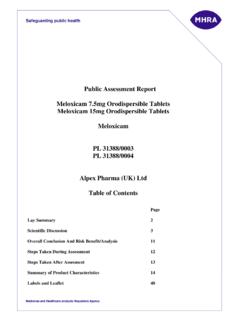
1 MHRA PUBLIC ASSESSMENT REPORT Controlling the risk of misuse of medicines containing pseudoephedrine and ephedrine July 2009 Executive summary 2 1. Introduction 4 2. Background 4 3. Amendment of legislation 5 4. Summary of implementation of measures 6 Pharmacy supervision plus education and awareness initiative 6 Pharmacy reporting of suspicions 6 Sales tracking and other measures to monitor evidence of use of OTC medicines in the manufacture of methylamphetamine 7 Triggers for a review of the availability of PSE/EPH OTC medicines 7 5. International position 9 6.
2 Action under misuse of drugs legislation 11 7. Summary and discussion on impact of action 12 8. Recommendations and conclusions 13 9. References 14 10. Glossary 17 1 EXECUTIVE SUMMARY (Please note that this summary is intended to be accessible to all members of the PUBLIC , including health professionals) Background The Medicines and Healthcare products Regulatory Agency (MHRA) is the government agency responsible for regulating the effectiveness and safety of medicines and medical devices in the UK. We continually review the safety of all medicines in the UK and inform healthcare professionals and the PUBLIC of the latest updates on the balance of risks and benefits associated with medicines. The following MHRA PUBLIC ASSESSMENT REPORT presents an update on the impact of measures introduced to control the potential misuse of medicines that contain pseudoephedrine (PSE) and ephedrine (EPH), in the manufacture of the Class A controlled drug methylamphetamine.
3 PSE and EPH are nasal decongestants (drugs which help to clear a blocked nose) contained in many cough and cold medicines sold over-the-counter (OTC) in UK pharmacies. There is concern that PSE and EPH can be extracted from these medicines and used in the illegal manufacture of the Class A controlled drug methylamphetamine (commonly known as methamphetamine , crystal meth or ice ). Because of this concern, the MHRA held a PUBLIC consultation in 2007 on whether to reclassify OTC medicines containing PSE or EPH to prescription-only medicines (POM). Following the consultation, The Commission on Human Medicines (CHM; an independent body who give advice to government Ministers about the safety, quality, and efficacy of medicines) advised that a number of measures should be introduced to control the supply of OTC medicines containing PSE and EPH. These measures included reducing the pack size for OTC products containing PSE and EPH and a restriction on sale to one pack per transaction.
4 CHM also advised that a working group be set up to monitor the effectiveness of the pharmacy controls and to advise the CHM on implementation of other measures that should be put in place to minimise the misuse of OTC medicines containing PSE or EPH in the illicit manufacture of methylamphetamine. The CHM also advised that products containing PSE or EPH should be reclassified to POM in July 2009 unless the risk of their misuse in the manufacture of methylamphetamine was contained. Based on recommendations from CHM, the following legal sales restrictions were put in place on April 1st 2008: It became illegal to sell or supply any product that contains more than 720 mg PSE or 180 mg EPH without a prescription It became illegal to sell or supply a combination of products that between them add up to more than 720 mg PSE or 180 mg EPH without a prescription in one transaction It became illegal to sell or supply a product that contains PSE and a product that contains EPH in one transaction In addition the Royal Pharmaceutical Society of Great Britain issued guidance that the sale and supply of products containing PSE or EPH must only be made by pharmacists or suitably trained pharmacy staff under the supervision of a pharmacist.
5 Impact of restrictions and CHM recommendations In July 2009, the Working Group presented to the CHM an update on the impact of the tighter pharmacy controls on the potential misuse of PSE and EPH, since their implementation. From the available evidence it appears that the measures implemented 2are helping to contain the potential problem of misuse and that there has been a reduction in sales. In light of this evidence, the CHM agreed with the Working Group that medicines containing PSE or EPH may continue to be sold as OTC pharmacy medicines, provided the measures put in place to contain their misuse continue to be adequate. The CHM also recommended that: the present levels of monitoring, education and awareness measures by pharmacies should be maintained; liaison with stakeholders such as the Home Office, the Association of Chief Police Officers (ACPO) and the Serious Organised Crime Agency (SOCA) should continue; and the Working Group should be reconstituted to review the situation as necessary, and in any case on a yearly basis.
6 31. INTRODUCTION (See glossary for explanation of terms) The Medicines and Healthcare products Regulatory Agency (MHRA) is the government agency responsible for regulating the effectiveness and safety of medicines and medical devices in the UK. We continually review the safety of all medicines in the UK and inform healthcare professionals and the PUBLIC of the latest updates on the balance of risks and benefits associated with medicines. The following MHRA PUBLIC ASSESSMENT REPORT presents an update on the impact of measures introduced to control the potential misuse of medicines that contain pseudoephedrine (PSE) and ephedrine (EPH), in the manufacture of the Class A controlled drug methylamphetamine. 2. BACKGROUND PSE and EPH are nasal decongestants contained in many cough and cold medicines sold over-the-counter (OTC) in UK pharmacies. There has been increasing concern that PSE and EPH can be extracted relatively easily from over-the-counter (OTC) medicines and used in the illicit manufacture of methylamphetamine (commonly known as methamphetamine , crystal meth or ice ).
7 Methylamphetamine is a highly addictive, potent stimulant which affects the central nervous system, and can cause serious physical and psychological harm. Methylamphetamine was reclassified on 18 January 2007 by the Home Office as a Class A controlled drug, based on the recommendation of the Advisory Council on the Misuse of Drugs1 (ACMD). A PUBLIC consultation was carried out in March 2007 on minimising the risk of misuse of medicines containing PSE or EPH in the manufacture of methylamphetamine. In this consultation, the MHRA sought views on potentially restricting the availability of these medicines by changing their legal status from pharmacy (P) to prescription-only medicines (POM), together with a restriction in their pack size. In July 2007, the Commission on Human Medicines (CHM; an independent body who give advice to government Ministers about the safety, quality, and efficacy of medicines) considered the responses to the consultation. They advised that the legal status of medicinal products containing PSE or EPH should be reclassified from P to POM in July 2009, unless the risk of misuse of these OTC medicines in the illicit manufacture of methylamphetamine was contained.
8 They also advised that these products could be reclassified at any time before this date if evidence emerged that misuse had not been contained. The CHM provided advice on pack size restrictions and other measures to control the supply of OTC medicines containing PSE or EPH and advised that a working group should be set up to advise on implementation of these measures (see press release and weblinked minutes). Accordingly, the CHM Working Group on PSE and EPH (Working Group) was set up in September 2007 to advise the CHM on the implementation of measures that should be put in place to minimise the misuse of OTC medicines containing PSE or EPH in the illicit manufacture of methylamphetamine. Following CHM advice to restrict pack sizes of PSE and EPH, a further PUBLIC consultation in October 2007 considered specific amendments to the Prescription Only Medicines Order 1997 (POM Order) to make the sale and supply of products containing more than 720 mg of PSE or 180 mg EPH prescription-only.
9 This legislation was established on 1st April 2008 (see next section). 1 An independent expert body that advises the government on drug-related issues in the UK 43. AMENDMENT OF LEGISLATION The following legislation (SI 2008/464) was put in place from 1st April 2008 to restrict the sales of PSE and EPH: It became illegal to sell or supply any product that contains more than 720 mg PSE or 180 mg EPH without a prescription It became illegal to sell or supply a combination of products that between them add up to more than 720 mg PSE or 180 mg EPH without a prescription in one transaction It became illegal to sell or supply a product that contains PSE and a product that contains EPH in one transaction Professional guidance was also issued by the Royal Pharmaceutical Society of Great Britain (RPSGB) for PSE or EPH-containing products to be supplied personally by a pharmacist or a trained staff member under the supervision of a pharmacist (see section below).
10 In July 2009, the CHM considered a paper from the Working Group which gave an update on the measures to control the misuse of PSE and EPH-containing medicines. CHM were asked to consider the impact of these measures, and to advise on whether small packs of these medicines should continue to be available as P medicines. The following MHRA PUBLIC ASSESSMENT REPORT presents the findings from this paper, and the recommendations based on the paper from CHM. 54. SUMMARY OF IMPLEMENTATION OF MEASURES The CHM Working Group met five times since its start in September 2007. Their progress on implementation of measures to minimise the misuse of PSE or EPH-containing OTC medicines in the illicit manufacture of methylamphetamine is summarised below: Pharmacy supervision plus education and awareness initiative The Working Group established close links with the RPSGB, the National Pharmacy Association (NPA), the Company Chemists Association (CCA) and the Proprietary Association of Great Britain (PAGB).