Transcription of Michael Porter's Five Forces Model
1 {SIS ect a healthcare entity and investi etc. using publicly available infor ~e Internet, and so on. With this alysis. Provide a narrative offering .r methods for its assembly, sources le analysis, and the resulting out- Michael Porter's five Forces Model LEARNING OBJECTIVES After examining this chapter, readers will have the ability to: Understand that intense competition and rivalry characterize the healthcare industry. Realize that healthcare entities are required to possess a deep understanding of their competitors to best position themselves for marketplace success. Recognize that competition is multidimensional, existing on multiple fronts, and that each front must be understood if marketing success is to be achieved. Realize that the nature ofcompetition in any industry is based on five Forces : existing competitors, potential entrants, sub stitutes, suppliers, and buyers. Appreciate the value of Michael Porter's five Forces Model as a tool for understanding and addressing competition in the health care marketplace.}
2 INTRODUCTION The healthcare marketplace is characterized by intense competition and rivalry-elements that will only intensify as healthcare entities ofall kinds vie for the opportunity to serve target markets. Those entities that can 191 192 CHAPTER 28 Michael Porter's five Forces Model successfully navigate the complex healthcare environment will be hand somely rewarded with increased market share and prosperity. Successful navigation of this environment, of course, requires a deep understanding of marketplace competitors. All too often, however, entities view their competitive environment in an overly narrow fashion that fails to acknowledge the true depth and breadth of competitive Forces in the marketplace. Competition is multidimensional, and its vastness must be clearly understood if marketing success is to be achieved. The critical task of accurately identifYing the competitive elements in a market is greatly facilitated by Michael Porter's five Forces Model .
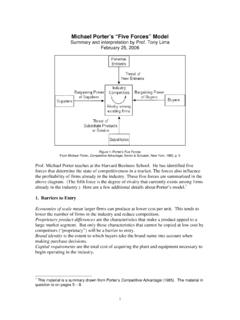
3 Illustrated in Figure 28-1, Porter's five Forces Model provides useful in sights into the multifaceted nature ofcompetition. According to Porter, the nature ofcompetition in any industry is based on five Forces : existing com petitors, potential entrants, substitutes, suppliers, and buyers. I POTENTIAL I ENTRANTS Threat of new entrants INDUSTRY COMPETITORSB argaining power Bargaining power of suppliers of buyers 0(ISUPPLIERS : BUYERSII i U1 t .j Rivalry Among Existing Firms Threat of substitute products I SUBSTITUTES I Reprinted with the permission of The Free Press, a Division of Simon & Schuster Adult Publishing Group, from COMPETITIVE STRATEGY: Techniques for Analyzing Industries and Competitors by Michael E. Porter. Copyright 1980, 1998 by The Free Press. All rights reserved. FIGURE 28-1 Porter's five Forces Model SUBSTITUTES 193 These Forces are unique to each industry-and industry segment-and combine to determine the competitive intensity and ultimate potential of associated markets.)
4 These five Forces are explained as follows. EXISTING COMPETITORS Existing competitors are the most obvious competitive force , jockeying for position through new product development, innovative promotional campaigns, and so on. Rivalry among existing competitors is especially in tense when competitors are numerous and fairly equivalent in terms of size and power, when exit barriers are high, and when industry growth is slow resulting in struggles for market share. These characteristics are frequently observed in the healthcare marketplace, illustrating the intense rivalry within the industry. POTENTIAL ENTRANTS Entities that might potentially enter the market represent significant threats to existing competitors. New entrants bring new capacity and re sources to the market along with desires for market share. The magnitude of the threat posed by new entrants is largely based on the particular barriers to entry that exist.
5 Typical examples of entry barriers include cap ital requirements, proprietary product differences, government policy, and the market dominance and brand identiry of existing competitors. Significant entry barriers yield significant protection from the threat of new entrants, while few barriers increase the competitive nature of the market. Certificates of need possessed by hospitals and patent protection possessed by pharmaceutical firms are examples of barriers that offer substantial pro tection in the healthcare marketplace. SUBSTITUTES Substitutes are products that differ from particular offerings but largely, and sometimes completely, fill equivalent wants and needs. As a result, substi tute offerings can greatly impact the performance of healthcare entities and even threaten their very existence. Laser vision correction could be viewed 194 CHAPTER 28 Michael Porter's five Forces Model as a substitute for eyeglasses and contact lenses.
6 The services of a chiroprac tor could be viewed as a substiture for the services ofan orthopedic surgeon. The seriousness of the threat ofsubstitutes is predominantly based on their performance and price characteristics. Substitutes that offer equal or bet ter performance pose significant threats, especially when price advantages exist. SUPPLIERS Suppliers provide the components necessary for healthcare organizations to offer goods and services to their customers. Surgery scalpels, pharma ceuticals, hospital beds, and diagnostic imaging equipment represent just a few of the many products that healthcare entities purchase from suppliers. Without these "raw materials," healthcare entities could not function. This dependence on suppliers poses a significant threat to healthcare entities. Suppliers can raise their prices, lower the quality ofthe components that they provide, or simply go our of business-all situations that can yield potentially devastating effects.
7 Suppliers are particularly powerful if they are few in number, if few substitures exist, and if entities are not key customers. BUYERS Porter's term buyers is equivalent to the term customers, which is better suited for the healthcare marketplace. Quite obviously, customers possess significant bargaining power over healthcare entities because their patron age ultimately determines institutional survival, growth, and prosperity. The array of customers in the healthcare marketplace is quite varied, in cluding residents in nursing home beds, patients in hospital beds, patrons at local pharmacies, recipients of home health services, and even health in surance companies and other third-party payer entities that pay for medical services on behalf of clients. Without customers, operations cease. For this reason, marketers must ensure that all marketing efforts are customer focused. Importantly, marketers must strive to accurately assess the wants and needs of customers and serve them in a manner that will meet and ex ceed their expectations.
8 OPERATIONAL MATTERS 195 OPERATIONAL MATTERS Porter's five Forces Model is highly useful in that it clearly illustrates the multidimensional nature ofmarketplace competition. Its use, however, can greatly be extended through the assembly and completion ofa five Forces Worksheet. Marketers simply (1) identifY the product offering to be eval uated, (2) construct the five Forces Worksheet, as illustrated in Figure 28-2, (3) identifY existing competitors, potential entrants, substitutes, suppliers, and buyers, and (4) place the identified current and potential competitors on the diagram accordingly. When completed, the five Forces Worksheet clearly identifies all five competitive Forces that entities currently face or could potentially face, as illustrated in Figure 28-3. Completion of this sim ple, yet highly effective, device yields considerable insights into the current POTENTIAL ENTRANTS 1.
9 _____ 2. _____ 3. _____ 4. _____ 5. _____ INDUSTRY COMPETITORS SUPPLIERS BUYERS 1. 1. 1. 2. 2. 2. 3. 3. 3. 4. 4. 4. 5. 5. 5. SUBSTITUTES 1. _____ 2. _____ 3. _____ 4. _____ 5. _____ Adapted with the permission of The Free Press, a Division of Simon & Schuster Adult Publishing Group, from COMPETITIVE STRATEGY: Techniques for Analyzing Industries and Competitors by Michael E. Porter. Copyright 1980, 1998 by The Free Press. All rights reserved. FIGURE 28-2 A five Forces Worksheet 196 CHAPTER 28 Michael Porter's five Forces Model POTENTIAL ENTRANTS National chain considering market Local hospital considering opening retail pharmacy Unknown retail start-ups Unknown Internet/mail-order start-ups .. SUPPLIERS INDUSTRY COMPETITORS BUYERS Durable medical equipment firms (2) City and county residents/visitorsRetail pharmacies -chain (5)Pharmaceutical manufacturers (2) Local hospitals (2).. Retail pharmacies -independent (2)Pharmaceutical wholesalers (3) Local nursing homes (3)Retail pharmacies -hospital ~ General wholesalers (4) Area medical clinics (7)owned/operated (1)Computer systems firms (2) Public third-party payers (2)Internet/mail-order pharmacies (10+)Office equipment suppliers (4) Private third-party payers (7) t SUBSTITUTES Herbal remedies Folk remedies Samples from physician office visits , , Abstaining from treatment (Le.)
10 , letting "time' heal headaches, colds, etc.) Adapted with the permission of The Free Press, a Division of Simon & Schuster Adult Publishing Group, from COMPETITIVE STRATEGY: Techniques for Analyzing Industries and Competitors by Michael E. Porter_ Copyright 1980, 1998 by The Free Press. All rights reserved. FIGURE 28-3 A Retail Pharmacy's five Forces Worksheet and future competitive marketplace and hence serves as an essential mar keting planning tool. SUMMARY By dearly illustrating the true depth and breadth of the competitive envi ronment, Porter's five Forces Model serves as an indispensable resource for marketers. With this information, healthcare marketers can establish strategic and tactical priorities and position their organizations to capitalize on opportunities and avoid or eliminate threats. Ideally, healthcare mar keters will address each of the five Forces . By properly addressing the com plete competitive environment, healthcare marketers are better prepared to meet and exceed market share and related performance objectives.