Transcription of Michigan Quality Improvement Consortium …
1 June 2018 Key ComponentsPeriodic assessment, annuallyLaboratory testsEducation, counseling and risk factor modification, at diagnosis and as recommendations, until therapeutic goals are achievedApproved by MQIC Medical Directors June 2008, 2010, 2012, 2013, 2014, 2015, 2016, 2018 This guideline lists core management steps. It is based on the American Diabetes Association Standards of Medical Care in Diabetes - 2018; Volume 41, Supplement 1, Pages S1-S159. Individual patient considerations and advances in medical science may supersede or modify these recommendations. 6 Diabetes Care, Volume 39, Supplement 1, January 2016, S43, Table (Tight control is risky in certain patients)The following guideline applies to patients aged 18-75 years with type 1 and type 2 diabetes mellitus. It recommends specific interventions for periodic medical assessment, laboratory tests and education to guide effective patient of evidence for the most significant recommendations: A = randomized controlled trials; B = controlled trials, no randomization; C = observational studies; D = opinion of expert panel1 National Standards for Diabetes Self-Management Education and Support2 There is no evidence that e-cigarettes are a healthier alternative to smoking or that e-cigarettes can facilitate smoking cessation3 Consider referral of patients with serum creatinine value > mg/dl (adult value) or persistent albuminuria to nephrologist for evaluation4 Diabetes Care, January 2016: Cardiovascular Disease and Risk Management52013 ACC/AHA Blood Cholesterol Guideline Table 5.
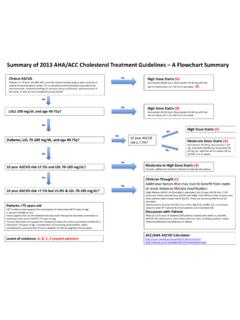
2 High-, Moderate-, and Low-Intensity Statin TherapyRecommendation and Level of EvidenceCardiovascular risks (tobacco use, hypertension, dyslipidemia, sedentary lifestyle, obesity, sleep [C], stress, family history, age > 40).Height, weight, BMI, blood pressure and pulse. [A] Record BP and pulse at every foot exam (inspection every visit, monofilament, and pulses). [B]Psychosocial evaluation and screen for depression. [D]Barriers to lifestyle and medication adherence including knowledge, attitudes, access to medications and supplies, and food insecurity. [D]Dilated eye exam by ophthalmologist or optometrist [B], or if no prior retinopathy, may screen with fundal photography. [B] In the absence of retinopathy, repeat retinal eye exam in 2 every 3-6 months. [D] Urine microalbumin [B], serum creatinine and calculated GFR [D], test annually.
3 Lipid profile for estimating initial risk and assessing adherence to therapy [B], need not be TSH testing in patients with type 1 diabetes mellitus. [D]Liver function test (LFT) at diagnosis, consider annually. [D]Comprehensive diabetes self-management education and support (DSME and DSMS) from a collaborative team or diabetic educator if availableEducation should be individualized, based on the National Standards for DSME1[B] and include: Importance of regular physical activity with sedentary periods interrupted every 30 minutes, healthy diet, appropriate BMI. [A] Diabetes disease process and treatment; access to, and safe and effective use of medications and supplies; prevention, detection and treatment of acute and chronic complications, including recognition and treatment of hypoglycemia. Consider endocrine referral for unrecognized hypoglycemia, type 1, atypical presentation, difficult to control, frequent hospitalizations or ER visits.
4 Role of self-monitoring of blood glucose in glycemic control. [A] Cardiovascular risk reduction. Tobacco cessation2 [B], secondhand smoke avoidance. [C] Self-care of feet, appropriate footwear, nail and skin care [B]; refer patients with high-risk feet to podiatrist or foot care specialist. Preconception counseling for all women capable of pregnancy. [B] Dental care. [D] Strategies for making health behavior changes and addressing self-management barriers, including social determinants of health. A1c Goals:< 7% for most patients [A]< - women planning pregnancy< - treated only with lifestyle, metformin-like drugs7-8% - limited life expectancy, severe hypoglycemia, severe macrovascular complications or severe CKDFor patients motivated to quit, medications for tobacco dependence are more effective than counseling alone.
5 [B]Treatment of hypertension using up to 3-4 anti-hypertensive medications to achieve adult target of < 140/90 mmHg. [A] (see MQIC hypertension guideline). Mortality may increase if diastolic is treated to levels < 70. [C] Prescription of ACE inhibitor or angiotensin receptor blocker in patients with chronic kidney disease or albuminuria3. [A]Moderate intensity statin4,5 therapy for persons 40 years without overt CVD for primary prevention against macrovacular complications ( , simvastatin 20-40 mg, atorvastatin 10-20 mg). [A]High intensity statin ( atorvastatin 40-80 mg) for patients with overt CVD. [A]Assurance of appropriate immunization status [Tdap or Td, influenza, pneumococcal vaccine (PPSV23), Hep B]. [C]Anti-platelet therapy [A]: low dose aspirin, unless contraindicated, for adults with cardiovascular disease. Individualize the A1c goal6.
6 Mortality increases as A1c increases [B]. Michigan Quality Improvement Consortium GuidelineManagement of Diabetes Mellitus