Transcription of MICHIGAN RABIES ASSESSMENT: WHEN A PERSON …
1 Was the exposure toa wild animal, suchas a bat, fox,raccoon, or skunk?Is the animal arodent, such as a squirrel, hamster,mouse, rabbit, or rat? 3Is the animal a dog,cat, or ferret?Consult the local or statehealth departmentMICHIGAN RABIES ASSESSMENT: WHEN A PERSON HAS BEEN EXPOSED 1 Did the PERSON have contact with the saliva or brain tissue of a mammal via fresh open wound or mucous membrane, or wasthe PERSON exposed to a bat? 2DO NOTADMINISTERPEPNOYESNONONODO NOTADMINISTERPEPWas the animalcaptured or can it belocated for 10-dayobservation?YESYESIs the animal brainavailable for rabiestesting at the statelaboratory? 5 Did the animal exhibitabnormal behavior ordie within 10-dayobservation period?
2 Did the animal exhibitabnormal behavior orbite unprovoked? 4 YES*NOYESIs the directfluorescent antibodytest positive?DO NOTADMINISTERPEPYES*YESNODO NOTADMINISTER PEPADMINISTERPEP 6,7 NONOYESPEP MAY BECONSIDEREDNOYESSEE IMPORTANT INFORMATION ON REVERSE SIDEI mmediately consult with local or state public health officialsMichigan law requires that animal bites be immediately reported to the local health department* RABIES PEP is a medical urgency, NOT an emergency. The decision to initiate RABIES PEP can normally wait to determine whether an animal is available for testing or observation, and for test results to become available. Testing is available at theMDHHS laboratory 24/7 including weekends and holidays; turnaround time for testing and results is normally 24-48 exposure risk assessment requires balancing a number of criteria: the species of animal and the endemicityof RABIES for that species for MICHIGAN , the observed health and behavior of the animal, and the circumstances of the bite.
3 This algorithm only addresses RABIES post-exposure prophylaxis. Other treatment such as wound care, antibiotics, and tetanus immunization may be addition to obvious bites or mucous membrane exposures, the CDC suggests that PEP be considered in cases where there is a reasonable probability that contact with a bat may have occurred ( a deeply sleeping PERSON awakens to find a bat in the same room, an adult witnesses a bat in a room with a previously unattended child, mentally disabled PERSON , or intoxicated individual) and RABIES cannot be ruled out by testing of the bat. PEP would not be warranted for other household members. Consult your local health department for questions regarding uncommon circumstances, rodents and rabbits are not likely to carry RABIES , and bites from these species almost never require RABIES PEP.
4 In questionable or unusual circumstances involving rodent or rabbit bites, consult your local health exposures are rare and typically require an animal to cross neutral space and attack. Provokedexposures may include: attempting to feed an animal having contact with an injured animal entering an animal s territory petting or playing with an animal handling an animal breaking up a fight between animals walking, running, or riding a bicycle past an animalThe physician should attempt to get the patient to describe the scenario in order to establish the true nature or the circumstances surrounding the biting incident DO NOT simply ask if the bite was provoked or PEP is a medical urgency NOT an emergency.
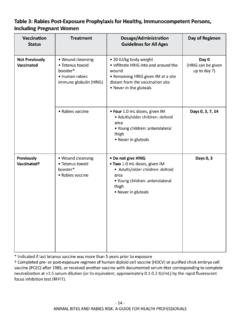
5 The severity and location of a wound (severe wounds or obvious wounds near the head and neck should be given highest priority), and the expected interval between the time of the bite and receipt of RABIES test results should be considered when making a decision to begin PEP while awaiting test results. Potentially exposed persons can normally afford to wait for 1) an animal to be located for quarantine or testing, or 2) animal RABIES testing results. Testing is available at the MDHHS laboratory 24/7 including weekends and holidays; turnaround time for testing and results is normally 24-48 the PERSON previously received RABIES immunoprophylaxis1or is immunosuppressed2, PEP consists of four (4) doses of vaccine ( ml each administered IM in the deltoid region) on days 0, 3, 7, and 14, and one (1) dose of human RABIES immune globulin (HRIG) administered on day 0.
6 HRIG(dosage 20 IU/kg) should be infiltrated into and around the bite wound as much as anatomically feasible, with the remainder administered IM at a site distant from vaccine administration. HRIG should not be administered in the same syringe or at the same site as previously vaccinated patient receives: No HRIG, and two (2) doses of vaccine on days 0 and immunosuppressed patient receives: HRIGand a five (5) dose series of vaccine (days 0, 3, 7, 14, 28). Serum should be tested for RABIES neutralizing antibody 1-2 weeks following completion of your local health department if deviations from the PEP schedule the biting animal is captured and tests negative for RABIES after PEP has begun, PEP may be : human RABIES Prevention United States, 2008: Recommendations of the Advisory Committee on Immunization Practices (ACIP).
7 CDC MMWR 2008; 57 (No. RR-3).Use of a Reduced (4-Dose) Vaccine Schedule for Postexposure Prophylaxis to Prevent human RABIES : Recommendations of the Advisory Committee on Immunization Practices (ACIP). CDC MMWR 2010; 59 (No. RR-2).Compendium of Animal RABIES Prevention and Control, 2016: National Association of State Public Health Veterinarians, Inc. Journal of the American Veterinary Association. , , March 1, 2016. IMPORTANT INFORMATIONE merging and Zoonotic Infectious Diseases SectionUpdated April