Transcription of Milestone 1 - essentials.uk.com
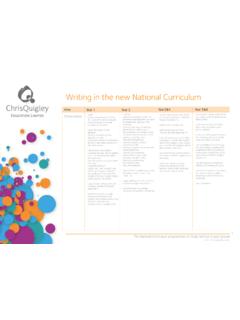
1 2014 Chris Quigley Education Ltd Milestone 1 Assessment criteria for writing Learning Objective Key Indic a tors Basic Advancing Deep Composition To write with purpose Use some of th e ch aracteristic features of th e typ e of writing used. A writin g frame or stru ctu re provided by th e teach er is used. When reminders are provided (for examp l e, in th e form of success criteria), kn owledge of ch aracteristic features is used. Knowledge of ch aracteristic features is applied independently without prompts or guidance Use well-ch osen adjectives to add detail. There is an awareness of the terminology (n ou n , adjective, verb , pronoun an d adverb). Writing may include some of th e features listed.
2 Structure an d help may be required. When reminders are provided, well ch osen descriptive language is used. A good ran ge of descriptive lan gu age is used independently, without prompts or guidance. Use names of people, places an d th in g s. There is an awareness of the terminology (n ou n , adjective, verb , pronoun an d adverb). Writing may include some of th e features listed. Structure an d help may be required. When reminders are provided, well ch osen descriptive language is used. A good ran ge of descriptive lan gu age is used independently, without prompts or guidan ce. Use nouns and pronouns for vari ety There is an awareness of the terminology (n ou n , adjective, verb , pronoun an d adverb).
3 Writing may include some of th e features listed. Structure an d help may be required. When reminders are provided, well ch osen descriptive language is used. A good ran ge of descriptive lan gu age is used independently, without prompts or guidance. To use imaginative description Use adverbs for extra detail. There is an awareness of the terminology (n ou n , adjective, verb , pronoun an d adverb). Writing may include some of th e features listed. Structure an d help may be required. When reminders are provided, well ch osen descriptive language is used. A good ran ge of descriptive lan gu age is used independently, without prompts or guidance. 2014 Chris Quigley Education Ltd Re-read writing to ch eck it makes sense.
4 There is an awareness of the need for writing to make sen se. Wh en h elp is p rovid ed , writing is read an d ch anges are made if necessary. Writing generally makes sense to the reader Writing is re-read and changed, if necessary, so that it makes sense to th e reader. Use th e correct ten ses. Tenses are used inconsistently. Tenses are generally used correctly. Tenses are used correctly an d con sisten tly th rou g h ou t. To organise writing appropriately Organ ise writing in line with its purpose. When help and structure are provided, writing is organised in line with its purpose Writing is generally organised appropriately. Writing has a clear organisational structure. Prompts an d guidance are not required.
5 Write abou t more th an one idea. When guides or prompts are provided, writing includes more th an one idea or step. When reminders are provided, ideas are split into paragraphs. Writing is clearly organised into paragraphs that contain a definite th eme. To use paragraphs Group related information. When guides or prompts are provided, writing includes more th an one idea or step. Paragraphs contain clearly related information. A number of th emes are developed. Sequence sentences to form a clear narrative. When help or structure is provided, writing includes a number of related sentences. When reminders are provided, writing includes a number of related sentences th at flow an d make sen se as a sh ort narrative.
6 Writing is fluent and includes a series of well-con stru cted sen ten ces th at en g ag e th e reader. Join sen ten ces with con ju n ction s an d con n ectives. When help or structure is provided, sentences are linked with con ju n ction s an d con n ectives. When reminders are provided, sentences are linked with a good range of con ju n ction s an d con n ectives. Sentences are linked with a good range of conjunctions and con n ectives. To use sentences appropriately Vary th e way sentences begin. When help or structure is provided, sentences begin with a range of words other than and or then . When reminders and ideas are provided, sentences begin in a vari ety of ways. Sentences begin in ways appropriate for the purpose of the writing and include imaginative vari ety.
7 2014 Chris Quigley Education Ltd Transcription Begin to form lower-case letters correctly an d of con sisten t size. When help an d su pport are provided, some letters and digits are beginning to show correct formation . Letters an d digits are gen erally formed correctly an d con sisten tly. Letters an d digits are correctly formed, with a definite sense of con trol. Form capital letters correctly an d of consistent size. When help an d support are provided, some letters an d digits are beginning to show correct formation . Letters an d digits are gen erally formed correctly an d con sisten tly. Letters an d digits are correctly formed, with a definite sense of con trol. Form digits 0 9 correctly an d of con sisten t size.
8 There may be inconsistencies in the size of letters. Letters an d digits are gen erally formed correctly an d con sisten tly. Letters an d digits are correctly formed, with a definite sense of con trol. Begin to join some letters. When help and support are provided, some letters are joined. Some letters are joined Most letters are joined. To present neatly Use spacing between words th at reflects th e size of th e letters When help and support are provided, words are begin n in g to be spaced appropriately. Words are usually spaced appropriately. Words are spaced evenly and letters are well spaced both above an d bel o w th e lin e. Spell words containing 40+ learned phonemes. When help is provided, some of the 40+ learned phonemes are applied in writing.
9 Most of the 40+ learned phonemes are applied correctly in writing Almost all simple words are spelled correctly. To spell cor r e ctly Spell common excep ti o n words. Some of the days of the week are attempted an d th e words said an d th e are sometimes written correctly Most of the common exception words are spelled correctly. All common exception words are spelled correctly. 2014 Chris Quigley Education Ltd Add prefixes an d su ffixes. Both -s an d -es are beginning to be used for plurals. Some prefixes (such as un-) an d suffixes (su ch as -ing, -ed, -er, -ing, -er an d -es t) are u sed. Writing includes a good range of prefixes and suffixes. Use the possessive (singular) apostroph e. Apostroph es may sometimes be u sed.
10 When reminders of the rules are provided, the possessive apostrophe is used correctly. The possessive apostrophe is generally used correctly. Distinguish between homophones an d near-homophones. Co mmo n h o mo p h o n es are s o meti mes con fu sed an d so misspelled. Co mmo n h o mo p h o n es are g en eral l y distinguished an d so spelled correctly Co mmo n h o mo p h o n es are al mo s t always spelled correctly. Begin to use a capital letter for th e names of people, places, the days of the week and I. When word banks and reminders are provided, capital letters are beginning to be used appropriately. When reminders are provided, capital letters are generally used appropriately. Cap i tal l etters are u s ed co n s i s ten tl y an d appropriately.