Transcription of Minnesota Opioid Prescribing Guidelines
1 Minnesota Opioid Prescribing Guidelines First edition, 2018 March 30, 2018 An open letter to Minnesota s medical community: Minnesota , like the rest of the nation is facing an epidemic of Opioid misuse, abuse and overdose. In recent years, our state has experienced alarming increases in rates of hospitalizations, substance use disorder treatment admissions and overdose deaths related to opioids. From 2000 to 2016, the number of deaths in Minnesota caused by Opioid -related overdoses increased fourfold.
2 Too many Minnesotans face the heartbreaking cycle of chronic pain and Opioid dependence that often results in a lower quality of life, or even worse, can lead to misuse, abuse, and overdose. The medical community is engaged in the Opioid crisis, and is actively developing solutions to the myriad of ways in which the crisis impacts our communities. A major part of this response is a thoughtful discussion of Opioid Prescribing practices and pain management supported by a growing body of research and evidence-based practices. This conversation must continue: in the medical literature, in gatherings of clinicians, and in the examination room with patients.
3 The Minnesota Opioid Prescribing Guidelines were developed within this movement by members of the Minnesota medical community, and with the support of health systems and medical organizations across the state. All strands of our community participated in this discussion. The State of Minnesota and the Opioid Prescribing Workgroup, via these Guidelines , created a framework for judicious Opioid Prescribing within the context of pain management. These Prescribing Guidelines address Opioid use throughout the pain continuum with a particular focus on the critical treatment period during acute pain and recovery from surgeries and injuries.
4 Preventing chronic Opioid use depends on setting new best practices for this recovery period and on carefully managing care for those already on chronic opioids. Please incorporate these Guidelines in your practice. Thank you for the care you provide to the citizens we all serve. Sincerely, Commissioner Emily Piper Commissioner Jan Malcolm Minnesota Department of Human Services Minnesota Department of Health March 2018 1 How to Use These Guidelines .. 2 Introduction .. 3 Glossary of Terms and Summary of Opioid Prescribing Recommendations.
5 13 Part I. Responsible Opioid Prescribing in all Pain Phases ..17 Section A. Patient Section B. Biopsychosocial Section C. Non- Opioid and Non-Pharmacologic Treatment Modalities ..26 Part II. Acute Pain Phase Prescribing Part III. Post-Acute Pain Phase Prescribing Recommendations ..33 Part IV. Chronic Pain Opioid Prescribing Part V. tapering and Discontinuing Opioid Part VI. Women of Childbearing Appendix A. Opioid Prescribing Work Group Appendix B. Opioid Prescribing Work Group: Acute and Post-acute Pain Prescribing and Assessment Appendix C.
6 Morphine Milligram Equivalence ..57 Appendix D. Resources ..58 References ..61 Table of Contents March 2018 1 How to Use These Guidelines The Guidelines are organized in the following parts: Introduction and Glossary describes the background for the Opioid Prescribing Improvement Program and these recommendations, an overview of the Opioid use crisis in Minnesota , the guiding principles of the recommendations and common terms used in the guidance. Summary of Opioid Prescribing Recommendations provides a table containing a summary version of all of the Prescribing recommendations.
7 Part I: Responsible Opioid Prescribing for All Pain Phases provides recommendations and discussion about topics that are common to the separate pain phase Prescribing recommendations. This includes patient safety when Prescribing opioids, the various assessments recommended when Prescribing opioids and recommendations about non- Opioid and non-pharmacological pain treatment. Part I should be read in conjunction with each or all of the specific pain phase recommendations. Part II: Acute Pain Phase Prescribing Recommendations provides the Prescribing recommendations for pain occurring 0-4 days (or up to 7 in the case of major surgery or trauma) after an acute event.
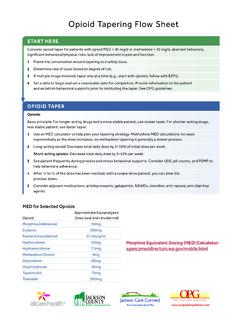
8 Part III: Post-Acute Pain Phase Prescribing Recommendations provides the Prescribing recommendations for pain lasting up to 45 days after an acute event. Part IV: Chronic Pain Prescribing Recommendations provides the Prescribing recommendations for pain lasting longer than 45 days after an acute event, or beyond the expected duration of recovery. Part V: tapering and Discontinuing Opioid Use Recommendations provides the recommendations related to tapering and discontinuing chronic Opioid analgesic therapy. Part VI. Women of Childbearing Age provides recommendations specific to women of childbearing age for both acute and chronic pain.
9 These recommendations should be considered in conjunction with the appropriate general pain phase recommendations. March 2018 2 Introduction This is the first edition of the Minnesota Opioid Prescribing Guidelines . The Guidelines provide a framework for the appropriate use of Opioid analgesia within the larger context of pain management. Specifically, these Guidelines aim to reduce the inappropriate use of Opioid analgesia, limit the oversupply of prescription opioids in the community and reduce variation in Opioid Prescribing behavior and above all else, improve the safety and effectiveness of treatments for pain and reduce the potential for harm of such treatments.
10 The Guidelines are for all Minnesota prescribers, and support the Opioid Prescribing quality improvement program for Minnesota Health Care Program-enrolled providers. The recommendations are based on current evidence, consideration of other Prescribing guidance, and expert, clinical opinion Combined with appropriate assessment and professional judgement, these Guidelines support a judicious approach to Opioid Prescribing . Scope and Audience The Guidelines are intended for use by clinicians in primary care and specialty outpatient settings who manage pain. These Guidelines are not intended to apply to hospice or palliative care patients or patients with end of life or cancer-related pain.