Transcription of MLA 8TH ED. CITATIONS - Stewart Library
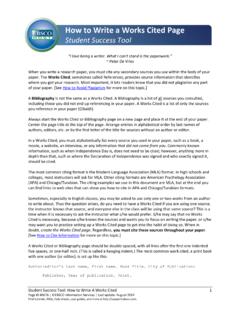
1 MLA 8 ED. TH. CITATIONS . MLA CITATIONS . After you locate sources for your assignment or project and determine that they are relevant for your research, make sure you record all the information that you'll need to cite it in your paper. This section will cover how to cite various types of books, articles, websites, and other electronic resources in MLA (Modern Language Association) 8th edition, which is one of the most popular citation styles for undergraduate students. When you are citing sources, it is important that you follow the rules closely; this includes things like using hanging indentation, italicizing certain parts of the citation , and putting periods and commas in the right place. There are many different sources that provide examples of CITATIONS , some of which will be mentioned here. However, the definitive source for citing in MLA is the official MLA handbook for writers of research papers, 7th Edition.
2 If you do not see an example that closely matches the source you are trying to cite, consult the manual directly. There are a number of copies available in the Stewart Library . Some are located in the reference collection, and others are in the general collection and may be checked out. Note: Do not rely on citation tools, such as the ones built into Library databases or Microsoft Word, or tools available on the Web, such as They often contain errors. It is important to check formatting for CITATIONS carefully before submitting assignments. CITING BOOKS. Books come in a variety of forms. Some are electronic and some are in print. Some have authors and some have editors. Some have multiple editions. All are cited differently, so it's important to know what type of source you have before you can cite it.
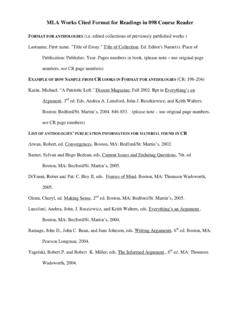
3 In general, book CITATIONS will include: the author(s) or editor(s), publication year, title (and subtitle) of the book, publisher name If you are citing a book chapter (rather than a whole book), you will also include the chapter title, authors, and page numbers of that chapter. If what you are citing does not fit one of these examples, consult the manual or other places for additional examples. The general rule of thumb to follow if you have a source that does not exactly fit the examples is to get it as close as you can. 2. Print book with one author: Jacobs, Alan. The Pleasures of Reading in an Age of Distraction. Oxford UP, 2011. Print Book with Multiple Authors (and an edition). Gillespie, Paula, and Neal Lerner. The Allyn and Bacon Guide to Peer Tutoring. Allyn and Bacon, 2000. Print Book with Multiple Editors Hill, Charles A.
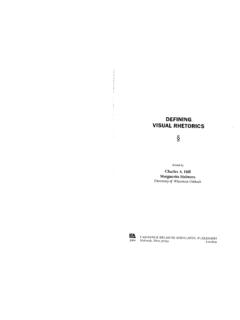
4 , and Marguerite Helmers, editors. defining visual Rhetorics. Lawrence Erlbaum Associates, 2004. Chapter from an Edited Print Book Harris, Muriel. Talk to Me: Engaging Reluctant Writers. A Tutor's Guide: Helping Writers One to One, edited by Ben Rafoth, Heinemann, 2000, pp. 24-34. Note: For more than three authors, give the name of the first author, followed by et al. ( and others'). CITING ARTICLES. Like books, articles come in a variety of forms. Some are electronic and some are in print. Some electronic articles are found in article databases, while others are found on the free Web. Articles may be classified as magazine articles, journal articles, trade publication articles, or newspaper articles. All are cited differently, so it's important to know what type of source you have before you can cite it.
5 In general, article CITATIONS will include: the author(s), date (only the year for journals, full date for magazines and newspapers). title of the article, name of the magazine, journal, or newspaper, 3. volume and issue (for journals), page numbers DOI (if available). Scholarly Journal Article Bagchi, Alaknanda. Conflicting Nationalisms: The Voice of the Subaltern in Mahasweta Devi's Bashai Tudu. Tulsa Studies in Women's Literature, vol. 15, no. 1, 1996, pp. 41-50. Scholarly Journal Article from an Article Database Langhamer, Claire. Love and Courtship in Mid-Twentieth-Century England. Historical Journal, vol. 50, no. 1, 2007, pp. 173-96. ProQuest, Accessed 27 May 2009. Scholarly Journal Article from the Web (with no page number). Dolby, Nadine. Research in Youth Culture and Policy: Current Conditions and Future Directions.
6 Social Work and Society: The International Online-Only Journal, vol. 6, no. 2, 2008, Accessed 20 May 2009. Popular Magazine Article (print version). Poniewozik, James. TV Makes a Too-Close Call. Time, 20 Nov. 2000, pp. 70-71. Popular Magazine Article from the Web Bernstein, Mark. 10 Tips on Writing the Living Web. A List Apart: For People Who Make Websites, 16 Aug. 2002, Accessed 4 May 2009. 4. Newspaper Article (print version). Brubaker, Bill. New Health Center Targets County's Uninsured Patients. Washington Post, 24 May 2007, p. LZ01. CITING WEBSITES & WEB PAGES. Material you find on the Web is probably the most difficult to cite, because the information provided is not consistent and can be difficult to find. In addition, it is important to distinguish whether you will be citing a website or a Web page.
7 On occasion, it may be appropriate to cite an entire website. However, you generally want to use the most specific information, so Web pages are the ones most often cited. An example of a website is the National Institute of Neurological Disorders and Stroke website: http://. This site links to many different pages; one example is their Epilepsy page: disorders/ There is a large amount of information found on the Web that does not fall into the category of Web page or website. These include blogs, chat rooms, discussion lists, and a variety of multimedia sources such as podcasts, YouTube videos, images, audio files, and others. Once again, it is important to know what it is you are citing, because all of these are cited differently. In general, CITATIONS will include: the author and/or sponsor, title of the specific page or document you are citing, title of the website, date updated or posted, URL (without the https://), DOI or permalink date you accessed the page Entire Website Felluga, Dino.
8 Guide to Literary and Critical Theory. Purdue U, 28 Nov. 2003, Accessed 10 May 2006. 5. Page from a Website (with author). Lundman, Susan. How to Make Vegetarian Chili. eHow, Accessed 6 July 2015. Blog Post Salmar1515 [Sal Hernandez]. Re: Best Strategy: Fenced Pastures vs. Max Number of Rooms? BoardGameGeek, 29 Sept. 2008, Accessed 5 Apr. 2009. CITING IMAGES. In MLA you list image CITATIONS in the Works Cited page, along with your other sources. With artist C zanne, Paul. Apples, The Metropolitan Museum of Art. ARTstor, 1978-1979. ViewImages?id=%2 FDFMaiMuOztdLS0wdD59R3wk. Accessed 14 Oct. 2016. Cultural group, unknown artist Yoruba. Beaded Cap, The Cleveland Museum of Art. ARTstor, mid-1900s. ViewImages?id=8D1 Efjk2 NjsgQi85cDV4 TnYr. Accessed 14 Oct. 2016. 6. Sponsor, no artist or cultural group and no date Art Resource.
9 Landscape of eastern Sinai, Eric Lessing Culture and Fine Arts Archives. Art Resource. Library /secure/ViewImages?id=%2 FThWdC8hIywtPygxFTx5 RnsuXnkqeFs%3D. Accessed 14 Oct. 2016. IN TEXT CITATIONS . Besides listing references at the end of your paper it is also important to cite sources throughout the document. MLA in-text citation follows the author-page number format. This means that your CITATIONS should list the name of the author along with the page number. This is true in all cases even if you are not quoting something directly. This can be done multiple ways: In text CITATIONS at the beginning of a statement: Anderson, Ferro, and Hilton stated that computer science is an important subject to learn in school (256). In text CITATIONS at the end of a statement: Many individuals believe that computer science is an important subject to learn in school (Anderson, Ferro, and Hilton 256).
10 Direct quotations: It is essential that students study technological subjects such as computer science in college if they are to gain an appreciation for the current job market (Anderson, Ferro, & Hilton 112). Although the rules for in-text citation outlined above will work in most cases, you may encounter a source where you can't cite it using any of the above methods. In that case, consult the MLA style manual, your instructor, or a reference librarian to get more specific information regarding how to cite that source. 7. ADDITIONAL EXAMPLES. This video will walk you through the process of citing materials in text in MLA format: This video offers a brief overview for creating a bibliography using the MLA citation format: This quick video walks you through the process of creating hanging indentation: Here are a few websites that have examples of MLA CITATIONS : OWL Purdue: Stewart Library Libguide: Citing Electronic Resources, MLA Examples (click on the MLA Examples tab to view): Cornell University: A printable PDF showing examples of how to cite books, articles, and materials found on the web may be found here: 8.