Transcription of Mob Grazing Mob Grazing - Angus
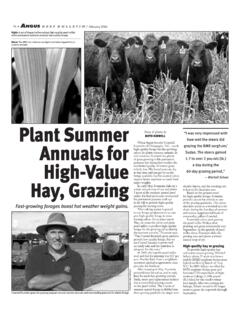
1 Mob Grazing saved Greg Judy s cattle operation. In 1999, Greg and his wife, Jan, faced losing their farm to bankruptcy. During the past 10 years, Judy has honed his Grazing management to the point that he has quit buying seed and fertilizer, owns no machinery and feeds almost no hay on the livestock operation near Clark, the same time, Judy has doubled the beef production on his land. As a result of reduced costs and increased production, the Judys have paid off the mortgage on their 300-acre farm and Greg recently gave up his off-farm job.
2 Greg gives the credit for this comeback to year-round mob Grazing . If you feed very much hay or supplements, you aren t making any money with beef cattle, Judy order to understand mob Grazing , or planned high-density Grazing as Judy also calls the technique, you need to understand where the Missouri grazier started and how he now operates. Before he turned to mob Grazing , Judy managed three herds of cattle on separate farms. He used management-intensive Grazing (MiG) with pastures divided into paddocks, and he managed 16 to 20 cows per acre with two-day Grazing periods followed by 30-day rest periods.
3 The operation required tons of hay, commercial fertilizer and Judy spent $5,000 per year on clover seed to plant his pastures with legumes. The cattle grazed each paddock eight times a , Judy manages all three herds as one big mob of 320 head at a rate of up to 250,000 pounds (lb.) per acre. Under planned high-density Grazing , Judy moves the animals twice a day and paddocks are grazed every 140-180 days, or two to three times per year. By not buying clover seed, Judy saves $5,000 a year and he has more legumes in his pastures than before.
4 New stands of big bluestem, Indian grass, switchgrass and gama grass have appeared from seed stored in the soil. The Grazing ratio has changed from acres per animal unit (AU=1,000 lb.) to acres per AU and forage production has doubled. Judy is using the extra forage to expand his cow herd for a grass-fed beef business, and he has added 300 head of hair sheep. Judy manages the livestock on 900 acres (300 acres owned and 600 acres leased.) This reduction in Grazing acres per AU is like having another 600-acre farm, and we don t even have to pay additional land taxes.
5 In our area, 600 acres is worth $ million, Judy litter effectAs Judy describes the benefits of mob Grazing , he emphasizes one word s planned high-density Grazing revolves around building up a heavy supply of ground litter (organic matter) that shades the soil and soaks up water from rainfall. When Judy leases a piece of land, his first step is to build up litter. As organic matter increases, microbes come alive in the soil. When Judy evaluates a pasture s health, he gets on his knees and digs for earthworms. I examined my soil recently and found 15 earthworms in 3 square inches of soil.
6 The earthworm holes have turned my pastures into big sponges that absorb rainwater, and earthworm castings build soil fertility, Judy says. I don t fear droughts any more. How to join the mobIf your pastures are bare coming out of winter, you may need to reduce cow numbers or lease additional land to initiate mob Grazing . Depending on how quickly your land produces forage, Grazing pressure must be reduced at first so plants grow tall and produce leftover organic matter that s trampled into the soil when the paddock is briefly hayfields into pastures is one place to gain Grazing acreage.
7 It s often more cost-efficient to move hayfield acres into a Grazing rotation and buy a smaller quantity of hay for weather emergencies. Unless an operation produces several hundred tons of hay per year, economists point out that most ranchers can t justify owning hay equipment. When forage is ready for mob Grazing , Judy s rule of thumb is, Graze half and leave half. Under his system, the mob grazes off the most nutritious parts of the plants and tramples in the remaining organic matter to increase litter. The animals will be in the paddock for a day or less and the stand will then have a recovery period of 140-180 days.
8 Tools of the tradeJudy manages his cattle operation with a minimum of equipment that includes a pickup (with a bale unroller for emergency feeding); a four-wheeler; 3:1 geared poly-wire reels; step-in posts; poly-wire fence; and electric fence cattle learn to expect fresh pasture when the four-wheeler arrives, moving animals to a new paddock takes less than 30 minutes. Over the weekend, Judy lays out seven paddocks for the week s Grazing pattern. Depending on forage supplies, Judy lays out paddocks of five to 10 acres each and includes travel lanes to water supplies and Grazing eliminates the need for clipping pastures and controls weeds so no herbicides are havenYou might think mob Grazing is negative for wildlife, but Judy contends that planned high-density Grazing improves habitat by bringing back warm-season grasses and legumes from seed laying dormant in the actually got one of his long-term leases because of a high deer population on his land.
9 He was showing his neighboring landowner, an out-of-state resident, around the mob Grazing land when they jumped several whitetails. The absentee landowner is very interested in deer hunting and at that time wasn t managing livestock on his land in hopes of building up the deer population. However, the land was grown up in fescue and broom sedge, not high-quality wildlife habitat. The whitetails had moved to Judy s land for the legumes and native grasses brought back by mob Grazing . This is where all of my deer have gone, said the landowner, and instantly leased his land to Judy.
10 Now the absentee landowner returns with his family each year to harvest deer and to fill his freezer with grass-fed beef produced on his own addition to deer, Judy sees increased populations of quail, wild turkey and songbirds that flock to the mob- Grazing area to eat insects stirred up by the Grazing spreadsOther cattlemen are discovering the benefits of mob Grazing . Jared Wareham Story & photos byBoyd KidWellUnfortunately, there has been little university research into mob Grazing . Most of the information is coming from ranchers who practice high-density Grazing techniques on their own land.