Transcription of Mobile elevating work platform guidelines
1 Mobile elevating work platforms (MEWP) guidelinesMobile elevating work platforms (MEWPs) are Mobile items of plant designed to lift or lower people and equipment by a telescopic, hinged or articulated device, or combination of these, from a base dutiesA PCBU must provide workers with reasonable information, instruction, training and supervision to operate the MEWP in all of the foreseeable work situations which may duties also include ensuring that: the type of MEWP is appropriate for the task being performed the work is conducted safely workers are supplied with correct personal protective equipment (PPE) the MEWP is safe to use in that particular environment ( structures in the area, proximity to other workers and powerlines, ground surface) the MEWP is maintained in a safe duties Workers must take all practicable steps to keep themselves safe in the workplace and ensure they do not place others at risk of harm.
2 This includes both the actions they take and the actions they don t take ( not wearing safety gear).Workers have a responsibility to: identify and report hazards as they arise follow the safe work procedures and instructions that are in place wear any required PPE report any accidents or near misses immediately to their supervisor or appropriate work practices when using MEWPsUse appropriate equipment for the taskConsider each task and any potential hazards ( indoors or outdoors, presence of overhead hazards, condition of supporting surfaces) and select a MEWP that is suitable to the task. It may be appropriate to use an alternative, like scaffolding, to reach and carry out the selecting a MEWP undertake a thorough task, site and equipment specific hazard identification and risk assessment. This may include consideration of the height, reach, crush or trapping hazards, safe working load, ground conditions and terrain, restricted working space and any electrical hazards, including overhead powerlines.
3 Identifying risksFatal incidents and serious injuries may occur when operators and/or passengers are crushed against structures while using self-propelled boom and scissor-type risks: There is an increased risk of crush to operators or passengers when the MEWP is used near or adjacent overhead or fixed structures. The likelihood of a crushing incident increases in direct proportion to the number and proximity of fixed structures, such as roofs, cable trays and pipework near the MEWP stability: The basket moving unexpectedly may be due to unstable ground conditions, an operator s lack of familiarity with the MEWP s model-specific controls, or malfunction of obstacles: Ground-based obstacles in close proximity to the MEWP may divert an operator s attention from overhead or adjacent structures, or their passenger s safety, while travelling or maneuvering the more time spent in a MEWP close to fixed structures, the more likely a crush incident may MEWPs may control work at height risks, the movement of Mobile plant introduces new risks.
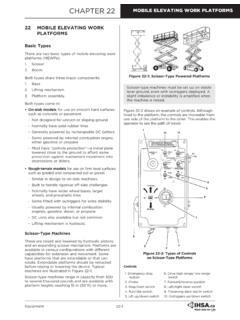
4 Persons conducting a business or undertaking (PCBU) usually understand the risks MEWPs pose to people on the ground however, what s often not fully considered is the increased crush risk to workers from the MEWP platform or within the basket. PCBU and self-employed persons must, so far as is reasonably practicable, identify all hazards and eliminate any risks associated with the use of MEWPs in a Standards AS : Cranes, hoists and winches Safe use. Part 10: Mobile elevating work platforms is an approved code of practice in South : Three types of Mobile elevating work platforms. Left to right; a scissor lift, an articulated boom lift and a telescopic boom risksThe range of motion available on some modern MEWPs, such as the ability to move into and between structures, increases the likelihood of a crush incident occurring. Before operating a MEWP in, around or near fixed structures, PCBUs must eliminate crush risks where practicable to do so.
5 If this is not possible, risks must be reduced by:SubstitutionAssess the task and consider if the task can be done using an alternative, such as a scaffold instead of a MEWP. Engineering controlsOperator protective devices Where an increased risk of workers being crushed against a fixed structure has been identified, the MEWP should be fitted with an effective operator protective protective devices are commonly known as secondary guarding . Such devices may include, but are not limited to:Physical barriers These barriers are attached to the basket which reduce the likelihood of workers being crushed against structures. Pressure sensing devicesPressure sensing devices are positioned over the control panel which detect pending crush incidents and prevent further hazardous sensing devices Proximity sensing devices prevent a MEWP s basket from maneuvering into crushing proximity of fixed controls When hiring a MEWP or selecting one to use on site, seek out models with standardised controls.
6 Familiarity with a control system contributes to safer operation of the MEWP, and can improve outcomes from rescue or remote control box When using a scissor lift, consider one with a moveable or remote control box. Being able to control the plant remotely allows for safer movement of the plant through doorways or where lower overhead structures create a crush should be used to monitor blind spots for pedestrians when being driven by external umbilical engineering options If a MEWP is not fitted with secondary guarding, standardised controls or a remote control box, talk to the supplier about retrofitting options to manage risks of crush injuries. If you plan to fit a secondary guarding device to an existing MEWP, you must undertake a specific engineering risk assessment. This includes consultation with the designer/manufacturer/supplier to determine whether there are any impacts on design registration and to ensure any proposed changes do not introduce new safety hazards or negatively impact the operation of the MEWP.
7 You can contact SafeWork SA for further information about design registration guarding is now available on most scissor and boom type combination of control controls will be required to support substitution and engineering controls. Administrative controls should include: training and licensing of operators (if required) familiarising operators with specific MEWP model controls, including emergency descent controls inspecting and maintaining MEWP consistent with the manufacturer s instructions altering work procedures, including safe work method statements if the MEWP is used in construction work providing additional operator supervision having MEWP-specific emergency procedures having an agreed system of communication with support personnel who have line of sight of the operator assigning support personnel who are trained to use MEWP ground-based controls for emergency Protective Equipment (PPE) Full safety harnesses must be worn by everyone on the platform of a boom-type MEWP and be secured to the anchor point.
8 Where there is a risk of a free fall, a fall-arrest harness designed for attachment to a lanyard assembly, including a personal energy absorber, must be worn by everyone on the : Lower risk minimal overhead structure in proximity. Secondary guarding not : Increased risk multiple overhead structures in proximity. Secondary guarding standard of trainingBefore operators start using MEWPs, training must be provided about its functions and any current safe work methods and emergency SA has developed the following minimum standard of training expected for workers who operate Mobile elevating work platforms (MEWPs) Although the majority of MEWPs are used in construction, this information applies to all industries to ensure the minimum standard of training is being met. Minimum standardThe minimum standard consists of specific criteria that must be addressed to satisfy the five elements Plant identification2.
9 Hazard identification and control3. Pre and post-start inspections4. Safe general use5. Shutdown and post-use inspectionRefer to Checklist: MEWP minimum standards of TrainingBefore a worker can operate a MEWP of any type they must be appropriately trained and competent on each type of MEWP to be recognised training is available from Registered Training Organisations (RTOs) for the various types of MEWPs, including boom-type, scissor and trailer Statement of Attainment for High Risk work Licence (class WP) training from an RTO is acceptable as proof of training for the operation of a boom-type MEWP. For a boom-type MEWP, where the boom length is 11 metres or more, the operator must hold a High Risk work boom length is the greater of: the vertical distance from the surface supporting the boom-type MEWP to the floor of the platform , with the platform extended to its maximum height or the horizontal distance from the centre point of the boom s rotation to the outer edge of the platform , with the platform extended to its maximum of training and operator competency need to be of equipment need to ensure they provide all relevant safety information and should obtain or record verification of operator competency before hiring an experienced MEWP operators without evidence of training, an alternative could be to arrange a registered training provider to confirm trainingWhen operating models different to those used in the training and assessment.
10 The operator should be provided with familiarisation training on the specific MEWP they will be operating due to the design differences between manufacturers and even models by the same operator must also be supervised during the training period until they are deemed competent to operate the must also be given to other workers within the MEWP harness use, emergency procedures, overhead structures should also receive regular refresher training that covers the minimum standard set out in this experienced MEWP operators without evidence of training, an alternative could be to arrange a registered training provider to confirm PCBU must put in place arrangements for ensuring that a MEWP is used in accordance with safe work procedures by ensuring adequate supervision and monitoring by a nominated competent person. The use of MEWPs during high risk construction work requires the implementation of a safe work method statement (SWMS) that describes how the control measures are to be person supervising the work activity must ensure there are clear lines of sight and communication while the MEWP is being operated, to enable the warning of potential the work Positioning and stabilityThe position of a MEWP must be carefully assessed, in particular where there are overhead power lines or underground services.