Transcription of MODE S TRANSPONDERS - Aircraft Electronics …
1 44 AVIONICS NEWS APRIL 2005 All About MODE S TRANSPONDERSWith all of the new hype the past few months concern-ing Elementary Surveil-lance and Mode S enhancements, it would seem appropriate to discuss the technical characteristics and purpose behind the new functionality and how avionics technicians can appropriately correct course, knowing the purpose of TRANSPONDERS and what affects en-hancements have to the functionality are extremely important, especially since this is one system you can count on to continually evolve. The recent mandates for this system are just the tip of the iceberg as the real capabili-ties and functions have not even been tapped yet. Believe it or not, transpon-ders in Aircraft make up the smallest segment of their to market forecasts, the Radio Frequency Identifi cation (RFID) industry is expected to have double digit growth over the next few years and be a multi-billion dollar industry by 2008. New uses for the military and commercial applications are literally staggering.
2 Everything from animal tracking to ski passes are utilizing tran-sponder technology to communicate tracking information between sources. Wal-Mart has issued mandates to their suppliers to incorporate a version of the technology in all of their products. What does this mean for aviation? Well, the technology is defi nitely get-ting refi ned and what does a transponder do? Technically a transponder is a com-bined radio transmitter and receiver which operates automatically relaying data between Aircraft and Air Traffi c Control (ATC) on the ground. The sig-Control (ATC) on the ground. The sig-nals sent provide a unique identity for each Aircraft , essential in crowded airspace to avoid mid-air collisions. TRANSPONDERS were originally devel-oped for military Aircraft in WWII for identifi cation friend or foe (IFF) appli-cation but evolved into the commercial arena. Most air traffi c control centers rely on the range and altitude informa-tion returned by commercial Aircraft rather than raw radar interrogations are made on 1030 MHz, all replies on 1090 MHz.
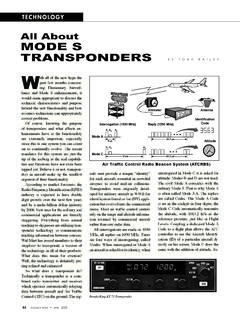
3 There are four ways of interrogating, called Modes. When interrogated in Mode A an Aircraft is asked for its identity, when interrogated in Mode C it is asked for altitude. Modes B and D are not used. The civil Mode A coincides with the military Mode 3. That is why Mode A is often called Mode 3/A. The replies are called Codes. The Mode A Code is set in the cockpit in four digits, the Mode C Code automatically transmits the altitude, with hPa as the reference pressure, just like in Flight Levels. Coupling a dedicated Mode A Code to a fl ight plan allows the ATC controller to see the Aircraft Identifi -cation (ID) of a particular Aircraft di-rectly on his screen. Mode C does the same with the addition of altitude. To-B Y T O N Y B A I L E YTECHNOLOGYAir Traffi c Control Radio Beacon System (ATCRBS)Bendix/King KT 73 TransponderAVIONICS NEWS APRIL 2005 45gether with the heading, derived from the tracking algorithm, the information available to the radar controller on his screen has enormously , because of the increasing commercial traffi c there is a lack of Mode A codes.
4 Additionally, the 1090 MHz reply frequency is becoming saturated, with two typical subsequent problems: garbling, which means that the reply pulse trains from more than one Aircraft upon one interrogation may overlap, sometimes causing con-fusion, and erroneous replies received on the ground from TRANSPONDERS that were interrogated by other interroga-tors on the ground. The Mode Select Beacon System, commonly referred to as Mode S, was developed by Lincoln Labs in 1975 as a way to monitor Aircraft to support an evolutionary addition to the Air Traffi c Control Radar Beacon Sys-tem (ATCRBS) for automation in dense traffi c areas and to solve the Mode A/C short comings. In 1986 a mid-air col-lision between an Aero Mexico DC-9 passenger Aircraft and a single engine Piper over Cerritos, Calif. which killed 82 people placed more emphasis on the technology. The crash was blamed on inadequate automatic confl ict alert systems and surveillance equipment resulting in congress passing into law the Airport and Airway Safety and Ca-pacity Expansion Act in 1987.
5 This new law required that all air carriers (part 121 operators) operat-ing within the United States with more than 30 seats must be equipped with TCAS (Traffi c Collision Avoidance System) II by 1993. Air carriers with 10 to 30 seats only had to have TCAS I. Mode S performs all the functions of Mode A and C TRANSPONDERS , and has datalink capability. Mode S transpon-ders are an integral component of all TCAS II installations and replace the Mode A and C transponder for TCAS II equipped Aircraft . A Mode S tran-sponder may be installed to replace a Mode A or C transponder without ne-cessitating the installation of TCAS. However, Mode S is required with TCAS in order to facilitate ID, fl ight status (on ground/in fl ight) and alti-tude. Different Classes of transpon-ders that identify the capability levels have been developed over time. How-ever, to meet the EUROCONTROL requirements for Elementary (Basic) Surveillance, a Level 2 transponder is necessary as a minimum capable of supporting both Interrogator Identifi er (II) and Surveillance Identifi er (SI) codes in accordance with International Civil Aviation Organization (ICAO) requirements.
6 One new feature of the Mode S transponder is that each Aircraft is as-signed a unique address code, which is broadcast in unsolicited SQUITTER transmissions occurring approximately every second. ATC or another Mode S equipped Aircraft can use this address for interrogation or communication purposes. Flight ID capability is one of the functions required by Elementary Surveillance is the new cat on the block which allows for an extension to the Squitter Code up to 24 bits containing the International Civil Aviation Organization (ICAO) required Aircraft address and Aircraft reporting Aircraft parameters required for Enhanced Surveillance are as follows:Magnetic HeadingSpeedRoll AngleTrack Angle RateVertical RateTrue Track AngleGround SpeedSelected Flight Level/AltitudeFMS Selected AltitudeBaro Correction ValueInertial Vertical VelocityThe standards for Mode S spe-cifi c services are described in ICAO Annex 10 Mode S System. The minimum operational performance standards are described in RTCA DO-181C ATCRBS/Mode S MOPS.
7 A detailed technical defi nition of all the parameters required for Elemen-tary and Enhanced Surveillance is given in the ICAO Manual on Mode S Specifi c Services, Doc 9688. These defi nitions are further refi ned in EU-ROCONTROL document , DAP Technical Characteristics for Mode S Enhanced Surveillance. The transponder design and interface requirements are docu-mented in the ARINC Characteristic are numerous Mode S Tran-sponders in service and troubleshoot-ing begins with identifi cation. There are currently nine manufacturers of Aircraft Mode S transponder systems: ACSS, AlliedSignal, Bendix/King, Filser, Garmin, Honeywell, Narco, Rockwell Collins and Thompson-CSF. Continued on following page Continued on following page TECHNOLOGY46 AVIONICS NEWS APRIL 2005 MODE S MODELS BY MANUFACTURER AND THEIR CAPABILITIES:MODE S TRANSPONDERSC ontinued from page 45 ACSSA lliedSignal (Honeywell)Bendix/King (Honeywell)FilserGarminAVIONICS NEWS APRIL 2005 47 Once you have identifi ed the unit, it is important to get the correct, most current manual (we always do, right?)
8 Because the checkouts are constantly changing. TRANSPONDERS must be checked and certifi ed for operation every two years as a minimum commonly referred to as the 413 check. Federal Aviation Regulation US FAR states: ATC transponder tests and inspections.(a) No persons may use an ATC transponder that is speci-fi ed in (a), (c), or Sec. (c) of this chap-ter unless, within the preceding 24 calendar months, the ATC transponder has been tested and inspected and found to com-ply with appendix F of part 43 of this chapter; and(b) Following any installation or maintenance on an ATC transponder where data correspondence error could be intro-duced, the integrated system has been tested, inspected, and found to comply with paragraph (c), appendix E, of part 43 of this chapter.(c) The tests and inspections specifi ed in this section must be conducted by (1) A certifi cated repair station properly equipped to per-form those functions and holding (i) A radio rating, Class III;(ii) A limited radio rating appropriate to the make and model transponder to be tested;(iii) A limited rating appropriate to the test to be per-formed.
9 HoneywellRockwell CollinsRockwell Collins(continued)Thompson-CSF Continued on page 49 AVIONICS NEWS APRIL 2005 49 Terms and Defi nitionsATC Air Traffic Control ATCRBS Air Traffic Control Radar Beacon System MODE S Mode Select Beacon System EAS Electronic Article Surveillance TCAS Traffic Collision Avoidance System ICAO International Civil Aviation OrganizationID Aircraft Identification II Interrogator Identifier SI Surveillance Identifier IFF Identification Friend or Foe SLS Side Lobe Suppression ADS-B Automatic Dependent Surveillance-BroadcastTIS-B Traffic Information Service Broadcast [(iv) deleted](2) A holder of a continuous airworthiness maintenance program as provided in part 121 or Sec. (a)(2) of this chapter; or(3) The manufacturer of the Aircraft on which the transpon-der to be tested is installed, if the transponder was installed by that most avionics technicians have been performing and checks for most of their careers, Enhanced Mode S requires updated test equipment and procedures.
10 The IFR ATC-601 is the most common test set used in conjunc-tion with a pitot/static test set for testing transponder systems. However, any test set can be utilized providing it can test the following transponder responses:Mode A responseMode C response with altitude if availableMode S all-call responseMode S lockoutTransmitter frequencyTransponder power outputReceiver frequency discriminationReceiver sensitivityReceiver interrogation pulse spacing discrimination (all modes)Individual pulse-width discrimination (all modes)SLS (Side Lobe Suppression) transponder response to invalid address interrogationsSPR on/offMode S, UF0 (uplink format 0)Mode S, UF4 Mode S, UF5 Mode S, UF11 Mode S, UF16 Mode S, UF20 Mode S, UF21 Diversity isolationTransponder squitterAirplane identifi cation code It is very important to test the transponder system in the right steps with the right equipment. In the future, Automatic Dependent Surveillance-Broadcast (ADS-B) and Traffi c In-formation Service Broadcast (TIS-B) are enhancements cur-rently under development that will add complement to radar for en-route, terminal area and airport surface surveillance, destination weather, Pilot Reports, add support for certain airborne separation maneuvers, facilitate the broadcasting of fl ight information ( gate, stand, and number of passen-gers) and the ability to utilize arrival management programs for airport terminals among hundreds of other combinations of data.