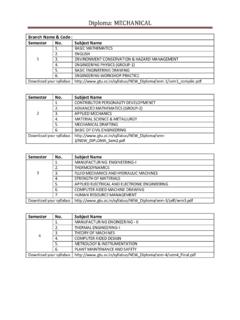
Transcription of MODEL CURRICULUM FOR POST SSC PROGRAMME IN …
1 MODEL CURRICULUM FOR POST SSC PROGRAMME IN diploma IN mechanical engineering 2011 ALL INDIA COUNCIL FOR TECHNICAL EDUCATION 7TH FLOOR, CHANDRALOK BUILDING, JANPATH NEW DELHI 110 001 FO REWO RD It is with great pleasure and honour that I write a forward for the MODEL scheme of instruction and syllabi for the Post SSC engineering diploma programmes prepared by the All India Board of Technician Education with Prof. Ashok A. Ghatol as its Chairman and other members. All India Council for Technical Education has the onerous responsibility for uniform development and qualitative growth of the Technical Education system and preparation of syllabi to maintain uniform standards throughout the county. In pursuance to clause 10 (2) of the AICTE Act 1987 AICTE has the objective of bringing about uniformity in the CURRICULUM of engineering .
2 In that direction, the efforts of the All India Board of Technician Education has been quite commendable and praiseworthy. A painstaking effort was made by the Chairman, members of the Board and various working groups composed of experts from leading institutions in framing of the Instruction and Syllabi. The Board was ably assisted by the official of the Academics Bureau in successfully organizing the meetings making available necessary documents and follow up action on the minutes of the meetings. Chairman All India Council for Technical Education ALL INDIA COUNCIL FOR TECHNICAL EDUCATION TEACHING AND EXAMINATION SCHEME FOR POST diploma COURSES COURSE NAME: ELECTRONICS/ mechanical /CIVIL/COMPUTER/EL ECTRICAL/CHEMICAL ENGG. GROUPS COURSE CODE : EJ/EN/EX/EV/IC/IE/IS/MU/DE/ME/PG/PT/AE/C E/CS/CR/CO/CM/IF/EE/EP/CH/CT/PS/ CD/EDEI/ CV/MH/FE/IU/MI DURATION OF COURSE : 6 SEMESTERS SEMESTER: FIRST SCHEME : C BRANCH: Common for all branches YEAR:I SEMISTER.
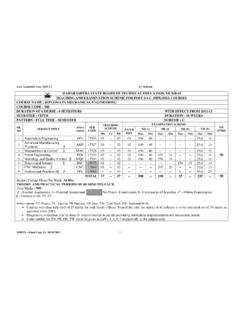
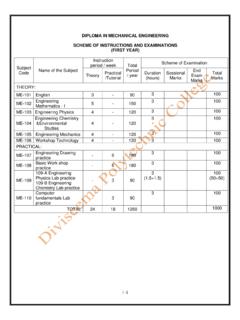
3 I SUBJECT PERIODS EVALUATION SCHEME Credits THEORY L TU PR SESSIONSAL EXAM ESE PR # TW @ TA CT Total 1 Basic Physics 2 - 2 10 20 30 70 50 - 3 2 Basic Chemistry 2 - 2 10 20 30 70 50 - 3 3 Basic Mathematics 4 1 - 10 20 30 70 - - 5 4 English 2 - 2 10 20 30 70 - 25 3 5 engineering Graphics 2 - 4 - - - - - 50 4 6 Computer Fundamentals 1 - 4 - - - - 50 25 3 7 Basic Workshop Practice (Group wise ) - - 3 - - - - 50 25 2 Total 13 1 17 40 80 120 280 200 125 23 STUDENT CONTACT HOURS PER WEEK: 31 HRS THEORY AND PRACTICAL PERIODS OF 60 MINUTES EACH # - External Assessment @ - Internal Assessment ESE - End Semester Exam. ABBREVIATIONS: CT- Class Test, TA - Teachers Assessment, L - Lecture, TU - Tutorial, PR - Practical TA: Attendance & surprise quizzes = 6 marks.
4 Assignment & group discussion = 4 marks. Total Marks : 725 Minimum passing under any head is 40%, 40% passing for Sessional, ESE, Oral, and TW Separately. Assessment of Practical, Oral & term work to be done as per the prevailing norms of CURRICULUM implementation & assessment. Name of the Course : ELECTRONICS/ mechanical /CIVIL/COMPUTER/EL ECTRICAL/ CHEMICAL ENGG. GROUPS Course code: EJ/EN/EX/EV/IC/IE/IS/MU/DE/ME/PG/PT/AE/C E/ CS/CR/CO/CM/IF/EE/EP/CH/CT/PS/CD/EDEI/ CV/MH/FE/IU/MI Semester : FIRST Duration : 6 SEMESTERS Maximum Marks : Teaching Scheme C Examination Scheme Theory : 13 hrs/week Mid Semester Exam: Marks Tutorial: 1 hrs/week Assignment & Quiz: Marks Practical : 17 hrs/week End Semester Exam: Marks Credit : Aim :- Nil Objective :- Nil Pre-Requisite :-Nil Contents:- Nil Hrs/week Text Books:- Nil Reference books :- Nil Suggested List of Laboratory Experiments :- Nil Suggested List of Assignments/Tutorial :- Nil Name of the Course : All Branches of diploma in engineering / Technology (Basic Physics).
5 Course code: EJ/EN/ET/EX/EV/IC/IE/IS/MU/DE/ ME/PG/PT/AE/CE/CS/CR/IF/EE/EP/CH/CT/PS/ CD/ED/EI/CV/MH/FE/IU Semester : First Duration : Maximum Marks : Teaching Scheme Examination Scheme Theory : hrs/week Mid Semester Exam: Marks Tutorial: hrs/week Assignment & Quiz: Marks Practical : hrs/week End Semester Exam: Marks Credit : Aim :-Nil Objective :- Student will be able to: 1. Measure given dimensions by using appropriate instruments accurately. Select proper measuring instrument on the basis of range, least count & precision required for measurement. Select proper material for intended purpose by studying properties of materials. 2. Identify good & bad conductors of heat.
6 Analyze relation among pressure, volume and temperature of gas & to interpret the results Identify the effect of interference between light waves. 3. Identify properties of laser light and photo electric effect for engineering applications. Identify, analyze, discriminate and interpret logical sequence of field problems with the study of physics. Pre-Requisite :-Nil Contents (Theory) Hrs/week Marks Unit -1 UNITS AND MEASUREMENTS Need of Measurement in engineering and science, unit of a physical quantity, requirements of standard unit, systems of units-CGS,MKS and SI, classification of physical quantities-Fundamental and Derived with their units Accuracy, Precision of instruments, Errors in measurement, Estimation of errors-Absolute error, Relative error and percentage error, significant figures.
7 (Simple Problems) Basic Measuring instruments-Vernier Caliper, Micrometer screw gauge, inner & outer caliper thermometer, spherometer, ammeter, voltmeter with their least count, range, accuracy and precision. Standard reference surfaces used in engineering measurements- surface plate, angle plate, V- block, Engineer s square. 03 06 Unit -2 GENERAL PROPERTIES OF MATTER Elasticity : Deforming force, Restoring force, Elastic and plastic body, Stress and strain with their types, Hooke s law, Stress strain diagram, Young s modulus, Bulk modulus, Modulus of rigidity and relation between them( no derivation), (simple problems). (Simple problems) Stress strain diagrams of Steel, Cast iron, Aluminium and Concrete, Ultimate and breaking stress, Factor of 03 06 safety.
8 Surface Tension: Forces cohesive and adhesive, , angle of contact, shape of liquid surface in a capillary tube, capillary action with examples, relation between surface tension , capillary rise and radius of capillary ( no derivation)( simple problem),effect of impurity and temperature on surface tension. Viscosity : Velocity gradient, Newton s law of viscosity, coefficient of viscosity ,streamline and turbulent flow, critical velocity, Reynold s number,( simple problems), Stokes law and terminal velocity( no derivation) ,buoyant (up thrust) force, effect of temperature & adulteration on viscosity of liquid. 02 02 04 04 Unit 3 HEAT Transmission of heat and expansion of solids Three modes of transmission of heat-conduction, convection and radiation, good and bad conductor of heat with examples, law of thermal conductivity, coefficient of thermal conductivity (simple problems), expansion of solids-linear, aerial and cubical and relation between them.
9 Gas laws and specific heats of gases Boyle s law, Charle s law, Gay Lussac s law, absolute temperature, Kelvin scale of temperature, general gas equation( no derivation)(simple problems),molar or universal gas constant, universal gas equation, standard or normal temperature and pressure ( ), specific heat of gases, relation between two specific heat (simple problems), thermodynamic variables, first law of thermodynamics (statement & equation only), isothermal, isobaric, isochoric & adiabatic processes (difference among these processes and equations of state) (simple problems). 02 04 06 08 Unit 4 LIGHT Properties of light Reflection and, refraction, Snell s law, physical significance of refractive index (simple problems), Total internal reflection, dispersion, diffraction and polarization of light (only introduction) Wave theory of light & Interference Newton s corpuscles theory of light, Huygen s wave theory, wave front, Types of wave front-spherical, cylindrical and plane Huygen s principle of propagation of wave front, Principle of superposition of waves, Interference of light, constructive and destructive interference, Young s experiment.
10 Analytical treatment of interference, conditions for stationary interference pattern. Laser Light amplification by stimulated emission of radiation, properties of laser, spontaneous and stimulated emission, population inversion, pumping methods, He-Ne laser- construction & working, recording and reconstructing of hologram by using He-Ne laser. 03 04 04 06 08 08 Unit 5 MODERN Photo electricity Plank s hypothesis, properties of photons, photo electric effect, 03 08 PHYSICS laws and characteristics of photoelectric effect, Einstein s photoelectric equation,(simple problems), construction and working of photoelectric cell, applications of photoelectric cell X-rays Production of X-rays, types of X-ray spectra-continuous and characteristics, X-ray wavelength (simple problems), properties of X-rays, applications of X-rays- engineering , medicine and scientific research work.