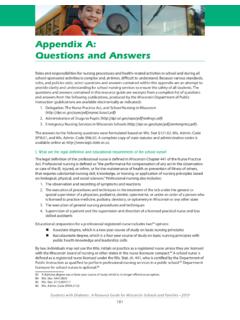
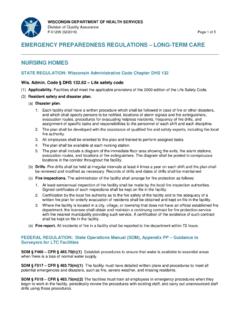
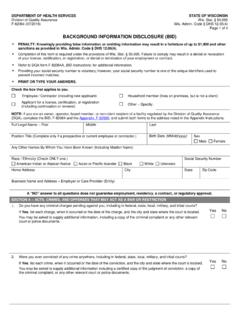
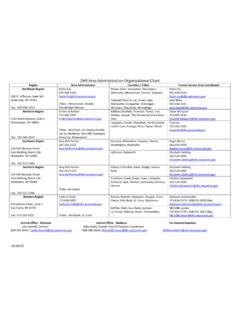
Transcription of MODEL LONG TERM CARE ASSESSMENT TOOL
1 MODEL . LONG TERM care . ASSESSMENT TOOL. Division of Community Services Wisconsin Department of Health and Social Services July 1995. Supported in part, by a grant (90 AMO714) from the Administration on Aging, Department of Health and Human Services, Washington, 20201. THE MODEL ASSESSMENT TOOL. The ASSESSMENT : ASSESSMENT is a structured process of interviews which is used to identify the participant's abilities, needs, preferences and supports; determine eligibility for programs and services; and provide a sound basis for developing the care plan. A. secondary purpose of the ASSESSMENT is to provide the participant with a good understanding of the program and the services that can be provided and of what is expected of him/her. Assessments are conducted in partnership with the participant and his/her family, guardian, or other supports as appropriate. Purpose of the ASSESSMENT Tool: This ASSESSMENT tool is designed to be a comprehensive examination of an individual's life situation which includes their deficits and their strengths.
2 This tool is part of the ASSESSMENT process that is on-going throughout the period of time that an individual receives long term care services. The ASSESSMENT process includes constant re-evaluation of the person's situation in order to change services provided to meet changing needs. This ASSESSMENT tool was developed to enable care managers to perform a thorough ASSESSMENT that will result in a comprehensive care plan that is individualized and considers the participant's preferences. The objective of this tool is to learn enough about the individual to create with the participant a comprehensive plan, meeting his/her needs and enhancing his/her life. Part of the ASSESSMENT process is the inclusion of addendum tools which have more in depth questions to determine additional services or to prompt the referral to professionals outside of the care management team.
3 These addenda are used on an individual basis and will provide a greater amount of information. Completing the Tool: It is recommended that a social worker and a nurse complete the ASSESSMENT as a team. Due to the length of this inquiry, it may be advisable to conduct the ASSESSMENT in two separate sessions. If a county has limited staff time and cannot perform this ASSESSMENT in two separate sessions, it is suggested that the nurse and social worker divide the survey and conduct their sessions separately. If the tool is used in this manner, it is recommended that a meeting take place in order for the two assessors to discuss the findings and any follow-up that is necessary. Please note that specific instructions for each page are printed on the facing page. ASSESSMENT FACE SHEET. The ASSESSMENT face sheet is designed to gather pertinent information and keep it within easy reach of the care manager for quick reference.
4 It is also designed to provide a short review of information about the participant if it is needed and the care manager is not available. Much of the information on the face sheet could/should have been obtained in the initial intake procedure. Participant Information Record the participant information as completely as possible. If information is unknown, write unknown. Do not leave any spaces blank. The emergency contact person and the guardian may be the same person. Write "same" in the second line. Person's Disability(ies). Check all that apply. Program(s). Check all that apply. If the person is not currently on a program but will be applying to one or more programs, check those that are anticipated to be providing services to the participant. Formal Supports Complete as accurately as possible with complete addresses and phone numbers. Complete addresses and phone numbers do not need to be obtained at the time of the ASSESSMENT but do need to be filled in later.
5 If the individual has no dentist, etc. write "none" and note that this may be an area to pursue. ASSESSMENT FACE. SHEET. _____/_____/_____. Name: (Last, First, ) Birthdate _____. Address: Zip Telephone County Marital Status: Sex: female male Ethnic Origin: married widowed American Indian Hispanic divorced single Veteran: yes no Asian White separated Black Other _____. Primary language (if other than English) _____. Emegency Contact Person: _____. Name/Relationship Address Telephone Guardian/Durable POA/Protective Payee/POA for Health care /Primary Caregiver: _____. Name Address Telephone _____. Name Address Telephone Chapter 55: yes Chapter 51: yes no Referral yes no no If yes, name of Court _____ Court ordered care yes no Social Security Number: _____ Medicare Number: _____. Medicaid Number/Start Date: _____ Other Insurance: _____. Person's Disability(ies): Program(s): Living Arrangement: Household Composition: frail elderly SHC CIP II own home/apartment lives alone chronic alcohol or drug abuse CIP 1A CSP relative's home/apartment w/spouse developmentally disabled COP COP W friend's home/apartment lives with others: serious or persistent mental CIP 1B CSLA CBRF/AFH #beds _____ _____.
6 Illness MA Case Other _____ Supervised/semi-super. physically disabled Management apartment Alzheimer's/dementia Other _____. Formal NAME ADDRESS TELEPOHONE FREQ. OF CONTACT OTHER INFO. Supports primary physician dentist specialist pharmacy(ies). agency agency other DATE COMPLETED _____. LONG TERM SUPPORT ASSESSMENT . Complete the first section with an explanation of the reason for the referral. If others are present at the ASSESSMENT please indicate who they are and their relationship to the participant. When asking the ASSESSMENT questions, direct them to the participant. If someone other than the participant answers the question, re-direct the question to the participant (unless they are physically incapable) and politely request that the individual answer the question. Note where you receive conflicting information or if the participant is unable to answer a question.
7 Advance Directives: Be sure the participant understands what an advance directive is and understands the difference between living wills, power of attorneys, and durable power of attorney for health care . LONG TERM SUPPORT ASSESSMENT . Date of ASSESSMENT : _____ Initial ASSESSMENT ASSESSMENT Update Referral Source: Date of Referral: _____. _____. Name/Agency/Relationship to participant Address Telephone Situation Precipitating Referral: ASSESSMENT Completed By: Others present at ASSESSMENT (relationship): Additional information obtained from: Level of care on Functional Screen: _____ COP Rights given: yes no ADVANCE DIRECTIVE: Have you been advised about Advance Directives? yes no If yes, have you completed one and where is it kept? _____. If no, has the Advance Directive pamphlet been give to you? yes no What family, friends or reliable resources can and/or do provide help to you?
8 Please list the activity provided. NAME RELATIONSHIP. ADDRESS TELEPHONE. SERVICE PROVIDED. NAME RELATIONSHIP. ADDRESS TELEPHONE. SERVICE PROVIDED. NAME RELATIONSHIP. ADDRESS TELEPHONE. SERVICE PROVIDED. 1. PHYSICAL HEALTH. It is important to obtain as complete a physical ASSESSMENT as possible. This will help you to involve medical professionals in the care plan if it is indicated. You will also become knowledgeable about areas to focus prevention efforts. It is recommended that this section be completed by a nurse. If the individual is in the hospital or has had a recent examination by a physician, medical records may be used in addition to the information obtained in this section. Do not use any medical information in lieu of asking the participant the questions directly. Part of a good health ASSESSMENT is determining if the individual is happy with their health care provider and what preferences they may have.
9 If a participant is unhappy with his/her provider or feel she/he doesn't have choices in his/her health care , it may lead to non-compliance with health care recommendations. PHYSICAL HEALTH. It is recommended that a nurse complete this section along with the section on ADLs and IADLs. If completed by the care manager, no need to duplicate top section _____/_____/_____. Name: (Last, First, ) Birthdate _____. Address: Zip Telephone County Physicians name: _____ Clinic: _____ Hospital: _____. Interviewer name _____ Sections completed: (circle) Physical health ADLs IADLs List previous, present or Under Comments: Treatment potential health problems Yes No When did you last see your doctor? _____ What was this for? _____. How often do you see your physician? _____. Are you happy or unhappy with your medical care ? (circle) If unhappy, explain _____. _____. Have you been hospitalized in the last year?
10 Yes no If yes, how many times? _____. What was this for? _____. _____. What hospital do you go to? _____. Have you ever been admitted to a nursing home, CBRF, AFH, other? yes no When? _____. Where? _____ Why were you there? _____. 2. Medications/Treatments/Services/Supplies When listing the medications, it is helpful to ask to see the medications and where they are kept. Take each medication individually and ask the participant the accompanying questions. Be sure to include over-the-counter medications. Note any indications that the person does not understand or is not taking the medication properly. If the individual does not administer their own medications, be sure to ask these questions of the provider. If you are able to look at the medication bottles, check the expiration dates. Follow-up with the physician and/or home health providers to double check the accuracy of the medications being taken.