Transcription of MODULE #1: Self-Awareness and Self Knowledge
1 1 MODULE #1: Self-Awareness and self Knowledge Objectives: Participants will recognize their personal strengths and enhance their self -image. Participants will be provided an opportunity to compare their positive self -concepts with others positive perception of them. Participants will be introduced to the concept of self -disclosure. Participants will reflect and write their thoughts in their journals. Context Before you can start to lead others, you must first know how to lead yourself. This has been the key to becoming a leader since the days of Socrates and Aristotle.
2 "Know thyself" was the inscription over the Oracle at Delphi, the Greek mecca of wisdom. It is by this principle that the great leaders of the past, present, and future gain an effective followership and achieve their goals. Leadership guru, Warren Bennis, states, "Know thyself means separating who you are and who you want to be from what the world thinks you are and wants you to be." Handouts & Resources Needed: Handout : In My Teens Handout : Who Am I? Handout : Identity Cube Handout : Masks Handout : The Johari Window Handout : Changing a Failure Identity Through Rational Self-Awareness Sheet of paper - one for each participant Pens/pencils Post cards Journals Color pencils/crayons Activity #1: Icebreakers-introduction (10 min) Procedure: Provide a summary of what the Personal Growth MODULE is about.
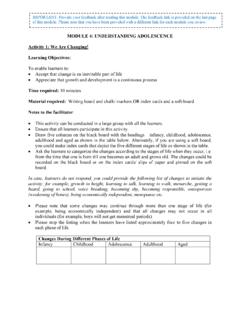
3 Provide participants with journals and ask them to record their thoughts and answers to questions as instructed throughout the program. Select from the following activities to focus on as necessary. Activity #2: understanding Human Development (30 min) Procedure: Icebreaker 2 The purpose of this activity is for students to understand human development and be better prepared for the unexpected changes. They will need to learn what to expect in order to take adequate measures. Explain to participants that as human beings we go trough a series of developmental stages during our life span.
4 The major periods of human development include: prenatal (conception-birth), infancy and toddlerhood (birth-2 years), early childhood (2-6 years), middle childhood (6-11 years), adolescence (11-18 years), early adulthood (18-40 years), middle adulthood (40-65 years) and late adulthood, 65 years-death (Berg, 2007).1 Focus on adolescence to relate to the group. For more information visit: Ask participants to fill out the activity worksheet, In my teen years (Handout ) to think about their developmental milestones. Ask participants about what they learned in this session.
5 If they don t feel comfortable talking about it, ask them to write their responses or concerns in their journals. Make sure to respond to the journal entries. Debriefing Activity #3: Who Am I? (55 min) Procedure: Icebreaker The purpose of this activity is to remind participants about the importance of knowing ourselves. Provide participants Handout : Who Am I? And ask them to write three words describing who they are (example, teacher, mother, wife). Engage in discussion based on the responses on status-oriented (student, husband, father, daughter, son, catholic) and value-oriented (affectionate person, caring, loving, free, generous) responses.
6 The facilitator will explain that neither of these two types is necessarily better than the other and that up to 30 or 40 years ago, most people defined themselves in terms of their jobs. Ask for volunteers to share their responses. Ask how many of them are status-oriented and how many are value-oriented. Debriefing Activity #4: Building self identity (55 min) Procedure: Icebreaker 1 Berg, Laura E. (2007). Development Through the Lifespan (Fourth Edition), pp. 361-427.
7 Boston, MA: Pearson Education, Inc 3 Explain to participants that building self identify is important to be able to face challenges with dignity and respect for ourselves and others. This activity will help build participants sense of identity in belonging to a particular cultural group. Have participants participate in Identity cube activity. Ask participants to break up into groups of 5-7 students (only done if group is more than 10 students) Distribute Identity cube and pencil to each student (Handout ). Each student completes the identity cube individually.
8 The cube should be completed based on how the students see and define themselves, not how others see them. Small group discussion: Each member of the group should share their cube. Each person should name one aspect of their culture in which they take pride. Point out the importance of maintaining one s culture. Debriefing Activity #5: Inside/ Outside Masks (55 min) Procedure: Icebreaker Like activity number 4, this activity serves to build a sense of identity. Distribute Handout and crayons. Ask students to draw two masks: one depicting what they look like on the outside and the other depicting what they "look" like on the inside.
9 The outside mask can include how they think others perceive them. Ask 3-4 people to share their masks. Debriefing Activity #6: The Johari window (55 min) (For advanced students) Icebreaker The purpose of this activity is for participants to learn more about themselves. Describe what the Johari Window is: It is a diagram showing four different selves and how the awareness or otherwise of these aspects of our self by others and ourselves leads to four categories (The public self , the private self , the blind self and the undiscovered self ).
10 Refer to Handout Explain that increased self -disclosure generally leads to greater self - awareness . Explain that the concept of self -disclosure refers to the sharing of information about oneself with others either consciously or unconsciously. The facilitator may also describe why members are initially reluctant to self -disclosure but gradually begin to do so. With appropriate self -disclosure in groups, cohesion and group morale generally increase. The facilitator should note that personal information should not be disclosed during this exercise.