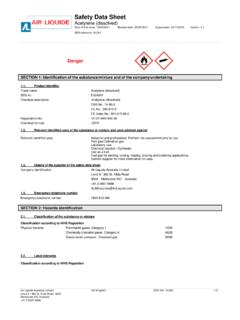
Transcription of Module 4 Safety Data Sheets SDS What is a SDS? …
1 Page 1 of 4 Module 4 Safety data Sheets SDS what is a SDS? what information is on the SDS? When is the SDS updated? As an employer, do I have responsibilities for SDSs? As a worker, when would I use a SDS? what is a SDS? Safety data Sheets (SDSs) are summary documents that provide information about the hazards of a product and advice about Safety precautions. SDSs provide more detailed hazard information about the product than the label. what information is on the SDS? The Hazardous Products Regulations specifies the sections and content for the SDS, as follows: SDS Section and Heading Specific Information Elements 1 Identification Product identifier ( Product name) Canadian supplier identifier o Name, full address and phone number(s) 2 Hazard identification Hazard classification (class, category) of substance or mixture or a description of the identified hazard for Physical or Health Hazards Not Otherwise Classified Label elements.
2 O Symbol (image) or the name of the symbol ( , flame, skull and crossbones) o Signal word o Hazard statement(s) Precautionary statement(s) 3 Composition/Information on ingredients When a hazardous product is a material or substance: o Chemical name o Common name and synonyms o Chemical Abstract Service (CAS) registry number and any unique identifiers Chemical name of impurities, stabilizing solvents and/or additives Page 2 of 4 4 First-aid measures First-aid measures by route of exposure: o Inhalation o Skin contact o Eye contact o Ingestion Most important symptoms and effects (acute or delayed) Immediate medical attention and special treatment, if necessary 5 Fire-fighting measures Suitable extinguishing media Unsuitable extinguishing media Specific hazards arising from the hazardous product ( , hazardous combustion products)
3 Special protective equipment and precautions for fire-fighters 6 Accidental release measures Personal precautions, protective equipment and emergency procedures Methods and materials for containment and cleaning up 7 Handling and storage Precautions for safe handling Conditions for safe storage (including incompatible materials) 8 Exposure controls/ Personal protection Control parameters, including occupational exposure guidelines or biological exposure limits and the source of those values Appropriate engineering controls Individual protection measures ( personal protective equipment) 9 Physical and chemical properties Appearance (physical state, colour, etc.)
4 Odour Odour threshold pH Melting point/Freezing point Initial boiling point/boiling range Flash point Evaporation rate Flammability (solid; gas) Lower flammable/explosive limit Upper flammable/explosive limit Vapour pressure Vapour density Relative density Solubility Partition coefficient - n-octanol/water Auto-ignition temperature Decomposition temperature Viscosity Page 3 of 4 10 Stability and reactivity Reactivity Chemical stability Possibility of hazardous reactions Conditions to avoid ( , static discharge, shock, or vibration) Incompatible materials Hazardous decomposition products 11 Toxicological information Concise but complete description of the various toxic health effects and the data used to identify those effects, including.
5 Information on the likely routes of exposure (inhalation, ingestion, skin and eye contact) Symptoms related to the physical, chemical and toxicological characteristics Delayed and immediate effects, and chronic effects from short-term and long-term exposure Numerical measures of toxicity 12 Ecological information* Ecotoxicity Persistence and degradability Bioaccumulative potential Mobility in soil Other adverse effects 13 Disposal considerations* Information on safe handling for disposal and methods of disposal, including any contaminated packaging 14 Transport information* UN number UN proper shipping name Transport hazard class(es)
6 Packing group Environmental hazards Transport in bulk, if applicable Special precautions 15 Regulatory information* Safety , health and environmental regulations specific to the product 16 Other information Date of the latest revision of the SDS *Sections 12 to 15 require the headings to be present, but under Canadian regulations, the supplier has the option to not provide information in these sections. Page 4 of 4 When is the SDS updated? A SDS will be required to be updated when the supplier becomes aware of any "significant new data ". SDSs will be required to be updated within 90 days of the supplier being aware of the new information.
7 Note that there is no requirement for the supplier to provide an updated SDS to past purchasers of a hazardous product. However, it continues to be good practice to provide this information to purchasers who may still be using the product. As an employer, do I have responsibilities for SDSs? Employers will be required to make sure that all hazardous products have an up-to-date SDS when it enters the workplace. The SDSs must be readily available to the workers who are exposed to the hazardous product, and to the health and Safety committee or representative. Employers may computerize the SDS information as long as: all employees have access to and are trained on how to use the computer or device, the computers/devices are kept in working order, and the employer makes a hard copy of the SDS available to the employee or health and Safety committee/representative upon request.
8 As a worker, when would I use a SDS? Always be familiar with the hazards of a product before you start using it. You should look at the SDS, match the name of the product on the container to the one on the SDS, know the hazards, understand safe handling and storage instructions, as well as understand what to do in an emergency. You can think of the SDS as having four main purposes. It provides information on: a. Identification: for the product and supplier. b. Hazards: physical and health. c. Prevention: steps you can take to work safely, reduce or prevent exposure, or what to do in the event of an emergency.
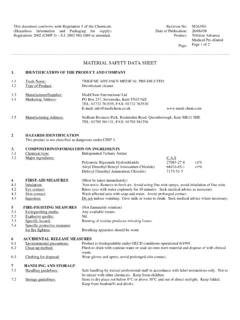
9 D. Response: appropriate responses in various situations ( , first-aid, fire, accidental release). 8052-41-3 Product Name: VARSOL SOLVENT Page 1 of 9 Safety data SHEETPRODUCTP roduct Name: VARSOL SOLVENT Product Description: Petroleum Hydrocarbons MSDS Number: 012345 Intended Use: Solvent COMPANY IDENTIFICATIONS upplier: Imperial Oil Chemicals Division240 4th Avenue Calgary, ALBERTA. T2P 3M9 Canada 24 Hour Environmental / Health Emergency Telephone516-325-4225 Transportation Emergency Phone Number 516-325-4226 Product Technical Information 1-888-613-4159 Reportable Hazardous Substance(s) or Complex Substance(s)NameCAS#Concentration*Acute ToxicityStoddard solvent 100% Dermal Lethality: LD50 > (Rabbit); Oral Lethality:LD50 > g/kg (Rat) Hazardous Constituent(s) Contained in Complex Substance(s)NameCAS#Concentration*Acute ToxicityETHYL BENZENE 100-41-4 < Dermal Lethality: LD50 15g/kg (Rabbit); InhalationLethality: LC50 4000 ppm(Rat).
10 Oral Lethality: LD50 g/kg (Rat) Naphthalene 91-20-3 < Dermal Lethality: LD50 > 20g/kg (Rabbit); Oral Lethality:LD50 g/kg (Rat)Nonane 111-84-2 1 - 5% None PSEUDOCUMENE (1,2,4-TRIMETHYLBENZENE) 95-63-6 < Inhalation Lethality: LC503662 ppm (Rat); OralLethality: LD50 g/kg (Rat)XYLENES 1330-20-7 < Dermal Lethality: LD50 (Rabbit); InhalationLethality: LC50 5000 ppm(Rat); Oral Lethality: LD50 g/kg (Rat) * All concentrations are percent by weight unless ingredient is a gas. Gas concentrations are in percent by volume.