Transcription of MORPHINE MILLIGRAM EQUIVALENTS: CENTERS FOR …
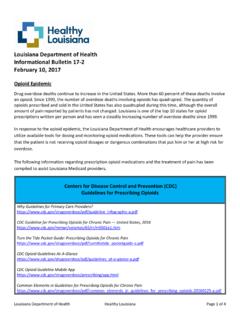
1 MORPHINE MILLIGRAM equivalents : CENTERS FOR disease CONTROL AND PREVENTIONThis sheet provides summary information from the CENTERS for disease Control and Prevention (CDC) on opioids and their oral MORPHINE MILLIGRAM equivalent (MME) conversion CDC s Injury center has compiled a listing of medications to help with analyzing prescription data for the purpose of preventing prescription drug misuse, abuse, and overdose. Oral MORPHINE MILLIGRAM Equivalent Conversion Factors1 Opioid (strength in mg except where noted)Oral MME Conversion Factor*Buprenorphine, tablet or film Buprenorphine, buccal film ( g) , buccal/SL tablet or lozenge/troche ( g) , film or oral spray ( g) , nasal spray ( g) , transdermal patch ( g/hr) (strength in mg except where noted)Levomethadyl acetate8 Levorphanol tartrate11 Meperidine N/A Please visit the CDC website for additional information, including the full data file containing the MME conversion factors Oral MMEs - Excel Data File : , transdermal patch ( g/hr)N/A Oral MME Conversion Factor**To be used in the formula: (Strength per Unit) X (Number of Units/Days Supply) X (MME conversion factor) = MME/Day Note: Buprenorphine products are listed in the table above but do not have an associated MME conversion factor.
2 Note: The conversion factors for drugs prescribed or provided as part of medication-assisted treatment for opioid use disorder should not be used to benchmark against dosage thresholds meant for opioids prescribed for pain. Please see reverse side for additional information on using the formula with fentanyl transdermal patches. Important Considerations The MME conversion factor is intended only for analytic purposes where prescription data are used to retrospectively calculate daily MME to inform analyses of risks associated with opioid prescribing. This value does not constitute clinical guidance or recommendations for converting patients from one form of opioid analgesic to another. Please consult the manufacturer s full prescribing information for such of the above table for the purposes of any clinical decision-making warrants caution. This is particularly true with regard to methadone. Calculating MME for methadone in clinical practice often involves a sliding-scale approach whereby the conversion factor increases with increasing dose.
3 The conversion factor of 3 for methadone presented in the above table could underestimate MME for a given patient. Please see clinical guidance provided here: .The content used in this document was created by the CDC National center for Injury Prevention and Control, September back panel for additional information on buprenorphine conversion factorsCALCULATION OF MORPHINE MILLIGRAM equivalents PER DAYMAIN SOURCES CONSULTED FOR MME CONVERSION FACTORS (as listed by the CDC) Korff M, Saunders K, Ray GT, Boudreau D, Campbell C, Merrill J, et al. De Facto Long-term Opioid Therapy for Noncancer Pain. The Clinical Journal of Pain 2008; 24: Assistance Guide No. 01-13: Calculating Daily MORPHINE MILLIGRAM equivalents . Waltham (MA): Prescription Drug Monitoring Program Technical Assistance center ; 2013. Accessed April 23, 2014. S, Degenhardt L, Hoban B, Gisev N. A Synthesis of Oral MORPHINE equivalents (OMS) for Opioid Utilisation Studies. Pharmacoepidemiology and Drug Safety 2016; 25: EH.
4 Use of the Low-Dose Buprenorphine Patch: A Response. J of Palliative Med 2014;17 No. 4: ML. Demystifying Opioid Conversion Calculations: A Guide for Effective Dosing. American Society of Health-System Pharmacists, variety of additional sources were consulted. (Strength per Unit) X (Number of Units/Days Supply) X (MME conversion factor) = MME/DayThe Number of Units and Days Supply comes from the prescription. Strength per Unit and MME conversion factor is sourced from the CDC Excel file noted under the table on the front of this : 25 g/hr fentanyl patch X (10 patches/30 days) X = 60 MME/day Example: 60 mg hydrocodone ER tablets X (30 tablets/30 days) X 1 = 60 MME/day Example: 20 mg oxycodone ER tablets X (60 tablets/30 days) X = 60 MME/day Example: 100 mg tapentadol ER tablets X (60 tablets/30 days) X = 80 MME/dayNOTES ON SELECT MME CONVERSION FACTORSP rovided to you by BioDelivery Sciences (BDSI ) BDSI is a registered trademark of BioDelivery Sciences International, Inc.
5 2020 BioDelivery Sciences International, Inc. All rights reserved. May 2020 | | 1-800-469-0261 CDC Suggested Citation/ center for Injury Prevention and Control. CDC compilation of benzodiazepines, muscle relaxants, stimulants, zolpidem, and opioid analgesics withoral MORPHINE MILLIGRAM equivalent conversion factors, 2018 version. Atlanta, GA: CENTERS for disease Control and Prevention; 2018. Available at special adjustment was made to permit use of the above formula with fentanyl patches to account for the fact that such patches are described in units of micrograms per hour rather than milligrams and are used for more than one MME conversion factor for fentanyl patches is based on the assumption that one MILLIGRAM of parenteral fentanyl is equivalent to 100 milligrams of oral MORPHINE and that one patch delivers the dispensed micrograms per hour over a 24 hour day. Example: 25 g/hr fentanyl patch X 24 hrs = 600 g/day fentanyl = 60 mg/day oral MORPHINE MILLIGRAM other words, the conversion factor not accounting for days of use would be 60/25 or , since the fentanyl patch remains in place for 3 days, we have multiplied the conversion factor by 3 ( X 3 = ).
6 In this example, MME/day for ten 25 g/hr fentanyl patches dispensed for use over 30 days would work out as follows:Example: 25 g/hr fentanyl patch X (10 patches/30 days) X = 60 MME/dayPlease note that because this allowance has been made based on the typical dosage of one fentanyl patch per 3 days, you should first change all Days Supply in your prescription data to follow this standard, , Days Supply for fentanyl patches = # of patches X MME conversion factor for fentanyl buccal tablets, sublingual tablets, and lozenges/troche is This conversion factor should be multiplied by the number of micrograms in a given tablet or MME conversion factor for fentanyl films and oral sprays is This reflects a 40% greater bioavailability for films compared to lozenges/tablets and 38% greater bioavailability for oral sprays compared to MME conversion factor for fentanyl nasal spray is , which reflects a 20% greater bioavailability for sprays compared to is a mu receptor agonist and norepinephrine reuptake inhibitor.
7 Oral MMEs are based on degree of mu-receptor agonist activity, but it is unknown if this drug is associated with overdose in the same dose-dependent manner as observed with medications that are solely mu receptor (strength in mg except where noted)Oral MME ConversionFactor* Buprenorphine, tablet or film30 AUGUST 2016 CDC CONVERSION FACTORS FOR BUPRENORPHINEE xample: 900 g buprenorphine buccal film X (60 films/30 days) X = 54 MME/dayExample: 5 g buprenorphine patch X (4patches/28 days) X = 9 MME/dayThe MME conversion factor for buprenorphine patches is based on the assumption that one MILLIGRAM of parenteral buprenorphine is equivalent to 75 milligrams of oral MORPHINE and that one patch delivers the dispensed micrograms per hour over a 24-hour note that because this allowance has been made based on the typical dosage of one buprenorphine patch per 7 days, you should first change all Days Supply in your prescription data to follow this standard, , Days Supply for buprenorphine patches = # of patches x 7 Buprenorphine, transdermal patch ( /hr) , buccal film ( g) MME conversion factors for buprenorphine were removed by the CDC in the September 2017 revisio