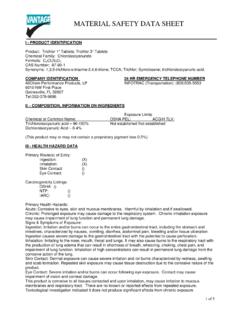
Transcription of MSDS - Material Safety Data Sheet
1 Technical Support Department Palram Industries Ltd. Ramat Yohanan 30035, Israel Tel 972-4-8459900 Fax 972-4-8444012 E-Mail Website MSDS - Material Safety Data Sheet Foamed Rigid Polyvinyl Chloride Sheet DATE OF ISSUE: 20 April 2004 Updated: 14 March, 2005 This Safety Data Sheet conforms to EC Directive 91/155/EEC PALRAM urges the recipient of this Material Safety Data Sheet to study it carefully to become aware of hazards, if any, of the product involved. In the interest of Safety it is recommended (1) notify your employees, agents and contractors of the relevant information on this Sheet , (2) furnish a copy to each of your customers for the product, and (3) request your customers to inform their employees and customers as well. 1. IDENTIFICATION OF THE SUBSTANCE AND THE COMPANY IDENTIFICATION OF THE SUBSTANCE OR PREPARATION TRADE NAMES : PALIGHT PRODUCT NAME : Foamed Rigid Polyvinyl Chloride sheets CHEMICAL NAME : Polyvinyl Chloride Homopolymer CHEMICAL FAMILY : Polyvinyl Chloride FORMULA : (CH3CH2Cl)n CAS number : 9002-86-2 UN number : None ACX number : X1007407-8 RTECS : KV0350000 SYNONIMS : PVC NFPA RATINGS : HEALTH=1, FIRE=0, REACTIVITY=0 COMPANY IDENTIFICATION PALRAM INDUSTRIES (1990) LTD.
2 Ramat Yohanan 30035, ISRAEL Tel: 972 4 8459 900 Fax: 972 4 8444 012 EMERGENCY TELEPHONE NUMBERS ISRAEL: Tel: 972 4 8459 979 Fax: 972 4 8459 910 E-mail: Local: Call your nearest poison control center 2. COMPOSITION / INFORMATION OF INGREDIENTS Tin stabilized PVC sheets, by weight tin-mercaptide based stabilizer. Pigments and additives used to enhance specific properties are encapsulated in the polymer resin matrix. No solvents. No plasticizers. No cadmium, lead, or other heavy metals used. 3. HAZARDS IDENTIFICATION No particular hazards known. HEALTH HAZARD DATA EFFECTS OF A SINGLE OVEREXPOSURE Swallowing : non-relevant Skin absorption : non-relevant Inhalation : non-relevant Skin contact : exposure is not expected to cause adverse health effects Eye contact : non-relevant EFFECTS OF A REPEATED OVEREXPOSURE - None currently known MEDICAL CONDITIONS AGGRAVATED BY OVEREXPOSURE - None currently known OTHER EFFECTS OF OVEREXPOSURE - None currently known Technical Support Department Palram Industries Ltd.
3 Ramat Yohanan 30035, Israel Tel 972-4-8459900 Fax 972-4-8444012 E-Mail Website 4. FIRST AID MEASURES In general handling the Material will not cause accidents. INHALATION Route of entry inhalation: No If exposed to combustion fumes in high concentration - bring victim to fresh air. Medical attention needed. INGESTION Route of entry ingestion: No SKIN CONTACT Burns resulting from accidental contact with molten Material must be flushed immediately with cold water . Do not remove the polymer from the skin. Medical attention needed. SKIN ABSORPTION Route of entry skin: No EYE CONTACT Like any foreign body, can cause mechanical irritation. Consult physician. NOTES FOR PHYSICIAN There are no specific notes. 5. FIRE FIGHTING MEASURES EXTINGUISHING MEDIA water spray or CO2.
4 CO2 is less recommended due to lack of cooling capacity. EXTINGUISHING MEDIA TO AVOID No information currently available. SPECIAL FIRE FIGHTING PROCEDURES Personnel without suitable respiratory apparatus should leave the affected area to prevent exposure to toxic or combustible gases. SPECIAL PROTECTIVE EQUIPMENT FOR FIREFIGHTERS Positive-pressure self-contained breathing apparatus, protective closing, gas mask approved for acid vapours. UNUSUAL FIRE AND EXPLOSION HAZARDS PVC is a self extinguishing fire retardant Material , that being exposed to open fire and high temperatures decomposes emitting large quantities of HCl, which tends to extinguish the flames. It does not continue to burn after ignition without an external fire source. HCl has a strong acidic odor that causes sensory alert at very low concentrations.
5 HCl odor threshold = ppm. Exposure to high concentrations of HCl will cause irritation of the respiratory passages, at very high concentrations may cause burns to mucous membranes. OSHA legal airborne PEL is 5 ppm, not to be exceeded at any time. ACGIH recommended airborne exposure limit is 5 ppm, which should not be exceeded at any time. Soot emitted when PVC is forced to burn may obscure visibility. 6. ACCIDENTAL RELEASE MEASURES No special precautions and no personal protective equipment needed. Collect mechanically for disposal. 7. HANDLING AND STORAGE HANDLING General handling precautions Avoid mechanical contact with eyes. Ventilation General (mechanical) room ventilation is expected to be satisfactory where this product is stored and handled.
6 Technical Support Department Palram Industries Ltd. Ramat Yohanan 30035, Israel Tel 972-4-8459900 Fax 972-4-8444012 E-Mail Website Other precautions No explosion hazard. In the event of fire, cool and overlap product with water . Static electricity discharge sparks possible during handling. Avoid contact or vicinity of flammable materials. STORAGE Store in a cool shady area. No special technical protective measures required. 8. EXPOSURE CONTROLS / PERSONAL PROTECTION EXPOSURE LIMITS No occupational exposure limits established by OSHA, ACGIH, or NIOSH. PERSONAL PROTECTION Respiratory protection : No special protection needed Hand protection / protection gloves : No special protection needed Eye protection : No special protection needed Other protective equipment : No special protection needed 9.
7 PHYSICAL AND CHEMICAL PROPERTIES APPEARANCE : flat and corrugated opaque foamed plastic sheets PHYSICAL STATE : solid COLOUR : white or coloured ODOR : none DENSITY : gr/cm3 HEAT DEFLECTION : 62-65 C BOILING POINT, 760 Hg : not relevant VISCOSITY : not relevant SOLUBILITY IN water : < at 23oC pH VALUE : not relevant FLASH POINT : 391oC ASTM D 1929 AUTOIGNITION TEMP. : 454oC ASTM D 1921 FLAMMABILITY LIMIT : none EXPLOSION LIMITS : none EVAPORATION RATE : not relevant PERCENT VOLATILES : not relevant 10.
8 STABILITY AND REACTIVITY STABILITY Stable. Conditions to avoid Excessive heat, or open flame. Temperature above 150 oC will decompose raw polymer resin and liberate HCl. Incompatible materials Oxidizing agents or strong mineral acids can cause reaction. Thermal decomposition Begins above 150oC caused by fire, overheating during improper processing. Fumes damaging to health may be released. Hazardous decomposition products Burning can produce the following combustion products: Carbon monoxide (CO) - is highly toxic if inhaled, present in combustion fumes of all organic materials; Carbon dioxide (CO2) - in sufficient concentrations can act as an asphyxiant, present in combustion fumes of all organic materials; Hydrogen chloride (HCl) - in high concentrations cause irritation of the respiratory passages, at very high concentrations may cause burns to mucous membranes.
9 Technical Support Department Palram Industries Ltd. Ramat Yohanan 30035, Israel Tel 972-4-8459900 Fax 972-4-8444012 E-Mail Website REACTIVITY Hazardous polymerization : Will not occur Hazardous reactions : None. 11. TOXICOLOGICAL INFORMATION PVC materials have a very low acute toxicity. In rats an acute LD50 > 10 gr/kg of body weight. PNEUMOCONIOSIS has been described from inhalation of combustion products (effects of overexposure). Industrial hygiene studies have shown that under normal and expected conditions of use of PVC materials, exposures are well below applicable limits. ACUTE TOXOCOLOGICAL INFORMATION Acute oral toxicity : none Acute percutaneous toxicity : none Acute vapour exposure : none Primary skin irritation : no irritation Eye irritation : no irritation Sensitization : no information available Chronic effects.
10 Unknown Carcinogenicity - NTP : not listed - IARC : not listed - OSHA : not listed OTHER TOXICOLOGICAL INFORMATION No known toxicological effects with normal use. For heating see section 10. ADDITIONAL INFORMATION No additional toxicity information currently available. 12. ECOLOGICAL INFORMATION PERSISTANCE AND DEGRADABILITY Detailed studies have not been conducted concerning the environmental fate of the product. According to present knowledge no unfavorable ecological effects are to be expected. Not generally hazardous to water . Insoluble in water , non-toxic solid. Mobility : No information currently available Persistence and biodegrad ability : Biodegradation period - tens of years.