Transcription of MULTIPLE-POINT ROPE ANCHOR SYSTEM - REACT
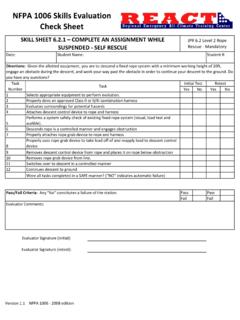
1 Version NFPA 1006 - 2008 editionYesNoYesNo123456711 PassPassFailFailNFPA 1006 Skills Evaluation Check SheetSKILL STATION MULTIPLE-POINT rope ANCHOR SYSTEM CONSTRUCTION Student #:JPR Level 1 rope Rescue - MandatoryDate:Student Name:Determines incident needs related to choosing ANCHOR systemDirections: Construct a MULTIPLE-POINT ANCHOR SYSTEM , given life safety rope and other rope rescue equipment, so that the chosen ANCHOR SYSTEM fits the incident needs, the SYSTEM strength meets or exceeds the expected load and doesn't interfere with rescue operations, equipment is visually inspected prior to being put tin service, the nearest ANCHOR point that will support the load is chosen, the ANCHOR SYSTEM is SYSTEM safety checked prior to being placed into service, the integrity of the SYSTEM is maintained throughout the operation.
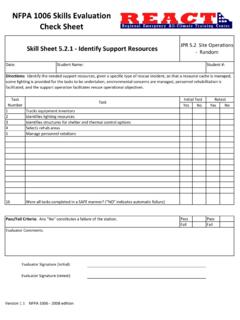
2 And weight will be distributed between more than one ANCHOR NumberTaskInitial TestRetestPerforms a SYSTEM safety checkSelects and ties effective knotsDetermines effective loadsEvaluates incident issues concerning interference and set-upChooses ANCHOR pointsEvaluates SYSTEM components for compromised integrityWere all tasks completed in a SAFE manner? ( NO indicates automatic failure)Pass/Fail Criteria: Any "No" constitutes a failure of the Signature (retest):Evaluator Signature (initial):Evaluator Comments:Version NFPA 1006 - 2008 editionYesNoYesNo12345611 PassPassFailFailWere all tasks completed in a SAFE manner? ( NO indicates automatic failure)Pass/Fail Criteria: Any "No" constitutes a failure of the Signature (retest):Evaluator Signature (initial):Evaluator Comments:Performs a SYSTEM safety checkSelects and ties effective knotsCalculates effective loadsEvaluates incident issues concerning interference and set-upEvaluates SYSTEM components for compromised integrityIncident needs related to choosing a compound MA SYSTEM are determinedDirections.
3 Construct a compound rope mechanical advantage (MA) SYSTEM , given a load, and ANCHOR SYSTEM , life safety rope , and rope rescue equipment, so that the SYSTEM constructed accommodates the load, reduces the force required to lift the load, operational interference is factored and minimized, the SYSTEM is efficient, a SYSTEM safety check is completed, and the SYSTEM is connected to an ANCHOR SYSTEM and the loadTask NumberTaskInitial TestRetestNFPA 1006 Skills Evaluation Check SheetSKILL STATION CONSTRUCT A COMPOUND rope MECHANICAL ADVANTAGE SYSTEMS tudent #:JPR Level 1 rope Rescue - MandatoryDate:Student Name:Version NFPA 1006 - 2008 editionYesNoYesNo12345611 PassPassFailFailNFPA 1006 Skills Evaluation Check SheetSKILL STATION CONSTRUCT A FIXED rope SYSTEMS tudent #:JPR Level 1 rope Rescue - MandatoryDate:Student Name:Uses rigging principalsDirections.
4 Construct a fixed rope SYSTEM , given an ANCHOR SYSTEM , life safety rope , and rope rescue equipment, so that the SYSTEM constructed can accommodate the load, is efficient, and is connected to an ANCHOR SYSTEM and the load, and a SYSTEM safety check is performed and the results meet the incident requirements for descending or ascending NumberTaskInitial TestRetestPerforms a SYSTEM safety checkSelects and ties effective knotsCalculates effective loadsEvaluates incident issues concerning interference and set-upEvaluates SYSTEM components for compromised integrityWere all tasks completed in a SAFE manner? ( NO indicates automatic failure)Pass/Fail Criteria: Any "No" constitutes a failure of the Signature (retest):Evaluator Signature (initial):Evaluator Comments:Version NFPA 1006 - 2008 editionYesNoYesNo1234567811 PassPassFailFailWere all tasks completed in a SAFE manner?
5 ( NO indicates automatic failure)Pass/Fail Criteria: Any "No" constitutes a failure of the Signature (retest):Evaluator Signature (initial):Evaluator Comments:Analyzes SYSTEM efficiencyManages load movementPerforms SYSTEM safety checkDirects personnel effectivelyCommunicates commands effectivelyEvaluates incident issues concerning interference and set-upContinually evaluates SYSTEM components for compromised integrityDetermines incident needsDirections: Direct the operation of a compound rope mechanical (MA) SYSTEM in a high angle environment, given a rope rescue SYSTEM incorporating a compound MA SYSTEM and a load to be moved, and a minimum load haul distance of 20 ft, so that a SYSTEM safety check is performed, the movement is controlled, the load can be held in place when needed, operating methods do not stress the SYSTEM to the point of failure, operational commands are clearly communicated, and potential problems are identified, communicated, and NumberTaskInitial TestRetestNFPA 1006 Skills Evaluation Check SheetSKILL STATION OPERATE A COMPOUND rope MECHANICAL ADVANTAGE SYSTEM - HIGH ANGLES tudent #:JPR Level 1 rope Rescue - MandatoryDate.
6 Student Name:Version NFPA 1006 - 2008 editionYesNoYesNo12345678910 PassPassFailFailAscend fixed rope a minimum of meters (20 ft) in a controlled efficient mannerStops on rope , suspended by SYSTEM with hands free, when instructedWere all tasks completed in a SAFE manner? ( NO indicates automatic failure)While suspended from the fixed rope , converts ascending SYSTEM to descending SYSTEM , utilizing a descent control devicePass/Fail Criteria: Any "No" constitutes a failure of the Signature (retest):Evaluator Signature (initial):Evaluator Comments:Performs a load test prior to life loading the systemSecures self to fixed rope SYSTEM by means of ascend control device(s) with at least two points of contactSelects appropriate ascending equipmentProperly attaches the ascending equipment to the fixed rope and to the harnessManeuvers around SYSTEM specific and environmental obstaclesEvaluates surroundings for prospective hazardsSelects and properly uses appropriate harness and PPED irections: Given a fixed rope SYSTEM , a minimum ascending distance of 20 ft.
7 , ascending equipment, a belay SYSTEM , and PPE including a harness, the candidate will secure him/herself to the fixed rope by means of an ascent control device with at least 2 points of contact, will stop at any point and rest suspended by his/her harness, the SYSTEM will not be stressed to the point of failure, and will be able to safely convert the ascending SYSTEM to a descending systemTask NumberTaskInitial TestRetestNFPA 1006 Skills Evaluation Check SheetSKILL SHEET ASCEND A FIXED rope SYSTEM Student #:JPR Level 1 rope Rescue - MandatoryDate:Student Name:Version NFPA 1006 - 2008 editionYesNoYesNo12345679 PassPassFailFailNFPA 1006 Skills Evaluation Check SheetSKILL SHEET DESCEND A FIXED rope SYSTEM Student #:JPR Level 1 rope Rescue - MandatoryDate:Student Name:Selects and properly uses appropriate harness and PPED irections: Given a fixed rope SYSTEM , a minimum descending distance of 20 ft.
8 , descending equipment, a belay SYSTEM , and PPE including a harness, the candidate will secure him/herself to the fixed rope by means of an descent control device, the speed of the descent will be controlled, will stop at any point and rest suspended by his/her harness, and the SYSTEM will not be stressed to the point of failureTask NumberTaskInitial TestRetestPerforms a load test prior to life loading the systemProperly operates the descent control deviceSelects appropriate descending equipmentProperly attaches the descending equipment to the fixed rope and to the harnessManeuvers around SYSTEM specific and environmental obstaclesEvaluates surroundings for prospective hazardsStops on rope , suspended by SYSTEM with hands free, when instructedWere all tasks completed in a SAFE manner?
9 ( NO indicates automatic failure)Pass/Fail Criteria: Any "No" constitutes a failure of the Signature (retest):Evaluator Signature (initial):Evaluator Comments.