Transcription of MULTIPLICATION & DIVISION STRATEGIES
1 3-5 MULTIPLICATION & DIVISION STRATEGIESINTRODUCTION ..MULTIPLY WITH 10 ..MULTIPLY WITH 5 ..MULTIPLY WITH 2 ..MULTIPLY WITH 4 ..MULTIPLY WITH 8 ..MULTIPLY WITH 1 ..MULTIPLY WITH 0 ..MULTIPLY WITH 3 ..MULTIPLY WITH 6 ..MULTIPLY WITH 7 ..MULTIPLY WITH 9 ..MULTIPLY MULTIPLES OF 10 ..DIVIDE WITH 1 AND 0 ..DIVIDE WITH 10 ..DIVIDE WITH 5 ..DIVIDE WITH 2 ..DIVIDE WITH 4 ..DIVIDE WITH 8 ..DIVIDE WITH 3 ..DIVIDE WITH 6 ..DIVIDE WITH 7 ..DIVIDE WITH 9 .. MULTIPLICATION STRATEGY CHARTS .. DIVISION STRATEGY CHARTS .. MULTIPLICATION fact FLUENCY SHEETS .. MULTIPLICATION GAMES .. DIVISION GAMES ..USER LICENSE ..TABLE OF CONTENTS47111519232729313539434749515559 6364717579838799107120158170 INTRODUCTIONB asic MULTIPLICATION and DIVISION facts are considered foundational for further advancement in mathematics.
2 They form the basis for learning multi-digit MULTIPLICATION and DIVISION , area, fractions, percentages, volume, ratios, and decimals. Thus, it is essential that students develop fluency with basic MULTIPLICATION facts (0 x 0 9 x 9) and related DIVISION suggests that in order for students to develop mastery of basic facts three phases of learning are necessary. Phase one involves concept learning. During this phase students develop an understanding of the meanings of MULTIPLICATION and DIVISION . Students at this stage often use modeling and/or counting to find an answer as they focus on actions that relate to MULTIPLICATION and DIVISION such as groups of , equal groups etc. For example, to solve 6 x 4 a student may draw an array with 6 rows of 4 dots and count by ones or skip count to find the total number of second crucial, but often neglected, phase involves students learning the basic facts in clusters based on thinking and reasoning STRATEGIES .
3 For example, doubling is one of the MULTIPLICATION clusters. Within that cluster are the twos facts (double), the fours facts (double, double), and the eights facts (double, double, double). During this stage it is important that STRATEGIES are introduced sequentially as the thinking required to learn one set of facts is a prerequisite for the next set of facts in the cluster. Regular opportunities for students to practice and discuss thinking and reasoning STRATEGIES in meaningful contexts ( number talks, strategy games, word problems, etc.) is essential during this three involves efficient and accurate recall of the basic facts. With repeated experiences working with numbers students will come to just know that 6 x 4 = 24. They become so fluent at applying the practiced STRATEGIES that they do so automatically without hesitation.
4 Although at this stage reasoning STRATEGIES may no longer be necessary for basic fact recall, students will continue to find these STRATEGIES useful when working with larger numbers. For example, use of the double, double, double strategy for x8 facts can be extended to mentally solve more difficult problems such as 115 x 8 by thinking: Double 115 is 230. Double 230 is 460. Double 460 is 920. So, 115 multiplied by 8 equals 920. Similarly, the strategy of halving three times when dividing by 8 can be extended to mentally solve problems with multi-digit dividends such as 416 8 by thinking: Half of 416 is 208. Half of 208 is 104. Half of 104 is 52. So, 416 divided by 8 equals 52. The following two pages outline the thinking and reasoning STRATEGIES that are the focus of the practice activities and games in this STRATEGIESC luster 1: Use Tensx 10: Use place value.
5 Example: 3 x 10 = ____ 3 x (one 10) = 3 tens 3 x 10 = 30x 5: Multiply by 10, then halve the product. Example: 8 x 5 = ____ 8 x 10 = 80 half of 80 is 40 8 x 5 = 40 Cluster 2: Use Doublesx 2: Double the other factor. Example: 6 x 2 = ____ double 6 is 12 6 x 2 = 12 x 4: Double the other factor, then double again. Example: 6 x 4 = ____ double 6 is 12 double 12 is 24 6 x 4 = 24x 8: Double, double, double. Example: 6 x 8 = ____ double 6 is 12 double 12 is 24 double 24 is 48 6 x 8 = 48 Cluster 3: Use a Rulex 0: Any number multiplied by 1 equals itself (Zero Property)x 1: Any number multiplied by 1 equals itself (Identity Property)Cluster 4: Build Up/Build Downx 3: Multiply by 2, then add one more group. Example: 7 x 3 = ____ 7 x 2 = 14 14 + 7 = 21 7 x 3 = 21 Other MULTIPLICATION STRATEGIES :Use Related Facts (Commutative Property)Example: If I know 7 x 6 = 42 then I also know 6 x 7 = 42x 7: Multiply by 5, then add the double Example: 4 x 7 = ____ 4 x 5 = 20 20 + 8 = 28 4 x 7 = 28x 6: Multiply by 5, then add one more group Example: 9 x 6 = ____ 9 x 5 = 45 45 + 9 = 54 9 x 6 = 54x 9: Multiply by 10, then subtract one group Example: 8 x 9 = ____ 8 x 10 = 80 80 8 = 72 8 x 9 = 72 Example: 48 2 = 24 Example: 24 3 = 8 Exam So, 48 6 = 8 Example: 45 3 = 15 Example: 15 3 = 5 Exam So, 45 9 = 5 DIVISION STRATEGIESC luster 1: Use Tens 5.
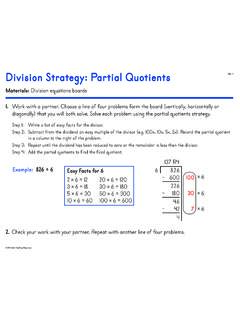
6 If the dividend ends in zero divide by 10 and double the quotient. Example: 40 5 = ____ 40 10 = 4 double 4 is 8 40 5 = 8 Cluster 2: Use Halving 2: (halve the dividend) Example: 18 2 = ____ half of 18 is 9 18 2 = 9 4: (halve, halve) Example: 32 4 = ____ half of 32 is 16 half of 16 is 8 32 4 = 8 8: (halve, halve, halve) Example: 72 8 = ____ half of 72 is 36 half of 36 is 18 half of 18 is 9 72 8 = 9 Cluster 3: Use a Rule 1: Any number divided by 1 equals itself. 9 1 = 9 0: Zero, divided by any number, except zero, equals 0. 0 9 = 0 Other DIVISION STRATEGIES :Think MULTIPLICATION Example: 15 5 = ____ Think: What do I multiply 5 by to equal 15?Example: 15 x 3 = 15 Exam So, 15 5 = 3(Distributive Property)72 6 = ( 60 6 ) + ( 12 6 )72 6 = 10 + 272 6 = 1210 + 2 = 1260 + 126 ORUse FactorsExample: 45 9 = ____ 48 6 = ____Partition the Dividend Example: 72 6 = ____ Think: How can I can split the dividend into parts that are easy to divide?
7 60 + 123 x 32 x 3 K-5 MathTeachingResources K-5 MathTeachingResources K-5 MathTeachingResources K-5 MathTeachingResources K-5 MathTeachingResources K-5 MathTeachingResources K-5 MathTeachingResources K-5 MathTeachingResources4 x 6 = ?2 x 6 = 12So, 4 x 6 = 242 x 12 = 24 USE DOUBLESD ouble 45 x 3 = ?10 x 3 = 30So, 5 x 3 = 15 Half of 30 is 15 USE TENSM ultiply by 10, then halve the 5