Transcription of NATIONAL DIPLOMA: INFORMATION …
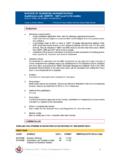
1 1 Prospectus 2018 - Faculty of INFORMATION and Communication technology NATIONAL diploma : INFORMATION technology : software DEVELOPMENT ( extended curriculum programme with foundation provision)Qualification code: NDISF1 - NQF Level 6 Campus where offered: Soshanguve South, eMalahleni and Polokwane campusesImportant notification to new applicants:Students who intend to enrol for this qualification for the first time in 2017 or thereafter, should note that it will not be possible to continue with any Baccalaureus Technologiae as from 2020, since it is being replaced by qualifications aligned with the newly-implemented Higher Education Qualification Sub-Framework. Potential students are advised to consult the University's website for any new qualifications which might not be published in this Admission requirement(s) and selection criteria:See qualification NDITF1 listed under the ICT First Years and Foundation Minimum duration:Four years, divided as follows: - Year one: foundation subjects.
2 - Year two: general first-year subjects. - Years three and four: specialisation Presentation: Day Intake for the qualification:January only. e. Exclusion and readmission:See Chapter 2 of Students Rules and Recognition of Prior Learning (RPL), equivalence and status:See Chapter 30 of Students Rules and Regulations. g. Industry Exposure IIIB (Work-Integrated Learning):Students may register for this subject only with the permission of the Head of the Depart-ment. See Chapter 5 of Students Rules and Regulations (paragraphs and ) for further INFORMATION . h. Subject credits:Subject credits are shown in brackets after each note that students will register for all first- and second-year subjects under qualification code YEARCODE SUBJECT CREDIT PREREQUISITE SUBJECT(S) FIRST SEMESTERFPALS01 Foundation Academic and Language (0,125) SkillsFPITM01 Foundation ICT Mathematical Skills (0,125)TOTAL CREDITS FOR THE SEMESTER: 0,2502 Prospectus 2018 - Faculty of INFORMATION and Communication TechnologySECOND SEMESTERFPIDS01 Foundation INFORMATION and software (0,125) Development SkillsFPPRS01 Foundation Presentation and Reporting (0,125) SkillsTOTAL CREDITS FOR THE SEMESTER: 0,250 TOTAL CREDITS FOR THE FIRST YEAR.
3 0,500 SECOND YEARA fter completion of all first-year SUBJECT CREDIT PREREQUISITE SUBJECT(S)FIRST SEMESTERCFS10AT Computing Fundamentals IA (0,062)CGS10AT Computing Systems IA (0,062)CMK10AT Computing Skills IA (0,063)DSO17AT Development software IA (0,063)TOTAL CREDITS FOR THE SEMESTER: 0,250 SECOND SEMESTERCFS10BT Computing Fundamentals IB (0,062)CGS10BT Computing Systems IB (0,062)CMK10BT Computing Skills IB (0,063)DSO17BT Development software IB (0,063) Development software IATOTAL CREDITS FOR THE SEMESTER: 0,250 TOTAL CREDITS FOR THE SECOND YEAR: 0,500As from the third year, a student will register for the specialisation field: software Development (NDISF1).THIRD YEARCODE SUBJECT CREDIT PREREQUISITE SUBJECT(S)FIRST SEMESTERDSO23AT Development software IIA (0,125) Development software IBISY23AT INFORMATION Systems IIA (0,125) Computing Fundamentals IBSSF24AT System software IIA (0,125) Computing Systems IBTPG111T Technical Programming I (0,250) Development software IB TOTAL CREDITS FOR THE SEMESTER: 0,625 SECOND SEMESTERDSO23BT Development software IIB (0,125) Development software IIAISY23BT INFORMATION Systems IIB (0,125) INFORMATION Systems IIASSF24BT System software IIB (0,125) Computing Systems IBTPG201T Technical Programming II (0,250) Technical Programming ITOTAL CREDITS FOR THE SEMESTER: 0,625 TOTAL CREDITS FOR THE THIRD YEAR.
4 1,2503 Prospectus 2018 - Faculty of INFORMATION and Communication TechnologyFOURTH YEARCODE SUBJECT CREDIT PREREQUISITE SUBJECT(S)FIRST SEMESTERDSO34AT Development software IIIA (0,125) Development software IIBDSO34BT Development software IIIB (0,125) Development software IIBIDC30AT Industry Exposure IIIA (0,125) ISY34AT INFORMATION Systems IIIA (0,125) INFORMATION Systems IIBISY34BT INFORMATION Systems IIIB (0,125) INFORMATION Systems IIBTOTAL CREDITS FOR THE SEMESTER: 0,625 SECOND SEMESTER On completion of all the above subjects. Students with only one subject outstanding may be allowed to register for that subject and Industry Exposure IIIB with the approval of the Head of the Industry Exposure IIIB (0,125)TOTAL CREDITS FOR THE SEMESTER: 0,125 TOTAL CREDITS FOR THE FOURTH YEAR: 0,750 TOTAL CREDITS FOR THE QUALIFICATION: 3,000 SUBJECT INFORMATION (OVERVIEW OF SYLLABUS) The syllabus content is subject to change to accommodate industry changes.
5 Please note that a more detailed syllabus is available at the Department or in the study guide that is applicable to a particular subject. On 23 August 2017, the syllabus content was defined as follows: CCOMPUTING FUNDAMENTALS IA (CFS10AT) 1 X 3-HOUR PAPER(Subject custodian: Department of Computer Science)The student is introduced to the fundamentals of computers and INFORMATION systems, computer organisation and data processing. (Total tuition time: 90 hours)COMPUTING FUNDAMENTALS IB (CFS10BT) 1 X 3-HOUR PAPER(Subject custodian: Department of Computer Science)The basic concepts of system development, data management, management INFORMATION systems, ethics, privacy and security, purchasing and maintaining microcomputers, number systems and binary logic. (Total tuition time: 54 hours)COMPUTING SKILLS IA (CMK10AT) 1 X 3-HOUR PAPER(Subject custodian: Department of Informatics)This subject aims to equip the student with fundamentals of IT Soft skills for both the ICT industry and other working environments upon which a successful career can be built.
6 In addition, it will also improve the student s relation and interaction abilities needed within the dynamic ICT industry. The student who successfully com-pletes this subject must identify and implement various thinking skills and learning styles, state the legal and cultural sensitivity issues of IT, identify and explain the variety of soft skills including study skills and strategies, research, presentation as well as communication skills, and identify and explain interpersonal skills in relation to character, time management and team building dynamics and conflict resolution. (Total tuition time: 60 hours)4 Prospectus 2018 - Faculty of INFORMATION and Communication TechnologyCOMPUTING SKILLS IB (CMK10BT) 1 X 3-HOUR PAPER(Subject custodian: Department of Informatics)The aim of this subject is to extend the skills in CMK10 AT so as to improve on student s relations and inter-action capabilities that will be applicable within the dynamic ICT industry and the external environment.
7 The student who successfully completes this subject must describe, distinguish and portray changes in terms of personality profiles, emotional intelligence, self-management, stress management and relationship manage-ment; identify and apply the notion of team dynamics; deal with conflict and understand the dynamics behind change; report on effective correspondence; produce meeting documents; conduct meetings; and demonstrate the required communication skills to develop interpersonal business relationships through by means of group work. (Total tuition time: 60 hours)COMPUTING SYSTEMS IA (CGS10AT) 1 X 3-HOUR PAPER(Subject custodian: Department of Computer Systems Engineering)Introduction to hardware, operating systems, motherboards, processors, memory, hard drives, installing and supporting I/O devices, multimedia devices and mass storage, PC maintenance and troubleshooting strategies, and installing and maintenance of Windows. (Total tuition time: 54 hours)COMPUTING SYSTEMS IB (CGS10BT) 1 X 3-HOUR PAPER(Subject custodian: Department of INFORMATION technology )Provides the foundation of data communications and local area management, OSI model and/ or TCP/IP protocol stack model, data transmission principles, media, major protocols, topologies, routing methods, introduction to networking principles and network operating system fundamentals.
8 (Total tuition time: 54 hours)DDEVELOPMENT software IA (DSO17AT) 1 X 4-HOUR COMPUTER-BASED(Subject custodian: Department of Computer Science)Aim: To learn to solve problems using the basic programming principles, and then practically apply that knowledge in C++. OBJECTIVES: To enable the student to understand problems and know how to solve them by using a computer; understand the general concepts and arithmetic used in programming, sequence, selection and iteration control structures and a variety of built-in data types, including strings. The students are exposed to the concept of event-driven programming in a visual programming environment focusing on the development of graphical user interfaces to solve real-life practical programming problems. (Total tuition time: 72 hours) DEVELOPMENT software IB (DSO17BT) 1 X 4-HOUR COMPUTER-BASED(Subject custodian: Department of Computer Science)Aim: To expand on the already mastered knowledge obtained in Development software IA.
9 Objectives: To broaden the programming skills base of the student by adding the following topics: write an algorithm and applying it in ++ using functions and sub-procedures, and write an algorithm containing one-dimensional arrays. String manipulation will be continued as well as a brief introduction to text file processing. (Total tuition time: 72 hours) DEVELOPMENT software IIA (DSO23AT) 1 X 4-HOUR COMPUTER-BASED(Subject custodian: Department of Computer Science)This subject introduces Oracle and SQL to students. The subject includes standard queries, joins, functions, sub-queries, report writing, creation of tables and views, data manipulation using the Oracle courseware and the Oracle software . Students also learn how to create and maintain database objects and how to store, retrieve and manipulate data. (Total tuition time: 59 hours)DEVELOPMENT software IIB (DSO23BT) 1 X 4-HOUR COMPUTER-BASED(Subject custodian: Department of Computer Science)This subject introduces students to PL/SQL programming blocks or program units in the Oracle environment.
10 This subject includes the Development of efficient PL/SQL programs to access Oracle databases, creation of stored procedures and functions for maximum reuse and easy code maintenance using the Oracle course-ware and the Oracle software . Students would need the knowledge of Oracle and SQL for this subject. (Total tuition time: 59 hours)5 Prospectus 2018 - Faculty of INFORMATION and Communication TechnologyDEVELOPMENT software IIIA (DSO34AT) 1 X 3-HOUR PAPER (Subject custodian: Department of Computer Science)This subject introduces students to the various database concepts, the design, implementation and man-agement of a database system. The subject will prepare the student for practical applications in the design, implementation and management of database systems. The student should be competent in: the principles of developing and implementing small IT systems. On completion, the student should be able to create, maintain and administer databases according to the DBLC.